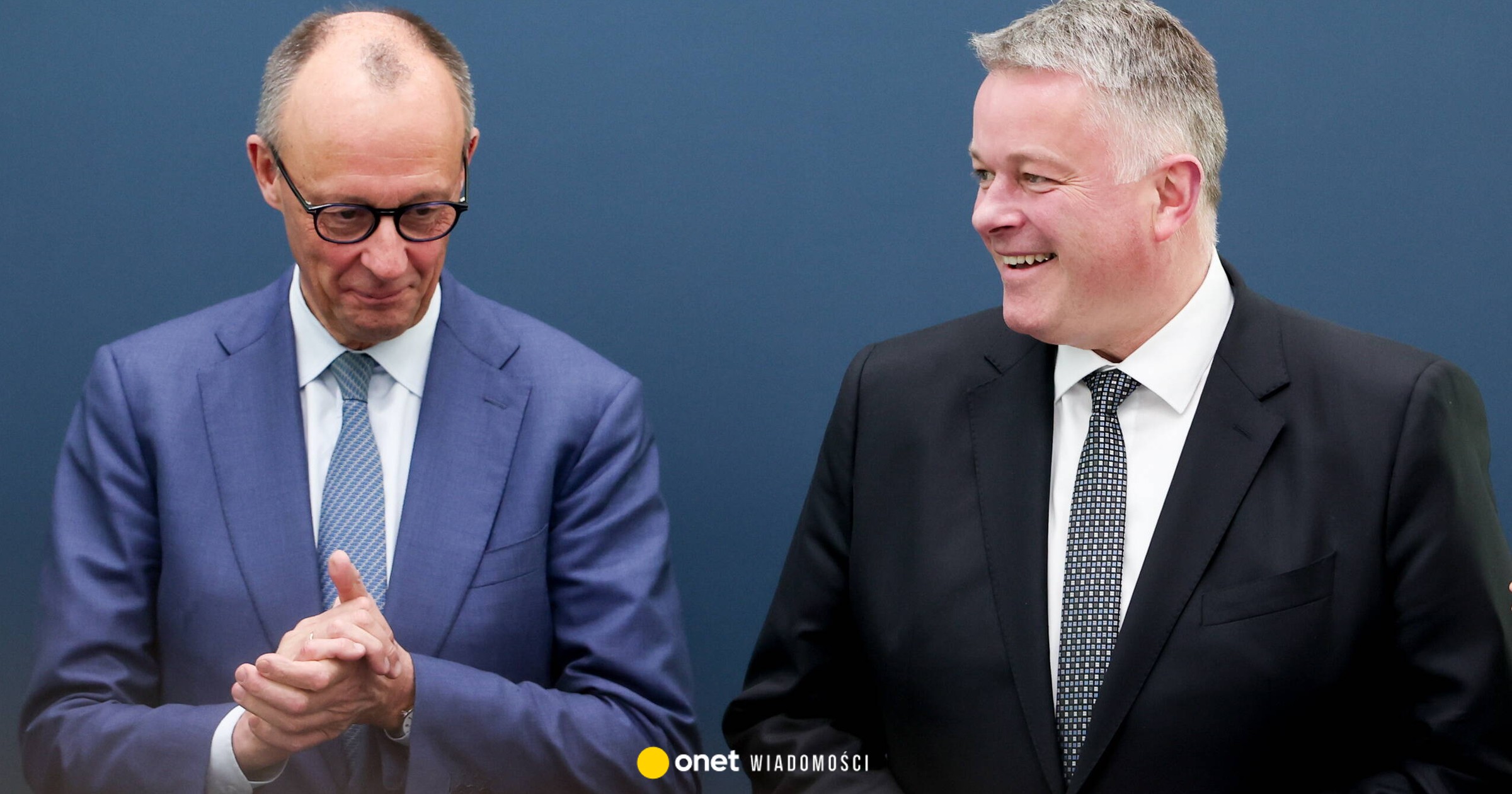
The banquet hall looks different now. Just after the polls close in Rhineland-Palatinate, CDU Secretary General Carsten Linnemann stands in an almost empty party headquarters in Berlin. Celebration? In Berlin? There are no plans for this. He, the head of the Union faction Jens Spahn and Minister for Special Tasks Thorsten Frei will make several statements in front of the cameras. That's all.
The CDU is ahead of the Social Democratic Party of Germany (SPD) in the state parliament elections. The Social Democrats are recording serious losses, the CDU is clearly gaining, the Alternative for Germany (AfD) is achieving record results in the West, and the Greens are weakening. However, the Berlin CDU approaches this success almost with some shame. CDU Secretary General Linnemann gives interviews with an impassive face. By no means fall into too much of a winning attitude – Linnemann shows how much he holds back.
Even the head of the Union faction, Jens Spahn, who is usually eager to throw hints at the SPD, remains reserved. He even shows self-criticism. Ensuring economic growth returns is critical: “This is what we still have to achieve,” he explains. He says “we”. No bad words about SPD or internal differences of opinion in the coalition. Nor about the accusations made within the party by his CDU colleagues that the SPD is simply blocking everything that comes from the EU. Not this Sunday.
On this election night the idea is not to irritate the SPD too much. The CDU needs social democrats in Rhineland-Palatinate. Because without them it is impossible to form a government in Mainz. And in Berlin. Because Friedrich Merz cannot continue working without SPD.
In the event that the SPD won the elections to the state parliament, and the winner was SPD leader Alexander Schweitzer and the loser was the leading CDU candidate Gordon Schnieder, the course of events in the federal party was to be as follows: – Shed a few crocodile tears, thank Gordon's campaign team for a courageous election campaign, and then simply continue the activities here in Berlin, says Spahn's team. This is more or less how the CDU reacted to the surprising defeat in Baden-Württemberg two weeks ago. The election result was a blow to both the CDU and the SPD, and therefore to the black-red coalition. Therefore, we should not attach too much importance to this – coalition partners at the federal level quickly agreed on this issue.
Now, however, the SPD has lost its second consecutive election to the national parliament. And in a spectacular way. The Bundestag elections a year ago were already a severe blow to the SPD. Since then, the party is no longer even concerned with itself, but with key projects that were invented during the “traffic light” coalition led by the SPD chancellor, Olaf Scholz. The SPD will be an even more difficult partner for the EU than before. And this was during the most difficult phase of Friedrich Merz's chancellorship.
Decisive importance for Merz's chancellorship
Merz now needs, above all, peace in his own party and with his coalition partner, SPD. The coming weeks will be decisive for whether the 70-year-old's term in office can be a success, whether he will manage to control the crisis outbreaks and put the country on the reform path, or whether the reform plans will get stuck halfway and Merz will fail as chancellor.
Merz apparently sees quite clearly that the window for implementing his program is closing. He has 16 weeks, this is how CDU strategists see it, to implement the big reform plans of the black-red coalition. July 10 is the last day of Bundestag sessions, after which the summer parliamentary break begins. And when it ends in early September, the election campaign in Saxony-Anhalt will enter a hot phase, and before the elections in this state on September 6, the CDU, SPD, the Greens and the Free Democratic Party (FDP) will have equally strong cards.
The AfD is clearly leading in the election polls there, only the CDU can be sure that it will enter the national parliament, in the case of the other parties it is not so obvious.
It may happen that AfD wins these elections and ultimately creates a minority government because no one wants to form a coalition with it. A prime minister from the AfD, the first in Germany – this would be a disaster even from the point of view of the CDU, which has ruled this state since 2002. First, a large package of reforms must be created for Germany so that the federal government has something to be proud of. Merz must therefore deliver in the summer what he promised in the fall.
Therefore, he does not want to waste time on long considerations regarding the elections to the national parliament. On Monday morning, first the party presidium and then the federal board were to discuss it. — Elections to the national parliament will be one of many topics, announced a board member on Sunday. Next, the issue of reforms that the Chancellor wants and must push through was to be discussed: regarding health and care, the social state, income tax, inheritance tax, energy prices, debt brake and reducing bureaucracy. And about a very important topic: pensions. Everything is interconnected. The Chancellor wants, and in this he agrees with SPD leader Lars Klingbeil, to combine everything into one big package. The rule applies here, as always in politics: nothing is agreed until everything is agreed.
The article continues below the video
Currently, little is agreed. And the time pressure is growing. The most important decisions would have to be made by the end of April. Until then, Vice-Chancellor and Minister of Finance Lars Klingbeil must present the main assumptions of his budget. The question now is to what extent the chancellor will be able to put the SPD, which lost its luster in the elections, on its reform path. A coalition partner who, at best, now wants to sharpen its profile, i.e. presents itself as exceptionally social democratic. Or, in a less favorable scenario for Merz, he is busy with factional fighting and reorganization, thus trying to oust his chairmen.
On Monday, the chancellor wants to “talk to the SPD leaders about how to get the country back on track.” Merz announced this during the end of the election campaign in Rhineland-Palatinate. On Sunday, there was no question of his participation in any of the election events.
I’m Ashley Davis as an editor, I’m committed to upholding the highest standards of integrity and accuracy in every piece we publish. My work is driven by curiosity, a passion for truth, and a belief that journalism plays a crucial role in shaping public discourse. I strive to tell stories that not only inform but also inspire action and conversation.