Banks in Poland are increasing employment despite closing branches. Who are they looking for now?


Over the years, the trend in Polish banks in terms of employment was clear: there were fewer employees every year. At the end of 2010, almost 177,000 people worked in the industry. people, but at the end of 2021 there were only 143 thousand employees. – according to data from the Polish Financial Supervision Authority. While in the years 2010-2018 there was usually a decrease of about 2,000. positions per year, the trend has accelerated since 2019.
In 2018, almost 5.7 thousand jobs were reduced in banking. full-time positions, and in the record year 2020, almost 7.9 thousand. In 2021, another almost 6,000 people lost their lives. jobs. This was caused by previously observed phenomena, which were further amplified by the pandemic. This is primarily due to ongoing digitalization and the decreasing tendency of customers to use traditional branches.
In addition, there was a deterioration in banks' profitability resulting from falling interest rates and huge write-offs on Swiss franc loans: increased group layoffs and voluntary departure programs were one of the ways to save money.
This is how the employment structure in banks is changing
However, in 2022 there was a turning point: this was the first year since 2011 when total employment in Polish banks increased. Then symbolically, by 178 positions, but in 2023, 2024 and 2025 employment increased by 2.21 thousand and 1.28 thousand respectively. and 2.46 thousand A total of 6.13 thousand have been added since the end of 2022. jobs across the sector.
However, it is worth taking a look at the structure. Over the years, the number of employees in branches has decreased because the network was systematically shrinking. The number of bank branches in Poland from 2012 (the last comparable data) to the end of 2025 decreased by almost 5.9 thousand. and amounts to almost 9.49 thousand Customer service and a large part (though increasingly smaller) of sales are conducted in branches. Customers – who have modern mobile and online banking at their disposal – visit them less and less often: the network is shrinking and employment is decreasing. From the end of 2010 to the end of 2025, 51.7 thousand people lost their lives. FTEs in branches (decrease to 54.3 thousand), each year during that time brought a significant reduction.
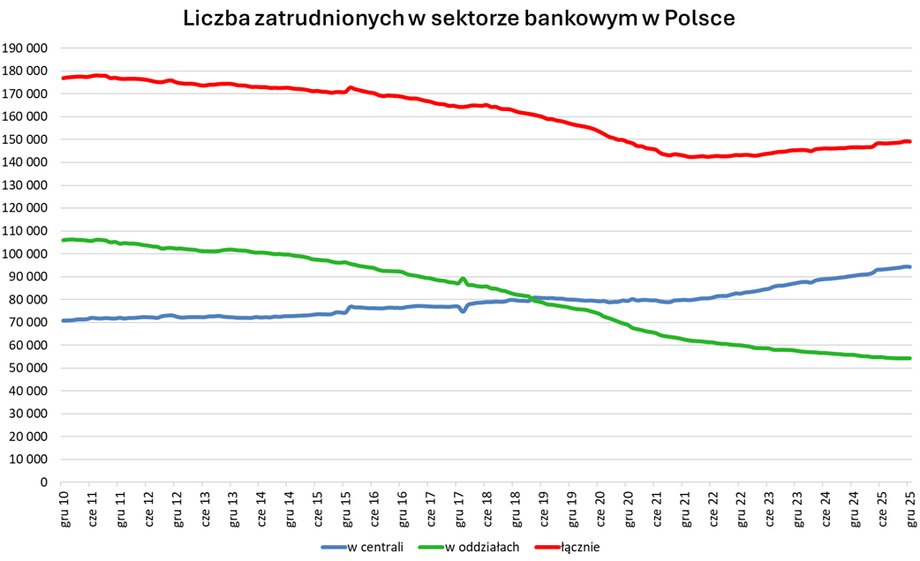
Employment in Polish banks has been decreasing for years, and this trend even accelerated during the pandemic. Recently, however, the number of full-time positions has been increasing and positions in the headquarters are responsible for them.
|
KNF, own study
For most of this period, employment at bank headquarters grew slowly or was stable (employees in positions such as IT, product development, risk management, compliance, marketing, HR, etc. are classified here). The change occurred in 2019, when for the first time fewer employees were employed in branches than in bank headquarters. Recently though the pace of employment growth in the headquarters has significantly accelerated and now 94.4 thousand people work there. people, by 23.6 thousand more than 15 years earlier (in just five years, 15.5 thousand positions were added at the headquarters).
— Banks are organizations that manage costs very effectively. The decline in employment in branches and the increase in headquarters is the result not only of the digitalization of sales channels, but of a conscious shift of competences towards technology, data, cybersecurity and regulatory areas – compliance, AML – says Magdalena Warpas, EY partner in the financial sector consulting department.
He adds that AI is playing an increasingly important role, but its impact today is not about mass job cuts, but about changing the work structure. — Spot implementations of copilots or AI agents will not make a difference – the real value appears only when the bank redesigns processes and actually simplifies the organization – notes the expert.
See also: The “dollar smile” has returned to the markets. See what this means for your savings
— There is a clear change in the operating model in the banking sector. Employment in branch networks is being reduced while central structures are being strengthened. Due to one of the least extensive branch networks on the market, our bank does not experience this trend to a comparable extent – says Adrianna Barska-Szymańska – deputy director of the department of employee relations and organizational culture at mBank.
Who do banks in Poland employ?
“In business areas we most often recruit candidates for financial and analytical positions, in the areas of risk, compliance, banking operations and back-office. More and more of these roles are expert in nature, particularly in the areas of risk, regulation and data analytics. In the IT area, we mainly employ specialists dealing with application development and cybersecurity. This includes both solutions used by customers in digital channels and internal systems,” PKO BP replies to our question.
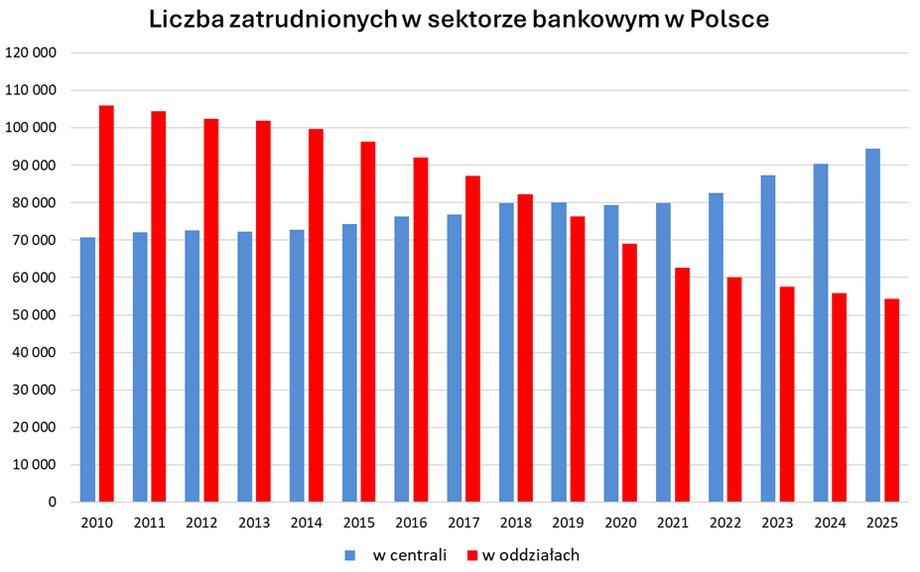
In 2019, for the first time the number of employees at bank headquarters was greater than the number of full-time positions in branches.
|
KNF, own study
Adrianna Barska-Szymańska adds that when planning employment, mBank focuses on two priorities. — On the one hand, we care about regulatory compliance and safety. On the other hand, it is about the best possible adaptation to customer needs. As a bank strongly associated with electronic banking, we intensively recruit for roles that support the development of these channels. Most of the new positions, not related to natural rotation, were created in the areas of operations, IT and corporate banking. After announcing our new strategy at the end of last year, we are focusing even more strongly on the competences of the future. Critical thinking, flexibility and readiness to work with GenAI-based tools are particularly important to us, explains the mBank expert.
He emphasizes that in the case of branches, the bank responds mainly to current recruitment needs. — Here, too, we pay attention to the development potential of candidates so that they can develop in other areas of the bank in the future. This is possible thanks to well-developed internal mobility. Last year, over 20 percent We closed the recruitment process by choosing an internal candidate, says Adrianna Barska-Szymańska.
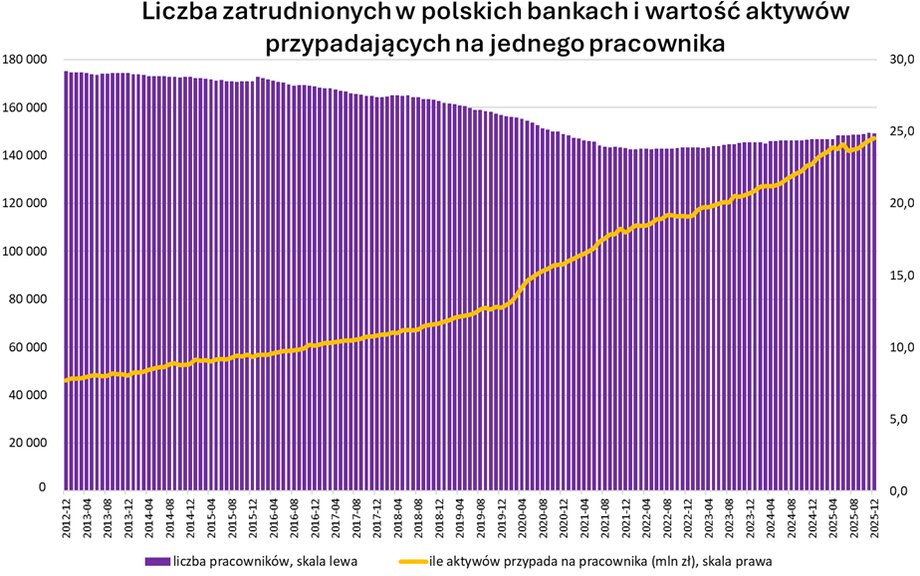
This chart shows that the banking sector's asset-to-employee ratio has been growing almost continuously.
|
KNF, own study
Will banking layoffs return when profits fall?
To what extent did the recent fat years in the banking sector (high profits and profitability) mean that there was no strong incentive for layoffs, which is the opposite than during the pandemic? Could a possible deterioration in the industry's profitability accelerate layoffs?
— Good results in recent years have not loosened cost discipline, but rather given banks the comfort to manage their cost base calmly and methodically. If the sector's profitability deteriorates, we will not see sudden layoffs, but an acceleration of an already ongoing trend: flattening structures, combining roles and further reducing the share of fixed costs. Banks have learned to manage employment as a variable cost, not a fixed one, says Magdalena Warpas from EY.
See also: Market fever. The conflict in the Middle East may drain the state budget
— In recent years, we have not carried out any employment reduction processes – on the contrary, we were one of the few banks that systematically increased the employment level. We do not anticipate any reduction activities in the coming years, says the representative of mBank.
Great competition for the best bankers
We hear that in the banking industry it is difficult to “pick up” an employee from another bank. This especially applies to senior positions and experienced bankers with good track records.
“The labor market in the financial sector is very competitive today, especially in areas requiring high specialization,” admits PKO BP. The industry leader recognizes that acquiring experts from other financial institutions can be demanding. “But at the same time, we observe growing interest among candidates in our projects, scale of operations and development opportunities. That is why we focus on building an attractive employer offer and long-term relationships with candidates,” says PKO BP.
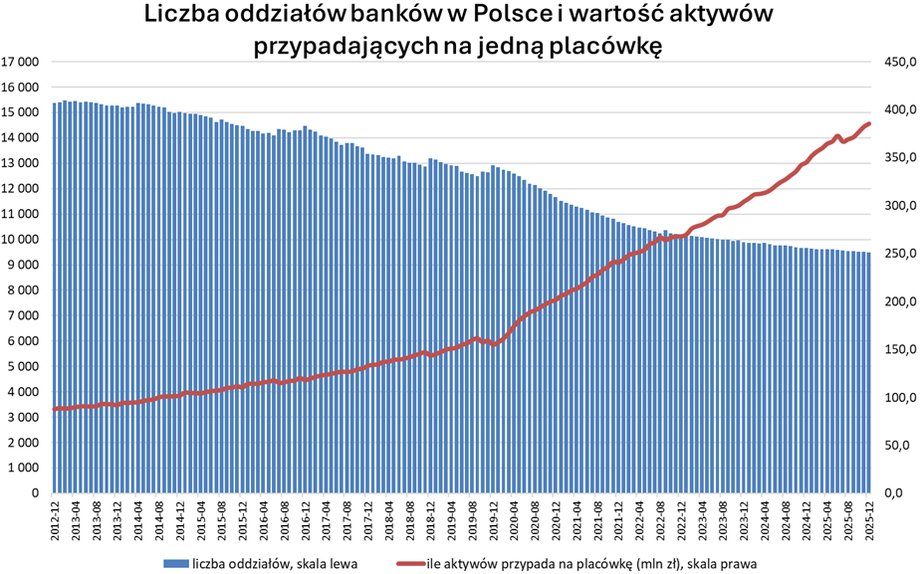
Bank branches are regularly decreasing and assets are swelling. This increases the indicator showing how many assets are allocated to one branch.
|
KNF, own study
In turn, mBank argues that its strong brand, clearly defined organizational culture and recognizable management staff make passive candidates, reached through direct search (through headhunters), open to talks about a potential career change.
— Year by year, we observe an increase in the number of candidates for expert and managerial roles obtained in this way. The final decision to establish cooperation always results from the agreement of both parties. It depends both on the candidate's readiness to take on a new role and on the real fit of his experience, competences and values to the role and culture of mBank – says Adrianna Barska-Szymańska.
Author: Maciej Rudke, journalist of Business Insider Polska