
2026-03-19 21:07
publication
2026-03-19 21:07
When Europeans finished trading in shares, it seemed that Wall Street would also see red declines. However, American investors eliminated their losses at the end of the day and, as usual, they left the Old Continent to the wind.
It was one of Wall Street's classic moves. When the main European stock exchanges ended trading around 6:00 p.m. Polish time, the S&P500 and Nasdaq fell by more than 1% each, deepening this year's correction and reaching their lowest levels since November. It is therefore not surprising that the indexes on the Old Continent finished more than 2% below the mark.
And then magic happened. An hour before the end of the cash session, New York indexes suddenly shot up, making up for initial losses and even breaking even. And although they ultimately ended the day in the red, the declines were only symbolic. And so the S&P500 gave up only 0.27% and finished with a score of 6,606.49 points. The Nasdaq Composite, after losing only 0.28%, closed at 22,090.69 points. The Dow Jones industrial average decreased by 0.44%, to 46,021.43 points.
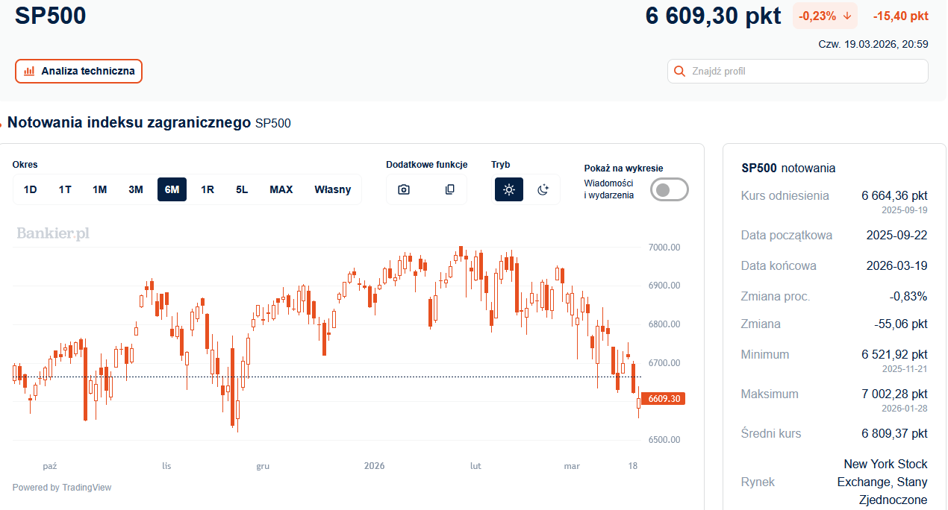
It's hard to say what exactly convinced Wall Street players to buy the discounted shares. Perhaps these were some more vague statements from President Donald Trump. Or maybe the declarations of the Prime Minister of Israel. Benjamin Netanyahu announced the destruction of Iran's uranium enrichment program and ballistic missile production. Regardless of whether it is true or not, such a declaration may bring us closer to ending the war between Israel and the US against Iran. After all, its main goal was considered accomplished.
Advertisement
And as late as noon, it seemed that the war in the Middle East was very far from over. On Wednesday, there was a sharp escalation of hostilities when Israel launched an attack on Iran's South Pars, which is the largest gas field in the world. In retaliation, Tehran directed missile attacks on Qatar's Ras Laffan liquefied natural gas (LNG) terminal. As a result, Brent oil prices reached USD 118 per barrel, and gas in Europe cost over €70 per MWh. Attacks on Iranian gas fields threatened to escalate the crisis and move from problems with the supply chain to the destruction of production itself.
Meanwhile, in response to Wednesday's announcements from the Federal Reserve, futures market traders basically canceled any bets on a reduction in the federal funds rate in 2026. The chance that such a decision will be made by December (inclusive) is estimated at only 28%. However, there have been bets on a Fed rate increase. This is the result of Wednesday's statements by Jerome Powell and the distribution of March fedodots.
K.K
The publication contains affiliate links.