PLN 603 million. This was the turnover in units of passive ETF funds on the Warsaw Stock Exchange in February. For comparison, a year earlier in February it was PLN 216 million, and two years earlier it was PLN 127 million. Daily turnover in March this year they amount to PLN 16-50 million. Poles have discovered this type of investment and are beginning to understand its advantage over ordinary funds.
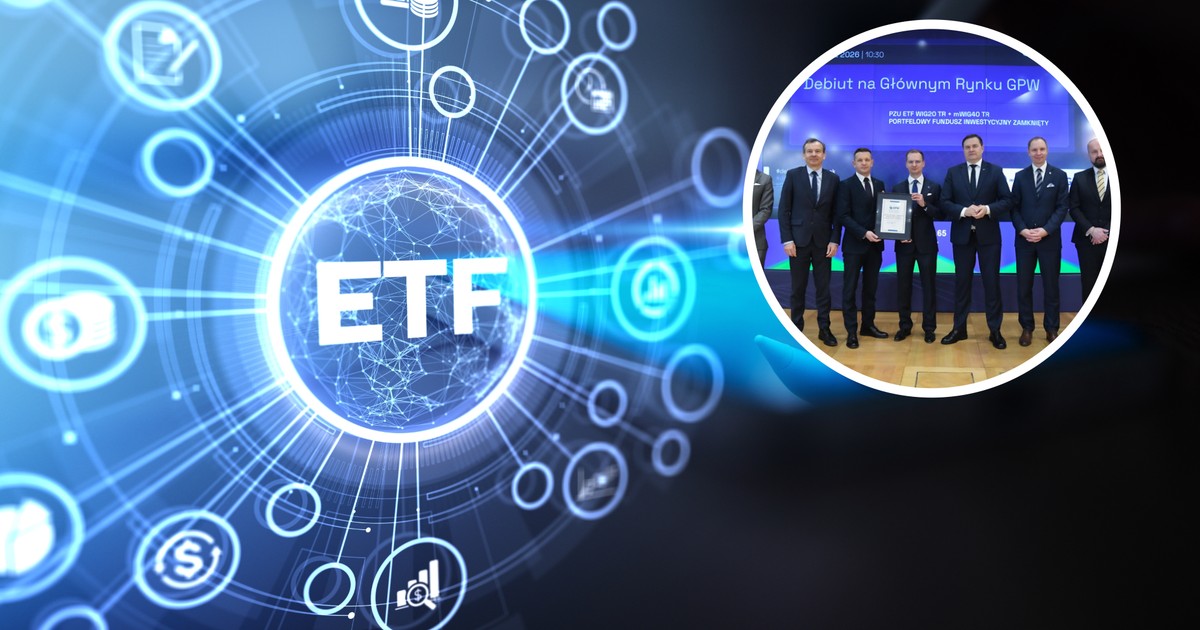
This was noticed by the second-placed leader of the Polish investment fund market, PZU TFI. The first ETF issued by this company debuted on the Warsaw Stock Exchange on Tuesday. ETF with a rather long name “PZU ETF WIG20 TR+mWIG40 TR Portfelowy FIZ” is a passive fund investing in shares of 60 most important Polish companies listed on the WSE. Half of them are shares from WIG20 (20 most important companies), and the other half are from mWIG40 (40 companies less important than the most important ones).
How do ETFs differ from regular investment funds and which ones are the most popular among Polish investors?
Important: the calculations included in the text are for information purposes only and do not constitute a recommendation or any other form of suggestion for the purchase or sale of financial products. Investment decisions should be preceded by your own analysis of risk and financial situation.
Read also in BUSINESS INSIDER
The difference lies, among other things, in the management costs borne by the buyer. The management fee for the new PZU TFI fund is low and amounts to 0.4%. P56,894,345 the remaining costs of the fund constituting the TER (total expense ratio) will be covered by TFI PZU, so the total cost for the owner of the fund certificates is this 0.4%. annually. For comparison, ordinary active equity funds in Poland charge from 1.8 to 2.1 percent.
What are ETFs?
ETFs (exchange traded funds) are actually ordinary investment funds, or more specifically, closed-end funds. But unlike those to which Poles have already become accustomed (OFI, OFE, PPK, UFK), this type has its main advantage low cost of operation.
There will be no highly remunerated managers who actively manage the portfolio, sometimes buying and sometimes selling. The passive approach necessarily reduces costs to a minimum, because apart from revising the portfolio from time to time (when changing the index portfolio) and valuation and conversion into a fund unit, there is actually nothing that needs to be done with such a fund portfolio.
The principle is simple. If you want to buy a gold ETF, it is as if you were investing in gold itself, because this ETF used your funds to buy only gold. If you buy an ETF on WIG20, it is as if you spent money on all 20 companies from this index in appropriate proportions. Such a fund buys or sells shares only when the structure of the index changes.
The popularity of ETFs began when investors began to realize that Actively managed funds provide rates of return that are mostly lower than the indexes themselves. In 2015, the value of ETFs in the world was approximately USD 3 trillion. At the end of last year it was almost $20 trillion.
Instead of paying quite large commissions for managing our money on the stock market and getting less for it than when buying an index, many investors decided that it was better to buy the index itself. And ETFs indirectly make this possible. He charges a commission, and yes, it is not a charity business, but it is relatively low compared to regular funds. Additionally, it allows trading not only in shares, but also in other securities that are not traded on a given stock exchange.
ETFs in Poland
Gold and bitcoins, for example, are not normally traded on the WSE, but thanks to ETFs you can do this. You can also play on WIG20 declines, because there is an ETF that reflects changes in the index focused on declines, WIG20TRsht (short).
At the end of February this year an investor with access to instruments traded on the Warsaw Stock Exchange had at his disposal 16 ETF funds for stock indices, one for gold and four for the largest cryptocurrencies. The total value of net assets stored in them is PLN 96.4 billion. For comparison, All Polish investment fund companies managed PLN 463 billion at the end of February.
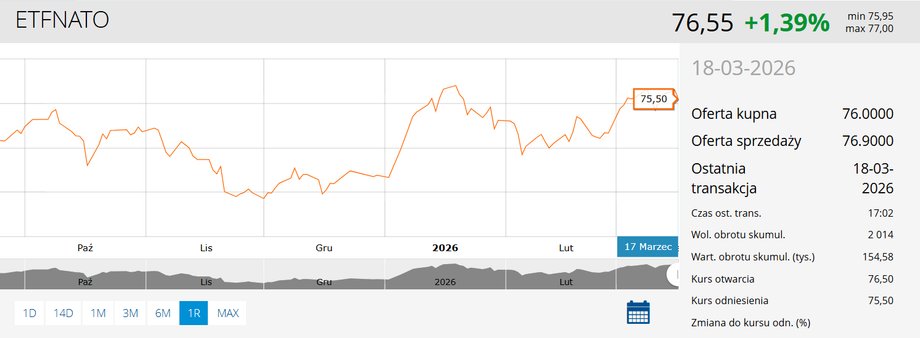
The largest net asset value (PLN 76.6 billion as of March 18 this year) is held by the Irish ETFNATO fund, which invests in defense companies from around the world and reflects changes in the EQM Future of Defense Index. This index includes companies such as: Pao Alto, BAE Systems, Lockheed Martin and Northrop Grummann. The total commission that the buyer pays for running the fund is only 0.49%. from net assets.
ETFNATO quotes
| GPW.pl
Due to the global popularity of these instruments, the WSE wants to develop the ETF market itself He does not charge commission for nowso brokerage offices do not charge high fees. They are usually in the order of 0.2%. on turnover, but e.g. BM Pekao demands only 0.1 percent. And there are also promotions, e.g. Alior and mBank until the end of March this year. they do not charge commission at all – normally in Alior it is 0.38% and in mBank 0.39%.
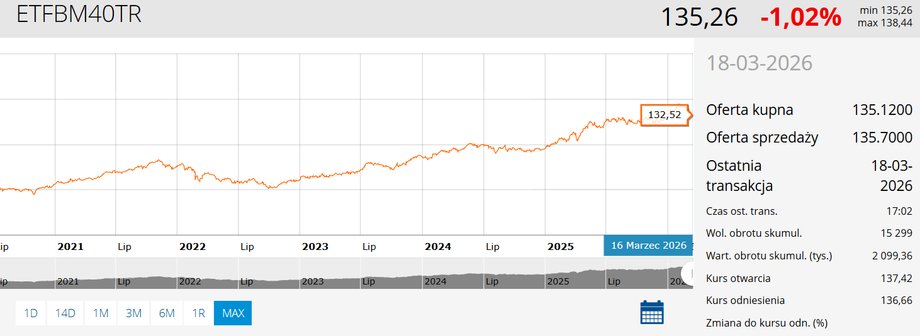
Among Polish funds, Agio TFI has been the most involved in the ETF market so far. It runs 13 such ETFs, which had net assets worth PLN 2.1 billion at the end of February. A year earlier it was PLN 840 million. The largest fund in this group (less than 600 million net assets) reflects changes in the mWIG40 TR index of medium-sized companies (total return, i.e. together with dividends) and charges a management fee of 0.8%, and the total expense ratio (TER) is 0.93%. – we read on the Agio TFI website.
Agio ETF quotations on mWIG40 TR (ETFBM40TR)
| GPW.pl
PZU TFI, currently the second TFI on the market (less than 12% of the market at the end of February) second only to PKO TFI (18.8% of the market), has no intention of stopping at the first ETF proposal for a combined WIG20 and mWIG40.
“Entering the ETF segment is a natural stage of development for us, and at the same time a response to the needs of a new generation of investors who expect modern, transparent and low-cost investment solutions,” said Artur Trela, president of the management board of TFI PZU.
In April, the PZU ETF MSCI World Portfelowy will debut on the WSE, investing in shares of developed markets, i.e. there are no Polish companies in it, and as many as 74 percent. portfolio includes American companies, 5.4 percent Japanese, and 3.4 percent British. The next fund should appear on the market in May.
“We are already working on further ETFs to provide investors with a range of +first-choice+ funds as soon as possible, providing exposure to the most important asset classes,” said Artur Trela.
How can I buy ETF units?
Investment certificates of the PZU ETF WIG20 TR+mWIG40 TR Portfelowy FIZ fund will be available for purchase through any brokerage account or investment platform giving access to the WSE – including IKE and IKZE brokerage pension accounts – the announcement said. The fund's animator is the BOŚ Brokerage House.
In other words, an ETF is created from a specific amount advanced by a given investment fund, and then the investment fund tries to interest the largest possible group of investors in it so that they buy units on the stock exchange. The more willing investors there are, the more commission income the company will collect.
After purchase, the investor can sell ETF certificates on the stock exchange. The fund evaluates the net asset value every day and this provides the basis for stock exchange valuation. Redemption of certificates takes place on the dates specified in the fund's statute. In the case of closed-end funds (FIZ), participants' money is safe and does not enter the bankruptcy estate of the TFI if the managers have problems.
Author: Jacek Frączyk, editor of Business Insider Polska
I’m Ashley Davis as an editor, I’m committed to upholding the highest standards of integrity and accuracy in every piece we publish. My work is driven by curiosity, a passion for truth, and a belief that journalism plays a crucial role in shaping public discourse. I strive to tell stories that not only inform but also inspire action and conversation.