Romanians, worried about the possibility of the country's involvement in a war. But what is the main danger to national security for them – INSCOP survey


Most Romanians believe that the main danger to national security is corruption, greater than the manipulation of public opinion, economic instability or an external military attack, according to the data of a survey carried out by INSCOP Research.
- The research carried out by INSCOP Research, titled “National Security Barometer”was carried out in February and March 2026, in two waves of data collection, on a sample of 1100 people each.
- The data were collected by the CATI method (telephone interviews). The maximum allowed error of the data is ± 2.9%, at a confidence level of 95%.
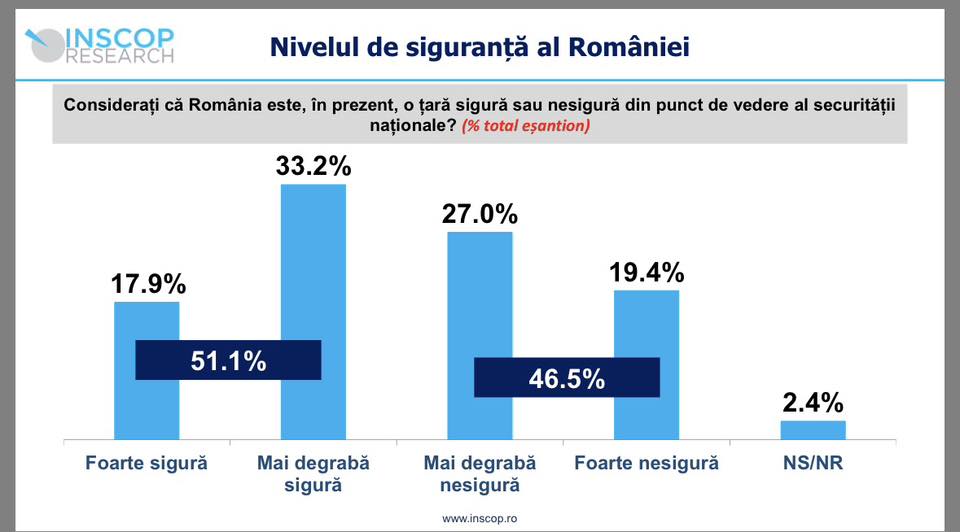
Is Romania a safe country?
Asked whether Romania is currently a safe or unsafe country from the point of view of national security, 17.9% of Romanians rated it as very safe, 33.2% rather safe, 27% rather unsafe, and 19.4% very unsafe. The share of non-responses is 2.4%.
Considers that Romania is a safe country from the point of view of national security, especially: PNL and USR voters, men, young people under 30, people with higher education, residents of Bucharest and large urban areas. I think that Romania is an unsafe country in particular: AUR voters, women, people over 60, those with primary education, rural residents.
The dangers to national security
35.3% of respondents believe that the main danger to Romania's national security is corruption. 19.4% indicate disinformation and manipulation of public opinion (fake news, influencing democratic processes), 18.7% economic instability, 5.8% a military attack (external aggression on the territory), and 5.3% foreign political influence.
Cyber attacks (on critical infrastructure: energy networks, banks, hospitals) are mentioned by 4.3% of Romanians, the energy crisis – 3%, acts of terrorism and sabotage – 1.1%, espionage actions – 0.9%, and 2% specify another danger. The share of non-responses is 4.1%.
Romania's involvement in a war: who are most worried
31% of the participants in the survey conducted between February 23-27 (before the attack against Iran) declare that they are very worried about the possibility of Romania's involvement in a war in the coming years (compared to 36.9% in the survey conducted between March 3 and 13). 33.1% are somewhat worried (up from 31.1% in the March 3-13 survey), 5.2% are somewhat not worried (up from 6.1% in the March 3-13 survey), and 29.1% say they are very little or not at all worried (up from 25.2% in the March 3-13 survey). 1.6% do not know or do not answer.
They are worried about the possibility of Romania's involvement in a war in the coming years especially: PSD and AUR voters, women, people between 30 and 44 years old, those with primary education, rural residents. PNL and USR voters, men, young people under 30, people with higher education, residents of Bucharest and the larger urban area, private sector employees are the least worried about such a perspective.
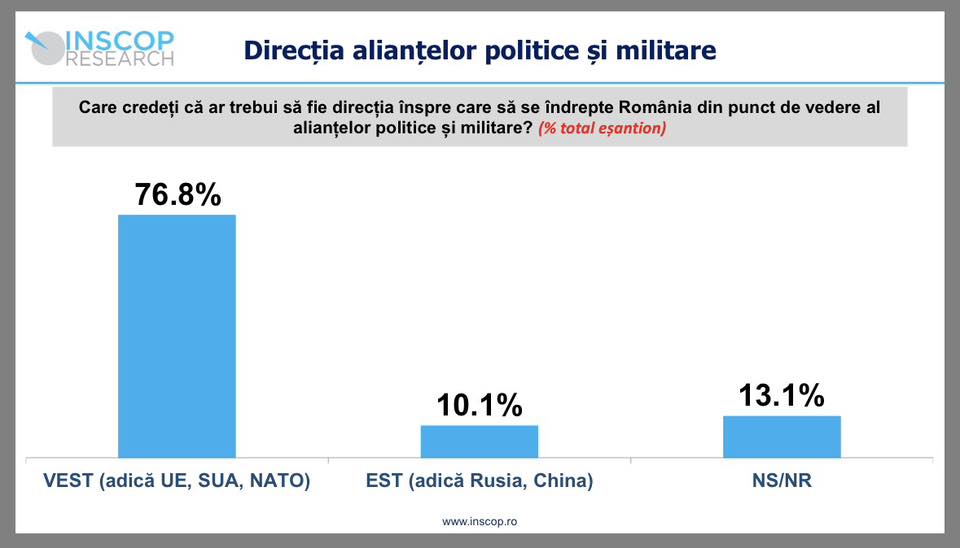
The West direction, desired by the overwhelming majority of Romanians
76.8% of those surveyed believe that Romania should turn to the West – i.e. the European Union, the USA, NATO (compared to 77% in January 2022 and 87.5% in December 2024), while 10.1% believe that the right direction would be to the East – i.e. Russia, China (compared to 10.4% in January 2022 and 4.1% in December 2024). 13.1% do not know or do not answer (compared to 12.6% in January 2022 and 8.4% in December 2024).
I am of the opinion that Romania should turn to the West especially: PSD, PNL and USR voters, young people under 30 and people over 60, residents of the Capital. He believes that Romania should turn to the East in particular: AUR voters, people between 30 and 44 years old and private sector employees.
How many want Romania's exit from NATO
11.8% of those interviewed believe that Romania should leave NATO (compared to 18.7% in January 2022 and 8.1% in December 2024), while 84.4% are of the opinion that the country should not leave the alliance (compared to 76.2% in January 2022 and 88.1% in December 2024). The share of non-responses is 3.8% (compared to 5.1% in January 2022 and 3.8% in December 2024).
I am of the opinion that Romania should leave NATO especially: AUR voters, people between 30 and 59 years old, rural residents, private sector employees.
How many want Romania's exit from the European Union
22.2% of respondents are of the opinion that Romania should leave the European Union (compared to 25.2% in January 2022 and 9.4% in December 2024), while 74.4% oppose it (compared to 71.7% in January 2022 and 88.1% in December 2024). 3.4% do not know or do not answer (compared to 3.1% in January 2022 and 2.5% in December 2024).
Considers that Romania should leave the EU in particular: AUR voters and private sector employees.
Romanians do not want the hosting of nuclear weapons
Extending France's 'nuclear umbrella'
In the context of the discussions about the expansion of the “nuclear umbrella” of France, 22.2% of Romanians would totally agree that Romania should participate in such a European project, 17.1% rather agree, 13.8% rather against, while 37.2% would be totally against. 9% do not know or cannot appreciate, and 0.7% do not answer.
I agree in a higher proportion than the rest of the population with this European project initiated by France: PNL and USR voters, young people under 30 years old, people with higher education, residents of Bucharest and large urban areas. Disagreement occurs in a higher-than-average percentage among: AUR voters, people over 60, and small urban dwellers.
Hosting French nuclear weapons
Asked to what extent they agree or disagree with the hosting of French nuclear weapons on Romanian territory, 12.6% of the survey participants totally agree. 12.1% rather agree, 16% rather against, and 52.9% totally against. 5.6% do not know or cannot appreciate, and 0.7% do not answer.
PNL and USR voters, young people under 30, people with higher education and residents of Bucharest agree in a higher percentage than the rest of the population with the hosting of French nuclear weapons on Romanian territory. A higher level of disagreement is recorded compared to the rest of the population among: AUR voters, people over 60 years old, and those with medium education.
Trust in countries
55.8% of respondents have very much and quite a lot of trust in the USA, 46.8% in the UK, 41.9% in France, 41.7% in Germany and 41.6% in Poland. The Republic of Moldova benefits from a trust capital of 29.9%, Bulgaria – 29.2%, Turkey – 28.6%, and Serbia – 21.2%. The last places are Hungary with 20.1%, Ukraine with 16.8%, and Russia with 12.6%.
They trust the USA especially: PSD and AUR voters, people over 60 years old. PNL and USR voters, men, young people under 30 years of age, people with higher education, residents of Bucharest and large urban areas tend to have the most trust in Great Britain. They trust France in particular: PNL and USR voters, men, young people under 30, people with higher education. PNL and USR voters, men, young people under 30 years of age, people with higher education, residents of Bucharest and large urban areas tend to trust Ukraine more than the rest of the population. Especially AUR voters, young people under 30 and employees in the private sector trust Russia.
Who would have the primary role in repelling an attack?
38.3% of the survey participants believe that the main role in repelling an attack would go to NATO (by activating Article 5). 27.6% indicate the states with which Romania has bilateral strategic partnerships (such as France, Germany or Great Britain), 19.6% the Romanian Army, and 8.6% the European Union (through military cooperation between member states). 5.9% do not know or do not answer.
Compliance with Article 5 of the NATO Treaty
Article 5 of the NATO treaty says that if a member country is attacked, the other countries must help it, including militarily. 75.6% of the survey participants believe that, if Romania were to be attacked, the US would respect this obligation. It specifies Germany – 69.4%, France – 69.3%, Great Britain – 63.9%, Poland – 61.7% and Hungary – 40 6%.
He believes that the US would respect the obligation provided by NATO in particular: AUR and PSD voters, people over 60 years old. PSD, PNL and USR voters, men, young people under 30, people with higher education, residents of the Capital and public sector employees believe in a higher proportion than the rest of the population that Germany would respect Article 5 of NATO. I believe that France would respect its obligations in the event of a military attack, especially: PNL and USR voters, men, young people under 30, people with higher education, residents of the Capital, public sector employees. I am of the opinion that Great Britain would respect its obligations in the event of a military attack on Romania, especially: PNL and USR voters, men, young people under 30, people with higher education, residents of the Capital, public sector employees. PNL and USR voters, men, young people under 30 and people over 60, those with higher education, residents of Bucharest and large urban areas believe to a greater extent than the average that Poland would respect Article 5 of NATO. Young people under 30 and public sector employees believe in a higher proportion than the rest of the population that Hungary will comply with the obligation of Article 5 of NATO.
Increase in defense spending
75.6% of respondents say they agree that Romania should significantly increase its defense spending to protect its sovereignty in the event of military aggression, while 21.5% say they are against it. The share of non-responses is 2.9%.
I agree that Romania should increase its defense spending especially: PSD, PNL, USR voters and people over 60 years old. AUR voters, 30- to 44-year-olds, and private sector workers are most opposed to increased defense spending.
What Romanians think about military actions against Iran
11.9% of the survey participants believe that the military actions of the United States of America and Israel against Iran are very justified. 21.1% consider them to be rather justified, 26.5% rather unjustified, and 21.4% very unjustified. The share of non-responses is 19%.
The methodology of the sociological study “National Security Barometer”
- The research carried out by INSCOP Research at the request of the Strategic Thinking Group included two waves of collection, between February 23-27, 2026, and March 3-13, 2026, respectively.
- The research method was the interview through the questionnaire.
- The data were collected by the CATI method (telephone interviews), and the volume of each sample was 1100 people.
- The samples are representative for the significant socio-demographic categories (sex, age, occupation) for the non-institutionalized population of Romania, aged 18 and over.
- The maximum allowable error of the data for each sample is ± 2.9%, at a confidence level of 95%.