Curiosities about the spring equinox 2026. The moment when the shadow disappears almost completely

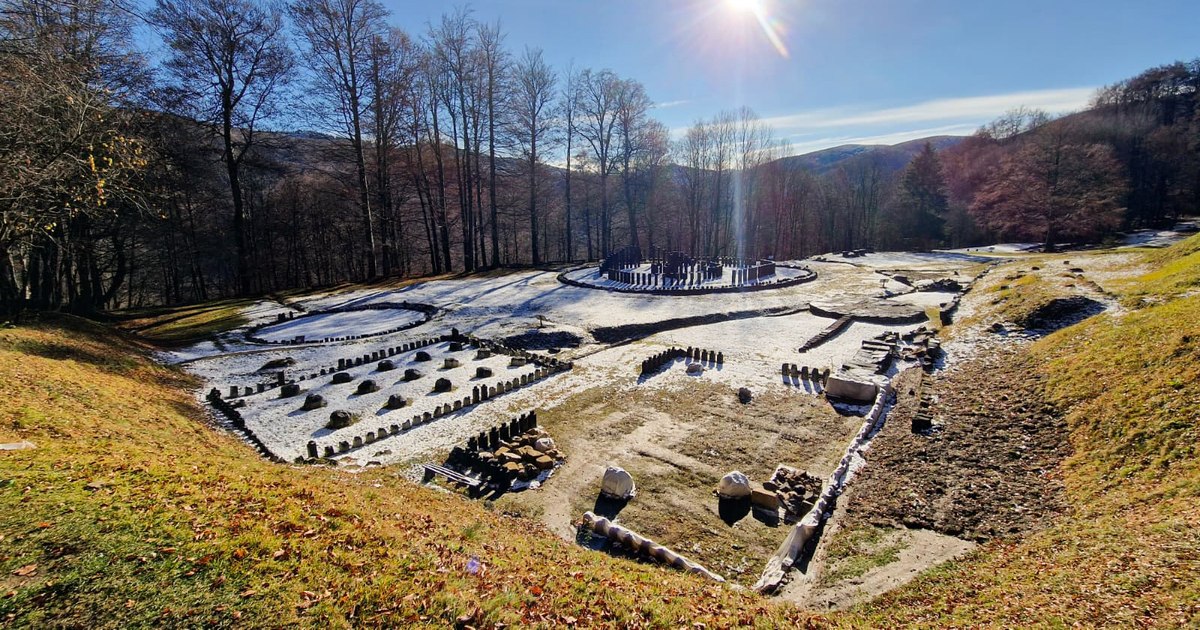
The equinox of March 20, the moment that marks the beginning of astronomical spring, has been celebrated since Antiquity. In Romania, in recent years, he has been linked to symbols of Dacian spirituality and ancient traditions.
Sarmizegetusa Regia, a sought-after place on the day of the equinox. Photo: Sarmizegetusa Regia Administration.
From Friday, March 20, astronomical spring begins in the Northern Hemisphere, the period of the year determined by the position of the Earth in relation to the Sun.
In many cultures, the equinox is celebrated throughout the day, but in reality it occurs at the exact moment when the Sun crosses the celestial equator, the imaginary line above the Earth's equator, passing from the southern to the northern hemisphere.
Scientific explanations for the vernal equinox
At that moment, the Earth's axis is not inclined either towards the Sun or in the opposite direction, but is perpendicular to its rays. In the year 2026, this happens on March 20, at 16:46, Romanian time. Due to the time zone, in some regions of the world the equinox is considered to occur on March 21.
The moment that marks the spring equinox is called the vernal point in astronomy and represents the position where the Sun crosses the celestial equator, an imaginary line that divides the sky into two hemispheres and is used for astronomical orientation.
In the Northern Hemisphere, astronomers use the March equinox as the start of spring, which lasts until the June solstice, when astronomical summer begins. However, meteorologists believe that spring begins on March 1 and ends on May 31.
Specialists from the “Amiral Vasile Urseanu” Astronomical Observatory show that the length of day and night differs throughout the year due to the movement of the Earth around the Sun and the tilt of its axis. In the sky, this is seen by the fact that the Sun appears to travel in a year in a great circle called the ecliptic, which represents the plane of the Earth's orbit and is inclined to the celestial equator by about 23°27′.
“At the time of the spring equinox, the Sun crosses the celestial equator, passing from the southern hemisphere of the celestial sphere to the northern one. When the Sun is at this point, called the vernal point, it describes the diurnal movement along the celestial equator, a phenomenon that determines, on that date, the equality of the length of day and night, regardless of latitude. At the latitudes of our country, for which we can consider the average value of 45°, this value is also the height of the Sun above the horizon at noon.Also, on this day, the Sun rises exactly in the east and sets exactly in the west“, show the specialists from the Astronomical Observatory.
Trivia about the equinox
The vernal equinox can occur on March 19, 20, or 21, depending on the calendar year and time zone.
“Many remember that the equinox was on March 21st, but this rarely happens. The last time was in 2007, and the next one will be in 2101.” shows the Time and Date platform.
The March equinox is the vernal equinox in the northern hemisphere, while in the southern hemisphere it is called the autumnal equinox and marks the beginning of astronomical autumn. In the polar regions, this time brings the beginning of polar day in the Northern Hemisphere and polar night in the Southern Hemisphere, each lasting about six months.
The second equinox, the September equinox, occurs around September 22 each year and marks the beginning of astronomical spring in the Southern Hemisphere and astronomical autumn in the Northern Hemisphere.
It is said that at the equinox day and night are exactly 12 hours each. Even the name of the phenomenon, derived from Latin, indicates this: aequus means equal, and nox means night.
“In reality, in most places on Earth the day is slightly longer than the night even at the equinoxes. This is because of the way sunrise and sunset are defined and because of the refraction of light in the atmosphere. But there are two days a year when day and night are almost perfectly equal, a phenomenon called the equinox, and the date differs by latitude.”notes Time and Date.
At the equinox, the Sun is above the equator, and at noon objects can have very short shadows.
“With a stick fixed at a certain angle, depending on the latitude, it can be seen that at noon the shadow disappears almost completely. This experiment can only be done twice a year: at the March equinox and at the September equinox.” informs the site dedicated to astronomy and time.
Why was the vernal equinox so important to the ancients
The astronomical moment when the length of the day becomes almost equal to that of the night has been celebrated since ancient times, in all corners of the world. In Antiquity, the equinox was one of the landmarks by which people set their calendar, holidays and agricultural work.
Sarmizegetusa Regia, “Stonehenge from Romania”. The capital of the Dacians shone at the summer solstice PHOTO
In ancient astronomy and astrology, this moment was also considered the beginning of the zodiac, being associated with the starting point of the Aries sign.
Numerous ancient writings mention the importance of the equinox to European civilizations. It marked the time of ritual sacrifices, the beginning of agricultural work, animal movements, military campaigns and important holidays during the year.
The 3rd century Roman scholar Censorinus mentioned that the equinox could mark the beginning of the year.
“Some reckon that the calendar year begins at the Birth of the Sun, that is, at Brumalia, others at the summer solstice; some fix it at the vernal equinox, and others at the autumnal equinox; some at the rising, and others at the setting of the Pleiades, and others at the rising of the star Canicula.” he notes in the work De Die Natali.
Another first-century Roman scholar, Pliny the Elder, explained why he believed the Earth was at the center of the universe.
“The fact is proved by the equality of day and night at the equinox, because then sunrise and sunset are on the same line,” he wrote in the work Natural History.
The ancients also used the equinox as a landmark for planning military campaigns, ancient writings show. Some ancient authors indicated that the equinox was also an important time for religious rituals.
“On the top of the mountain, those called Basilae offer sacrifices to Cronus at the spring equinox, in the month called Elaphius among the Hellenes”informs, in the second century, the Greek geographer Pausanias, in the Description of Greece.
The ancient Jews made the sacrifices after the spring equinox, when the sun was in the first sign of the zodiac, called Aries by the Greeks, and the moon was in the opposite part of the sky, stated the Byzantine historian Sozomenos in the work Ecclesiastical History.
Also, the celebration of Easter was oriented in relation to the vernal equinox. In the year 325, the First Council of Nicaea established that Easter should be celebrated by all Christians on the first Sunday after the first full moon following the vernal equinox.
Spring equinox, landmark of agriculture and shepherding
In Antiquity, the period of the equinox had an important role in agricultural work and animal husbandry.
“It is better that the sowing be done quickly and surely before the vernal equinox; the earlier we sow, if the weather permits, the better the result.” noted the Roman scholar Columella, in the work De Re Rustica, from the 1st century AD.
Sarmizegetusa Regia, Stonehenge from Romania. Scientists found 11 striking similarities between the monuments
In another treatise on agriculture, Marcus Terentius Varro, in the first century BC, showed that the proper time for shearing sheep was from the spring equinox to the solstice, after the sheep begin to sweat.
“Cabbage is sown all year round, but it is more advantageous to sow it at the autumnal equinox. In colder places, the loosening of the soil must begin at the spring equinox.” were the observations of the erudite Pliny the Elder, from the 1st century AD.
Bees remained in the hive until the equinox, large fish hibernate at the bottom of the waters until this time, and the mating of some animals and birds took place at the same time, other ancient authors showed.
The Dacian temples, sought after on the day of the equinox
The tribes that lived on the current territory of Romania in Antiquity had, according to old sources, knowledge of astronomy and astrology. One of the most famous accounts is that of the high priest Deceneus, who allegedly instructed the Getae in philosophy and science.
“Demonstrating to them the theory of the twelve signs of the zodiac, he showed them the course of the planets and all the astronomical secrets, and how the orbit of the moon waxes and wanes, and how much the fiery globe of the sun exceeds the measure of the terrestrial globe, and he expounded to them under what names and under what signs the three hundred and forty-six stars pass in their rapid course from sunrise to sunset, to approach or depart from the celestial pole.” informed the Latin author Iordanes, in the work Getica, written in the 6th century AD.
In recent years, the Dacian temples at Sarmizegetusa Regia have received the visit of many Romanians on the day of the spring equinox, for whom the astronomical event has a special significance, linked to Dacian spirituality.