Psychedelics in vaccines and beer. CIA documents leaked


The goal was not only to extract information from spies in other countries, but to potentially control the minds of entire populations – causing fear, apathy or obedience without the victims' awareness. These revelations, based on a program codenamed Project Artichoke, sound like a science-fiction movie script, but they are documented in CIA archives.
Project Artichoke, which ran from 1951 to 1956, was established during the height of the Cold War. American services were horrified by reports of “brainwashing” used by communists on prisoners of war in Korea. The CIA feared that the USSR and China had mastered mind-influencing techniques that could threaten national security.
- Read also: A Chinese official revealed the government's secret strategy. All via ChatGPT
In response, the US agency launched a secret program focused on researching the possibility of modifying human behavior, interrogation techniques and psychological manipulation. As declassified documents reveal, the experiments used a combination of chemicals, hypnosis, sensory deprivation, gases and oxygen deprivation to force people to act against their will – including crimes, without conscious memory of it.
Mind control “in beer and vaccines”
The key document, the seven-page report “Special Research for Artichoke” with the annex “Suggested Fields for Special Research Relative Artichoke”, was declassified in 1983, but only in 2025 did it reach the CIA's public reading room, allowing it to de facto “leak”.
Read also in BUSINESS INSIDER
In this document we read about substances for immediate use (such as truth serum – amytal or pentothal) and long-term compounds that could be administered discreetly. One quote sounds particularly ominous:
“Long-term compounds should produce a stimulant effect (causing anxiety, nervousness, tension, etc.) or a depressant effect (causing feelings of depression, hopelessness, lethargy, etc.) in substances that can be secretly introduced into food, water, Coca-Cola, beer, alcohol, cigarettes, vaccines, injections, etc.”
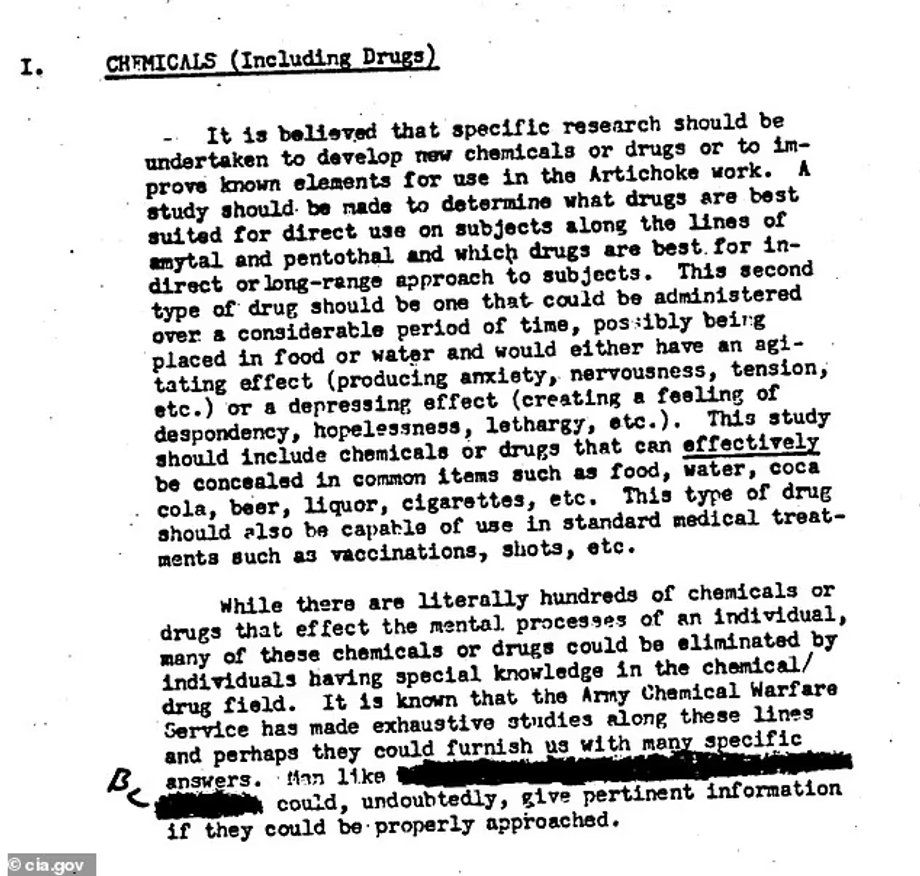
Fragment of a declassified document
This wasn't an abstract theory – the CIA consulted with military chemistry specialists who had experience with similar research during World War II.
Experiments were conducted on sensitive groups: prisoners, soldiers and psychiatric patients, often without their consent. The documents show a complete lack of ethics in this research – national security justified everything, and the echoes of World War II were still loud.
- Read also: There is no such thing as a private conversation with AI. We are preparing a disaster for ourselves
As later revealed, many files of documents from that era were destroyed in 1973 on the orders of CIA Director Richard Helms, leaving gaps in knowledge about the full scope of the program to this day.
From Artichoke to MKUltra
Project Artichoke was a direct precursor of the more famous MKUltra program, which began in 1953 and lasted until 1973. MKUltra expanded research to hundreds of substances, including LSD, tested on hundreds of unknowing people. The program included hundreds of sub-projects in universities, hospitals and prisons. One of the documented cases is that of gangster James “Whitey” Bulger, who in 1957, while serving a sentence in Atlanta, received doses of LSD for over a year.
He described the effects as a nightmare: – Complete loss of appetite. Hallucinations. The room was changing shape. Hours of paranoia and aggression… We experienced terrible periods of waking nightmares and even blood flowed from the walls. “People were turning into skeletons before my eyes,” Bulger described, suffering from paranoia, hallucinations and a sense of loss of mind. All in the name of “research”.
MKUltra came to light in the 1970s thanks to the Church Commission hearings in the US Congress, which exposed ethical and human rights violations. However, the destruction of most of the files in 1973 means that the full truth may never see the light of day. Other related programs, such as MKNAOMI (focused on biological weapons) and BLUEBIRD (predecessor to Artichoke), show that the CIA conducted extensive behavioral control efforts, often in cooperation with the military and private institutions.
- Read also: Naked photos of politicians with AI on the X platform. Authorities took action
Is it really over?
Do we have to assume that these efforts ended in the 1970s? History shows that authorities rarely give up their tools of control. Perhaps research has evolved from chemicals in vaccines to digital algorithms and surveillance. In today's world, social media, big data and AI can serve similar purposes: keeping the masses in debt, with their noses in their phones, voting for the same parties over and over again and too lazy to protest.

Social media takes up a lot of our time, and research shows that it also reduces our cognitive abilities
|
Beth Macdonald / Unsplash
The algorithms of platforms like Facebook and Twitter (X) promote content that causes anger and division, which increases engagement but also weakens critical thinking. Research shows that the overuse of social media leads to the homogenization of thought, addiction and “dark persuasion”, where companies and governments manipulate behavior through targeted advertising, placing people in information bubbles and disinformation. People become a “little thinking mass”, surrounded by loans, things for rent, fooled by short videos, without the strength to analyze their own situation.
This allows the elite to maintain power and wealth while we work for their benefit. Theories of “digital authoritarianism” suggest that governments use technology to monitor and shape opinion, inverting the idea of the internet as a tool of freedom. Is this a sequel to Artichoke? There is no evidence of this, but patterns – from total surveillance attempts to neuropolitics – make us watch out.