Cryptocurrency market experts note a sudden collapse in bitcoin prices on Wednesday afternoon. This happened, among others, following reports from the front in the Middle East. Investors treat bitcoin in an ambiguous manner, which results from the evolution of attitudes towards this highly speculative asset.
The rest of the article is below the video
It is happening on stock exchanges, and the changes are not one-way. There was greater optimism in the financial markets in the first part of the day. As a result, the Polish currency slightly recovered, and the dollar and euro weakened. Gold has been experiencing a black streak in recent days, and a on Wednesday afternoon, the quotations of the most popular cryptocurrency dropped sharply.
The price of Bitcoin suddenly crashed
Bitcoin's valuation has fluctuated around 74,000 over the last dozen or so hours. hole. (approximately PLN 274,000), similarly to Tuesday. Suddenly though in the afternoon they flew down, and after 14 popular cryptocurrency was about 3%. in the red, with the rate at less than $72,300.
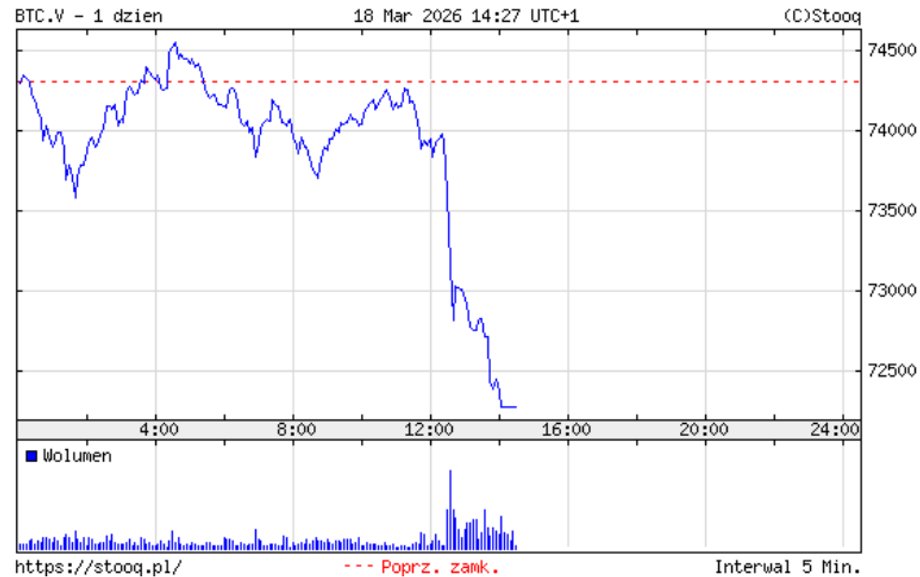
In the afternoon, bitcoin prices dropped significantly
|
Stooq, own study
“Bitcoin prices collapsed after reports of the escalation of hostilities in Iran, and then after data on American producer inflation, which turned out to be much higher than expected,” notes the CoinDesk portal.
See also: Where did bitcoin capital flee? This instrument is expanding on the market and replacing banks
He adds that the declines began when US President Donald Trump has adopted a more aggressive tone towards Iransuggesting further escalation in a series of posts on Truth Social and calling the country “the biggest sponsor of terror.” At the same time, Iranian state television reported that part of the South Pars gas field was attacked.
Bitcoin price in the face of crises
In crisis situations, such as the escalation of the conflict in the Middle East, investors treat bitcoin ambiguouslywhich results from the evolution of this cryptocurrency between a speculative asset and a safe haven (understood slightly differently than traditionally). At the moment of the first impact and the sudden outbreak of panic, the market reacted with a sell-off. This shock stage is usually very short-lived, followed by a sharp rebound fueled by the “digital gold” narrative, which attracts capital seeking protection from the destabilization of the traditional banking system and wartime inflation.
Investors increasingly perceive bitcoin as an asset independent of the decisions of central banks and government policies, and the presence of ETFs additionally stabilizes the exchange rate, attracting institutional capital even in conditions of high geopolitical uncertainty. In countries directly affected by the conflict, bitcoin is also becoming a real tool for transferring value and bypassing local financial restrictions, which further strengthens demand on a global scale.