The US hit 7,000 targets in Iran and destroyed 100 ships, Trump claims. “They were literally annihilated”

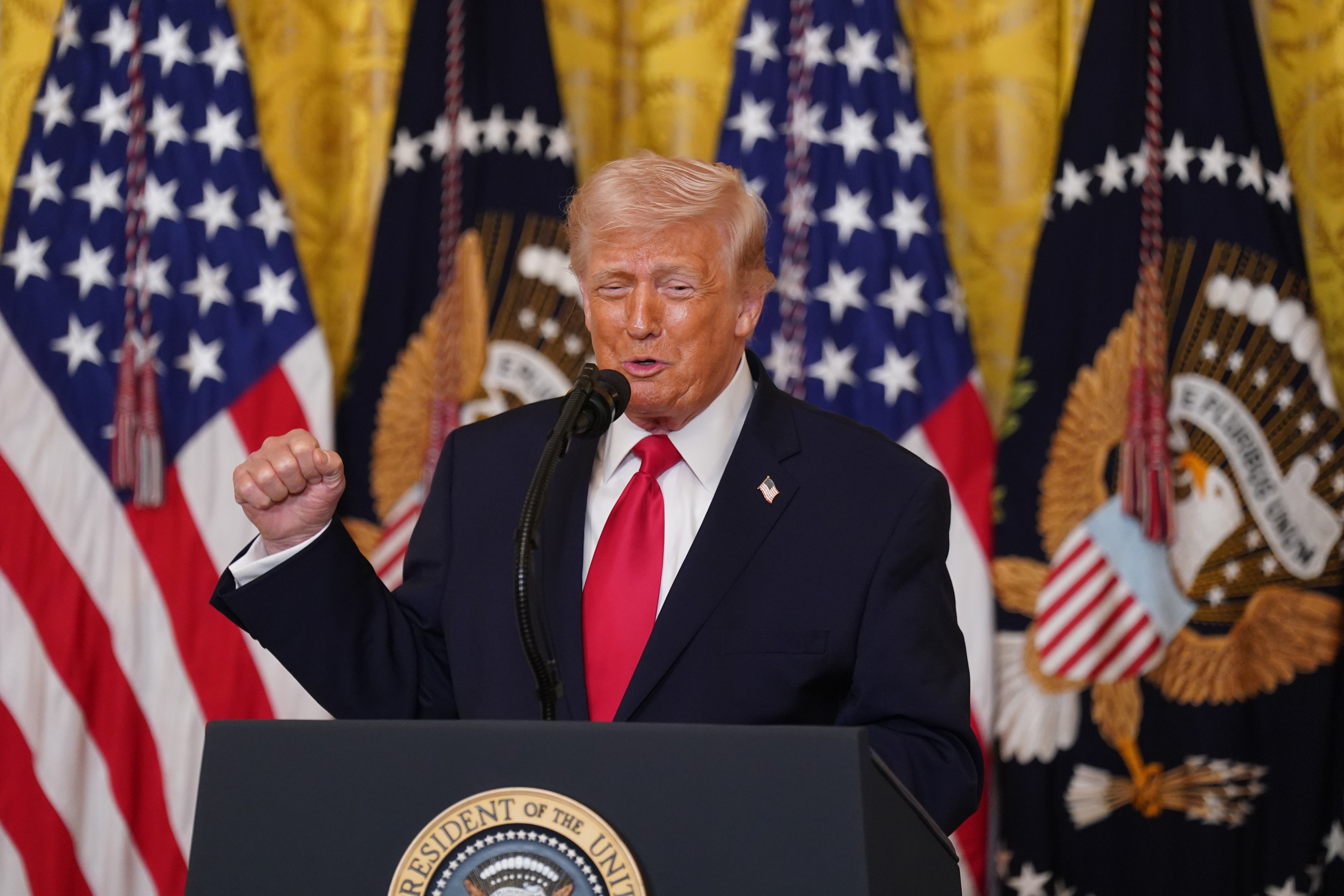
US President Donald Trump held a press conference at the White House on Monday, where he spoke about the war in Iran and where he announced that the current military campaign against the Islamic Republic “has continued in full force for the past few days”, reports The Guardian, Sky News and Reuters.
“They (the Iranians, no) were literally annihilated, the Air Force is gone, the Navy is gone, many ships have been sunk,” he said.
“Their radar systems are gone and their leaders are gone, other than that they're doing pretty well,” the US president added.
Trump has claimed that the US has struck more than 7,000 targets inside Iran.
“We got a 90 percent reduction in their ballistic missile launches and a 95 percent reduction in drone strikes,” the White House leader added.
“The missiles are now arriving in droves, because they don't have many left,” the American president also declared.
He went on to say that more than 100 Iranian military vessels have been sunk or destroyed in the past week and a half.
30 Minelaying Vessels Destroyed in Strait of Hormuz, Trump Says
Trump also claimed that the US had destroyed more than 30 mine-laying vessels, claiming that Iran's ability to launch drones is now “close to zero”, but did not provide further details or evidence.
According to the White House leader, the US is “destroying” Iran's ability to threaten commercial shipping in the Strait of Hormuz.
Instead, he added that the US was unsure whether mines had been placed in the strait crucial for about 20 percent of the world's oil supply.
“We hit, to the best of our knowledge, all of their minecraft…but we don't know if it was mines, we're not sure if that happened. We don't know if they dropped any, but we hit all 30 of their ships,” the US president said.
US hasn't hit Kharg Island oil reserves, 'but things may not stay that way'
In the same press conference on Monday, Donald Trump also said the US had “literally destroyed” everything on Iran's Kharg Island except for the island's oil facilities, but left open the possibility of targeting them in the future.
“As you know, we attacked Kharg Island and we hit it, we hit it, we destroyed literally everything on the island except for the oil area, I call it the pipeline area,” Trump added, also quoted by CNN.
“We left the pipelines (intact). We didn't want to do that, but … we're going to do it, we can do it in five minutes,” Trump said, going on to say that U.S. forces avoided attacking those areas “for the purpose of rebuilding that country one day” and adding, “I think we did the right thing, but it might not stay that way.”
Despite its small size, Kharg Island is an economic lifeline for Iran, handling about 90 percent of the country's crude oil exports, meaning any attack on it risks triggering a major escalation.
A U.S. military official previously told CNN that the attacks were “large-scale,” but U.S. forces avoided hitting the island's oil infrastructure. The targets included naval mine depots, missile bunkers and other military infrastructure, the official added.
Criticism of allies who rejected calls on Strait of Hormuz
Donald Trump also expressed his displeasure with US allies who rejected his requests to send warships to help escort oil tankers through the Strait of Hormuz, saying they were not loyal enough to the US after decades of security support.
“Numerous countries have told me they're on their way,” Trump said Monday, without naming any of them.
“Some are very excited and some are not. Some are countries that we've helped for very many years. We've protected them from terrible external threats, and they haven't shown much enthusiasm. And the level of enthusiasm matters to me,” he continued during the White House briefing.
Trump has tried to persuade other nations to help secure the passage of oil tankers through the de facto blocked strait, but so far US allies have either remained non-committal or flatly rejected the US president's requests.
“We have some countries where we have 45,000 soldiers, wonderful soldiers, protecting them from danger, and we've done an excellent job,” Trump said. “And when we want to know, 'Do you have any minesweepers?' “Well, we'd rather not get involved, sir,” he added.
Trump, however, described the potential naval mission as “something very minor,” even as Iran continues to fire missiles at oil tankers.
The White House leader also claimed that he knew that US allies would not come to the aid of the United States.
“I've been a big critic of protecting countries because I know we're going to protect them. And if we ever need help, they're not going to be there for us. I've known that for a long time,” he claimed.
Iran claims it can wage war as long as necessary
On the other hand, Iran said on Monday that its armed forces are determined to “defend themselves as long as necessary” in the current war waged by the US and Israel, until the latter two understand that they cannot attack it whenever they want and then end the conflict when the situation suits them or when they encounter difficulties.
“Our armed forces and our people are determined to defend themselves as long as necessary, until the enemy understands that he cannot initiate a war against Iran whenever he wants and stop it when it suits him,” said the spokesman of the Iranian Foreign Ministry, Esmail Baghaei, at a press conference, according to the EFE and Agerpres agencies.
He thus referred to both the ongoing war and the 12-day war launched by Israel last year against Iran, a conflict in which the United States then intervened by bombing Iran's underground nuclear facilities.
The same spokesman insisted that Iran will not tolerate “two evil regimes” (referring to the US and Israel) imposing a war on it and then, when it suits them or when faced with logistical or defensive difficulties, declare a ceasefire only to resume aggression a short time later.
“The aggressor, according to reason, logic and international law, must be held accountable. We must ensure that this war, or these intermittent wars, will not be imposed again on our region and our country periodically,” explained the Iranian official, who said the ongoing war was “imposed” on Iran while it was earnestly negotiating a deal on its nuclear program.
He warned of possible “false flag attacks” carried out by the US and Israel and attributed by those countries to Iran. The Iranian armed forces “declare with honor and courage every target they attack”, the spokesman of the Iranian Foreign Ministry indicated, according to DPA.
Also on Monday, the UN Human Rights Council organized an interactive debate between member states and its special rapporteur on the human rights situation in Iran and the UN briefing mission on events in Iran, in the context of the ongoing conflict and crackdown on anti-government protests that took place in December and January.
Iran reiterated to this council that it will not give in to “illegal aggression” by the US and Israel, while also warning that its citizens are in grave danger due to continued airstrikes.
“The most urgent and fundamental human rights issue in Iran is the imminent threat to 90 million people, whose lives are in immediate and grave danger under the shadow of reckless military aggression,” said Ali Bahreini, Iran's UN ambassador in Geneva, quoted by AFP.
He urged the UN's top human rights body to focus not on Iran's internal situation following recent protests, but on the state of Iran's cultural heritage, threatened by US-Israeli bombing, and the killing of children on school benches, referring to the deaths of 165 girls killed in the city of Minab after their school was hit on the first day of the US-Israeli bombing campaign. The Pentagon and US President Donald Trump said an investigation into the Minab school attack was ongoing. According to an investigation by the American publication New York Times, the school would have been hit by an American Tomahawk cruise missile.
The war, launched by the US and Israel on February 28 and consisting of an intense campaign of airstrikes, has entered its third week.
According to the Pentagon, more than 15,000 targets in Iran were attacked in the first two weeks of the conflict. Nuclear facilities, those for the production and launch of ballistic missiles, ammunition depots, army and Revolutionary Guard Corps bases, locations where political and military leaders are estimated to be, etc. are targeted.
Iran is retaliating with drones and missiles launched in waves at Israel and US bases and interests in the Gulf.
Faced with the impossibility of winning a direct confrontation, Iran opted to expand the conflict geographically to strike at enemy weaknesses such as early warning radars.
In parallel with these strikes, Tehran is focusing on the Strait of Hormuz, easily controlled from the Iranian coast, while the US is still hesitant to resort to the risky option of military escorting commercial ships crossing this waterway through which about 20% of the world's oil and liquefied natural gas (LNG) trade transits.