After a strong increase at the beginning of the year, expectations regarding the future of Germany's economic situation deteriorated significantly in March, according to data from the ZEW institute. They amounted to minus 0.5 points and they are there lower by minus 58.8 points from the previous month's reading. Optimists decreased by as much as 32.9 percentage points in March. compared to February, and the group of pessimists increased by 25.9 percentage points. mdm.
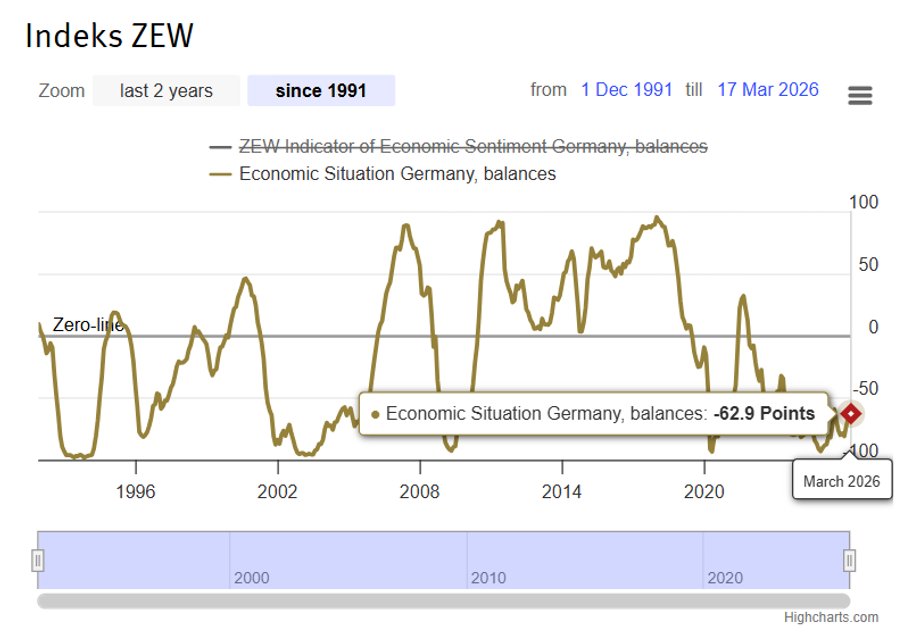
It is of little comfort to our western neighbors that the assessment of the current economic situation has improved slightly, as the levels are still close to record lows. The business climate index for Germany is minus 62.9 points, increasing by 3 points since the previous month. Only 1.1 percent entrepreneurs gave a positive answer about the situation of the economy and as many as 64 percent negative. The indicator improved because the latter decreased by 4.8 percentage points during the month, and the former by only 1.8 percentage points.
Germany: ZEW index current situation
|
OUTSIDE / OUTSIDE
For comparison, in the entire euro zone the indicator is minus 29.9%. and dropped by 16.3 percentage points. month to month, in the USA it is positive and amounts to plus 4.5 percentage points. and dropped by 15.1 percentage points. mdm, and in China it is negative and amounted to -33.7 percentage points, which means a decrease by 2.2 percentage points. mdm.
As bad as a pandemic
Although there is an improvement compared to the levels observed since August 2023, similar values of the German ZEW index were seen earlier during the pandemic in 2020 and even earlier in the global financial crisis of 2008-2009.
— The ZEW indicator collapsed. Escalation in the Middle East causes sharp increase in energy prices and increases inflationary pressure. This increases the risk for the German economy that the emerging trend of economic recovery will slow down. The strength of these effects depends on the intensity and duration of the conflict. Financial market experts are skeptical about the possibility of a quick resolution of the conflict – comments the president of ZEW, prof. Ph.D. Achim Wambach.
In March, the situation improves in few sectors. Negative trends especially concern energy-intensive industries: chemical and pharmaceutical (minus 43.6 points compared to the previous month), automotive (minus 34.3 points compared to the previous month) and machinery (minus 35.5 points compared to the previous month).
This shows that energy prices are the biggest pain point for companies today. After a sharp increase in gas prices, which currently remains above EUR 50 per MWh compared to EUR 30 at the end of February, the price of electricity in Germany has skyrocketed and is now close to that in Poland.
The steel and metal production and construction sectors are also reporting strong declines. In the latter case, it may also be related to expectations of interest rate increases. About 80 percent respondents expect increasing inflationary pressure both in Germany and in the euro zone.
Expectations for the euro zone fell sharply in March, reaching negative values of minus 8.5 points. Compared to February, the indicator is lower by minus 47.9 points. The assessment of the economic situation is deteriorating and amounts to minus 29.9 points, which is 16.3 points less than in the previous month.