Why Nvidia's greatest asset is its greatest risk

Nvidia officially began its existence on April 5, 1993, and its three founders – Jensen Huang, Curtis Priem and Chris Malachowsky – “acquired” equal shares in it by spending $200 each from their pockets. Currently, Nvidia's market capitalization is over USD 4.5 trillion, and it is still headed by Jensen Huang, who turned 63 on February 17 this year, which making him one of the longest-serving CEOs among S&P 500 companies. One of Jensen Huang's greatest values is that he combines great business skills with the mind of an engineerwhich is a rare mix.
He began developing communication and customer-facing skills as a teenager, when he worked at a Denny's restaurant in Portland, where he started with a dishwasher and cleaning toiletsto then become a waiter. Huang believes that this hard and low-prestige job taught him a lot and he still uses the life lessons he learned then, for example regarding the value of hard work or contact with customers. Later he worked as an engineer — he first designed processors at AMD, and then moved to LSI Logic, where, among other things, he was promoted to director of the department responsible for designing chips ordered by external customers. Jensen Huang so he is not a stereotypical CEO of a large companywho came out of a prestigious business school as an expert in management, and not necessarily in what he was supposed to manage.

Jensen Huang during a visit to the Denny's restaurant in Portland, where he started his professional life cleaning toilets and dishwashing.
The fact that the head of Nvidia is constantly hungry for knowledge and is able to conduct substantive discussions with his company's engineers pays off in many ways. Perhaps the most important of them is that thanks to this has a very good technical sensewhich has made Nvidia create a revolutionary product at least a few times. A more contemporary and consumer example of this is the fact that the idea for an image scaling mechanism using AI called DLSS, which brought quite a revolution in the world of video game graphics, was born in his head during one of his meetings with engineers. However, this solution, which in practice cemented Nvidia's position as the king of gaming graphics cards for years, pales in comparison to the proverbial Jensen Huang's “nose” for AI and the fact that sooner or later his products will be used on a massive scale in data centers.
Read also: Nvidia has found a way to prevent anyone from catching up with it. It's no coincidence that he's at the top
Jensen Huang, i.e. unprecedented patience and farsightedness
The beginnings of using Nvidia products for scientific applications can be traced back to the beginning of the century, in the ancient times of GeForce 3 graphics cards, which were released on the market in 2002. At the beginning, these were only experiments, often related to medical applications. It got much more serious in 2006, when the world saw the Nvidia chip called G80 and CUDAi.e. an ecosystem that allows you to relatively easily run code on this chip that has nothing to do with video games. Many people at Nvidia believed that CUDA support should only come to more expensive Nvidia products dedicated to workstations, but Jensen Huang insisted that any, even the cheapest, consumer Nvidia graphics card should be compatible with itin order to popularize this standard and attract programmers. He saw it as an opportunity to create a business moat around a gigantic market that, for now, existed almost only in his head.
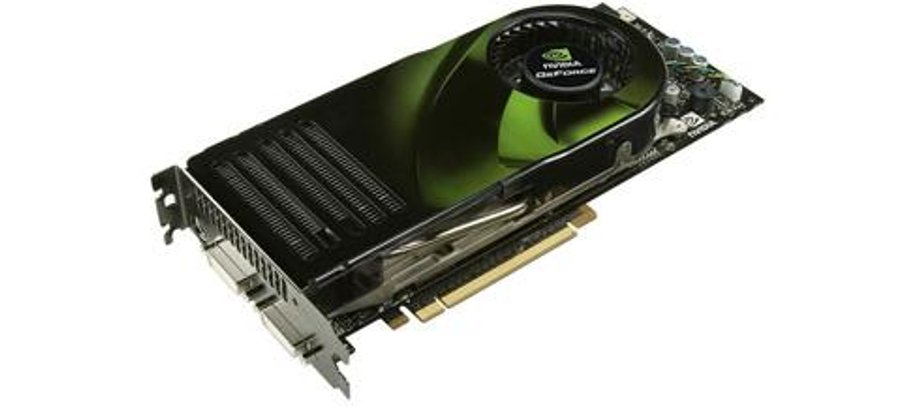
Nvidia started taking scientific computing seriously in 2006.
|
Onet
We now know that it was a brilliant idea. However, adding and maintaining CUDA compatibility across all Nvidia chips had a tangible transistor cost, and so effectively increased their production costs, which has meant lower margins and worse financial results for years. I remember those times well, because during the early years of CUDA I was reviewing graphics cards and I certainly wrote a few reviews that have aged very badly. I take comfort in the fact that I'm not the only one. Jensen Huang was pressured by customers, investors and even some of his colleagues. They did not see a distant future for this solution, which for years was very niche and generated costs. But Nvidia's CEO still defended him — even as Nvidia's share price fell over the course of the year from about 90 cents in late 2007 to about 15 cents in November 2008.
Nvidia continued to listen to scientists who had a real impact on the development of subsequent generations of Nvidia chips – sometimes Jensen himself came to talk to them. The appearance in 2012 of AlexNet – the legendary first artificial neural network capable of effectively recognizing images, which was created and run on two Nvidia GeForce GTX 580 graphics cards – further fueled Jensen's enthusiasm. Already in 2013, he stated that Nvidia would be a company seriously involved in accelerating AI calculations – 9 years before ChatGPT appeared. We also continued to support various scientific projects with free chips. The most famous example of such a situation was August 2016 personal delivery worth PLN 300,000 hole. DGX-1 supercomputer to the OpenAI headquarters into Elon Musk's own hands.
Apart from the issues of tough psyche and character traits, Jensen Huang certainly would not have had so much faith in his forecasts from the first decade of the 21st century if he did not understand technology well and did not feel the potential of the seeds of trends seen in academic circles.
Everything revolves around Jensen
Nvidia's success, however, is not only a matter of the good nose of the company's CEO, his patience and persistence in achieving goals, but also the unique – and very stressful for all investors thinking about Jensen Huang's succession – way Nvidia is managed.
Nvidia there is no typical corporate, multi-level structure in the form of interconnected inverted Vs. Although it is a gigantic company, there is no typical COO, because Jensen wants to have everything under control. There is also no typical separate office. About 60 people responsible for various tasks report directly to Jensen. Talking about tasks is not accidental, because Nvidia assumes that this assigned task is your boss, not your supervisor. In practice, this means that at any time someone can be assigned to supervise a new task and report to Jensen, and the flow of people between teams is very smooth, depending on priorities and the need of the moment.
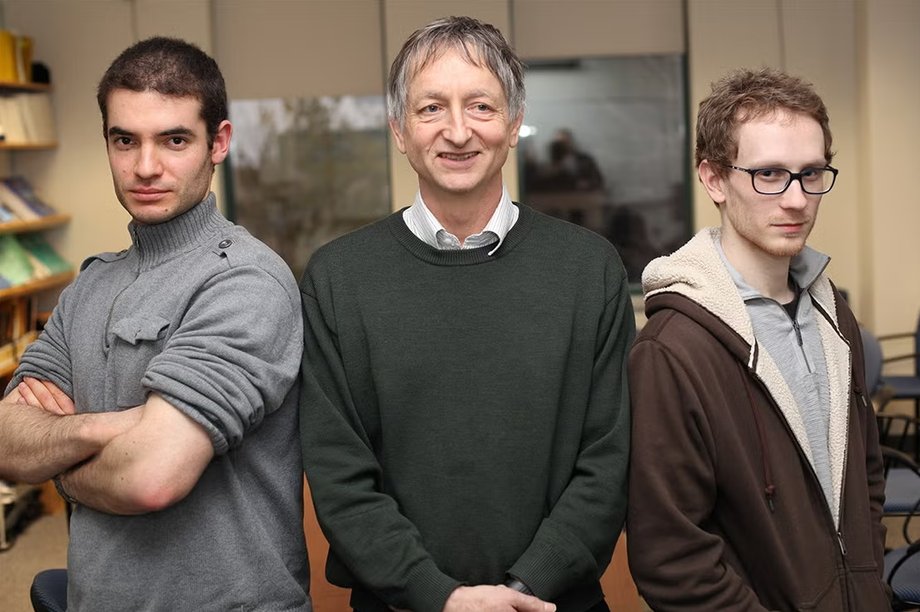
Ilya Sutskever, Geoffrey Hinton and Alex Krizhevsky. Their work on the AlexNet AI system led Jensen Huang to turn Nvidia into an accelerator manufacturer in 2013.
|
Johnny Guatto / University of Toronto
Something like this has been in place throughout the company for years Top 5 emails. Each employee is to send an email to the leader of their team with five things they are working on and trends or problems they have noticed. They are grouped by topic, Jensen has insight into them, reads hundreds of them every week and often responds to them with direct instructions. Apparently, nowadays the company's AI is more and more often involved in summarizing trends in emails, which means that Jensen reads fewer of them, but he still almost every Nvidia employee can expect an e-mail from the CEO at almost any time.
Another unique element of Nvidia's culture is brainstorming at white boards. In Nvidia there is no room for 1-on-1 meetings or classic PowerPoint presentationswhich, according to Jensen Huang, are a way to hide ignorance. Instead, everyone must be ready to explain their idea, work and its effects publicly and without spilling the beans, with a marker in hand and with the boss sitting in the front row, who can chime in at any time (and often does it because he either has some substantive comment or wants to know more).
There are more examples of extraordinary management of Nvidia and they mean that even though it is a company employing several dozen thousand people, operates more in the style of an overgrown startup than a classic large corporation. On the one hand, this makes Nvidia work very efficiently and is able to quickly change direction, but on the other hand, it causes everything revolves around Jensen Huang. It is, in a sense, the main pillar of Nvidia's design. It's working great for now, but it's hard not to ask yourself: What's next? What if something happens to Jensen or he decides to retire, which is not a very distant future (remember, he just celebrated his 63rd birthday)?
Read also: The most expensive company in the world took over a serious competitor. $20 billion on the table
The problem of finding a successor is like no other company
Of course, there is no shortage of examples of companies that had brilliant founders and continue to do very well after their departure. Just point to Apple or Microsoft (apart from the Steve Balmer episode). However, these corporations had a much more typical structure, in which, as they grew, fewer and fewer processes depended on brilliant management, and the issue of succession was quite obvious. It is true that Nvidia has four EVPs, but in practice none of these people is perceived as the successor of the company's founder (if only because two of them are over 70).

Jensen Huang. Exceptionally not in a leather jacket.
|
Tom Williams/CQ-Roll Call, Inc via Getty Images/Getty Images
Jensen Huang believes that he has 60 incredibly talented leaders around him, each of whom could be the head of a large company, and each of whom gets to closely observe how Jensen Huang thinks and acts every day. This means that potential successors should most likely be found in this group. But there's no point in cheating – current Nvidia is an extension of Jensen, a shell for his extraordinary mind, and even if the person who replaces him is highly trained by him and adopts his way of thinking as much as possible, Nvidia without Huang will be a very changed Nvidia. Breaking in all the internal mechanisms where the most important element has been replaced will be painful. Especially if Jensen's successor had to be chosen suddenly, because it is difficult to imagine that the process of selecting the new head of the world's most valuable company would take place peacefully (especially from among perhaps even several dozen talented leaders with their own ambitions).
The real test of Nvidia's maturity will not be the next generation of accelerators, but the answer to the question whether the company has built an institution as strong as its founder. If so, Jensen Huang will go down in history as the creator of a lasting empire. If not, what brought him and his work to the top will also be discussed as his greatest weakness.
PS I recommend the book “The Nvidia Way” written by Tae Kim to all people who want to know more about the history of Nvidia and Jensen Huang's style.