2026-03-16 09:40
publication
2026-03-16 09:40
The prolonged war in the Middle East is putting pressure on the US dollar and affecting emerging market currencies. While the Polish zloty is doing quite well when paired with the euro, the dollar was trading at its highest level since August last year.
Over the weekend, the US military bombed the Iranian island of Khark, hitting military targets but sparing oil infrastructure. The Strait of Hormuz remains closed to shipping, which pushed crude oil prices to USD 106 per barrel on Monday morning. Expensive oil raises inflation expectations and hits energy importing countries – virtually all of Europe and most of Asia.
Hence the continuing pressure on the weakening of the zloty. On Monday at 9:38 a.m. the euro cost PLN 4.2694 and was about a penny cheaper than at the close of Friday's quotations. In the case of the euro-zloty pair, the key resistance is the zone of PLN 4.30-4.31. Only a permanent break of this level would imply more serious consequences for the Polish currency.
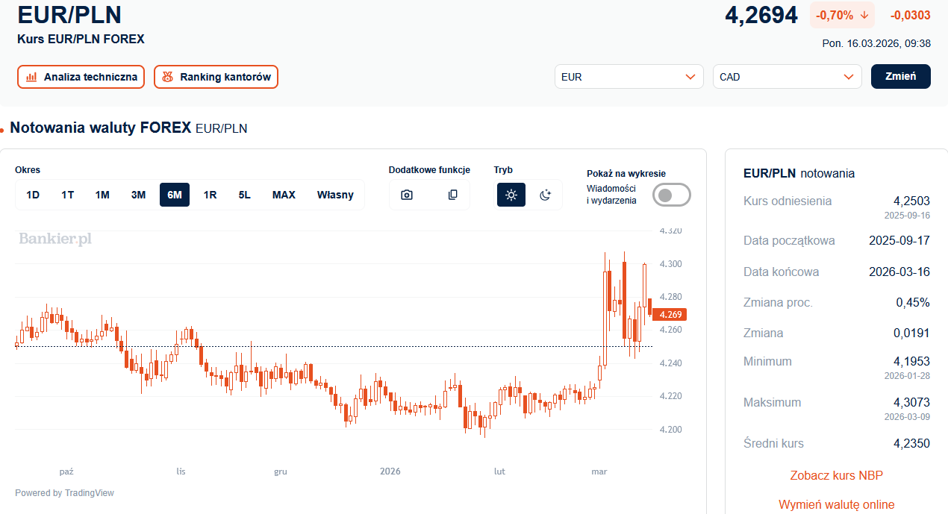
– Assuming that investors maintain their belief in the short-term negative impact of the war in the Persian Gulf on inflation and economic growth, we believe that EURPLN will remain in the range of 4.23-4.3050 in the coming days, closer to the zone of 4.27-4.28. In the case of USDPLN, we see a possibility of testing the 3.7450-3.7650 zone, and possible higher levels would mean an escalation of negative factors, which is not our base scenario at this stage – said PKO BP economists.
Advertisement
The situation on the dollar-zloty pair is worse. The USD/PLN exchange rate on Monday morning was PLN 3.7389 and was one penny lower than the Friday reference rate. Before the weekend, the dollar cost as much as PLN 3.75 and was the most expensive since August 2025. Since the long-term minimum at the end of January, the dollar exchange rate has already increased by 25 cents.
Later in the week, currency markets will focus on two issues. The first is, of course, the situation in the Persian Gulf and related oil prices. The second is the decisions of the most important central banks in the world. This week, the monetary authorities of the US, China, the euro zone, Japan, Switzerland, Sweden, Canada and the UK will decide on interest rates. In the case of the zloty, there is still a downgrade in Poland's credit rating by Moody's, which is to be published on Friday evening.
Meanwhile, the Swiss franc rates remain close to multi-year highs. In the morning, the Helvetian currency cost PLN 4.7235 and was over a penny more expensive than before the weekend. Recently, the most expensive franc was exactly a week ago, when it cost almost PLN 4.80 and was quoted at its highest level since October 2023.
K.K
The publication contains affiliate links.