It was past midnight when Andrei Moldovan, a 41-year-old sales manager from Cluj-Napoca, opened his laptop again. Not because he had work to do, but because he couldn't sleep. On the screen, the same table of rates, loans and maturities — arithmetic that never yielded the desired result.
The apartment payment, the car loan taken out in a hurry three years ago, the credit card inflated with Christmas expenses. “I was calculating in my head how I could cover everything if I got sick for a month,” he says. “It was like a horror movie that I couldn't stop.”
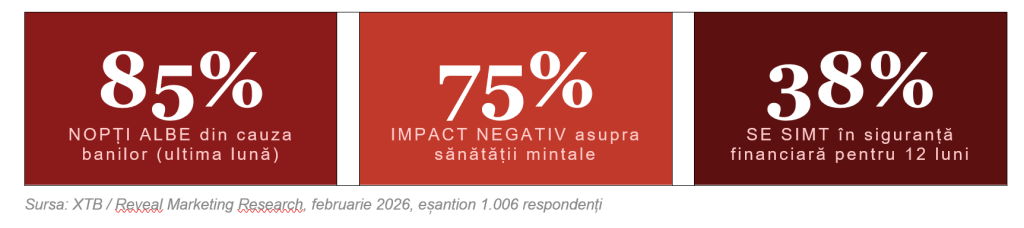
Andrei is not an isolated case. Financial stress has come to affect the sleep and mental health of the majority of Romanians, according to a survey sent to HotNews by the investment firm XTB Romania. According to the survey carried out on a sample of 1,006 people, 85% of Romanians have at least once had difficulty sleeping due to financial problems in the last month, and 75% say that these worries have negatively affected their mental health.
The study identifies several enemies of financial peace of mind. The first and most frequently cited is inflation — rising prices of essential goods are cited by 36% of respondents as the main source of stress, with a preponderance among over-55s. The second is the unpredictable: Unplanned expenses — a car repair, a medical emergency, a broken pipe — affect 19% of respondents and hit women and seniors harder
Next, with 15% each, are job insecurity and debt burden. The first category catches the 45-55-year-olds harder — people with experience, but vulnerable to restructuring and the onslaught of automation. The second category mainly affects people aged 35-44: the generation that bought houses, raised children and find themselves caught in the middle of a financial gear that no one explained in school.
“I was calculating in my head how I could cover everything if I got sick for a month. It was a horror movie that I couldn't stop,” says Andrei Moldovan.
Men tend to report less emotional distress, not that they feel it less
The survey data reveals a nuanced gender pattern. Women report a higher rate of impact—48% compared to 37% for men—in terms of mental health effects. But the difference does not say everything. Psychologists point out that men tend to report less emotional distress, not that they feel it less.
Andrei Moldovan admits that he rarely discussed his financial anxiety with anyone. “I would tell my wife I was tired. At work, I was the most energetic person in the office. At night, I was different.” Only after consulting a mental health specialist and an independent financial advisor was she able to restructure her credit and, with it, her sleep.
The gender gap also persists in the perception of security: 44% of men say they are confident in their financial stability over the next 12 months, compared to just 30% of women. A gap that reflects both salary realities — the pay gap persists in Romania at around 7-9% — and cultural models of distribution of household expenses.
Feeling of financial security by age
One of the most telling graphs in the study is the sense of financial security by age. At 18-24 years old, 51% of young people declare themselves safe. At 45 and over, the proportion drops to 30%. In the 55+ category, it reaches 28%. It's an inversion of the logic of accumulation: the more you've worked, the more insecure you feel.
The explanation is partly structural. Pensions remain uncertain in real terms, the private pension system is poorly adopted, and approaching retirement amplifies rather than alleviates anxiety. Added to this is the fear of medical costs—a variable that statistically explodes in old age.
Sleep faithfully reflects this map of restlessness. The most affected are those aged 45-55 (32% report frequent sleep problems), closely followed by the 25-34 age group (30%). Not by chance: the former bear the weight of careers in jeopardy and the children who still depend on them; the others are just entering the era of big financial commitments.
The side effect: social and family life
Financial stress does not remain confined to abstract domains. The study shows that the main effect felt is on mood and motivation (34%), followed by physical health (17%) and sleep quality (17%). But 15% of respondents mention that financial pressure affects their family life — a seemingly modest percentage, with concrete implications: tensions in the couple, nerves with children, withdrawal from social life.
The only relatively safe area is the professional: only 5% say that their performance at work has suffered. Irina Cristescu, General Manager of XTB Romania, quoted in the study, offers a sober reading of this apparent resilience: “When people continue to function professionally in conditions of constant stress, there is a risk that this pressure will move to other important areas of their lives.”
The study was conducted by Reveal Marketing Research in February 2026, on a representative sample of 1,006 adults in Romania. Andrei Moldovan is a pseudonym used at the request of the interviewee.