


publication
2026-03-16 14:00
It took over 6 years for core inflation to return to the NBP target of 2.5%. However, this is not the end of the story and the current oil shock may cause this measure of price growth to also increase in the coming months.
According to data published by the National Bank of Poland on March 16 inflation on a year-to-year basis in February 2025 it was as follows:
- after excluding food and energy prices was 2.5 percent compared to 2.7 percent recorded in October. Economists expected a result of 2.6%. This is the lowest reading since October 2019.
- after excluding administered prices (subject to state control) it was 1.6%. compared to 1.6 percent a month earlier,
- after excluding the most volatile prices, it was 2.3 percent. compared to 2.6 percent a month earlier;
- the so-called 15 percent trimmed mean, which eliminates the impact of 15 percent. basket of prices with the lowest and highest dynamics, amounted to 2.2 percent. compared to 2.4 percent a month earlier.
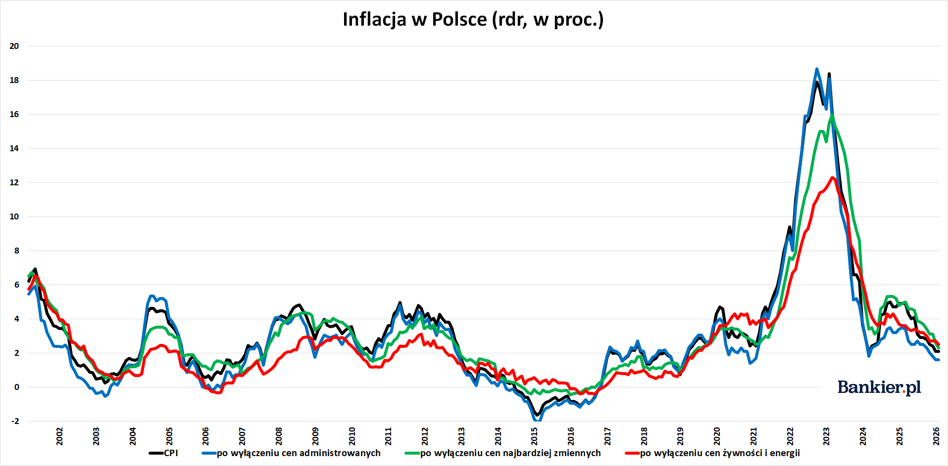
Let us just recall that in November and December core inflation dropped to 2.7%, marking the lowest value in 6 years. Yes, for the previous six years core CPI inflation has exceeded the National Bank of Poland's 2.5% inflation target. This state of affairs has been ongoing since November 2019. Only in April '25 did the annual dynamics of this price measure fall within the band of permissible deviations (i.e. +/- 1 percentage point) from the NBP target.
– The indicator most often used by analysts is the inflation rate excluding food and energy prices. It shows the price trends of those goods and services on which the monetary policy pursued by the central bank has a relatively large impact. Energy prices (including fuels) are determined not on the domestic market, but on global markets, sometimes also under the influence of speculation. Food prices depend largely on, among others: on the weather and the current situation on the domestic and global agricultural market – added in the statement of the National Bank of Poland.
Meanwhile, the “broad” consumer inflation rate (CPI) on an annual basis in February amounted to 2.1%. and was even below the NBP target. However, we know that this is history and that due to the sudden increase in fuel prices, March CPI inflation will most likely exceed 3%. And in the following months it may continue to grow thanks to the so-called second round effects.
What is core inflation and why is it counted at all?
Core inflation measures are used to assess the medium- and long-term trend in the increase in the general price level. It is usually assumed that core inflation is that part of inflation that is related to inflation expectations and demand pressure and which is not directly dependent on supply shocks, eliminating the prices of food, non-alcoholic beverages and energy, which are particularly sensitive to internal and external shocks, as written in the methodology of NBP core inflation measures.
– The National Bank of Poland calculates four core inflation indicators every month, which helps to understand the nature of inflation in Poland. The CPI shows the average change in prices of a large basket of goods purchased by consumers. When calculating core inflation rates, price changes in various segments of this basket are analyzed. This allows us to better identify the sources of inflation and more accurately forecast its future trends. It also allows us to determine the extent to which inflation is permanent and the extent to which it is shaped, for example, by short-term price changes caused by unpredictable factors – we read in the NBP press release.
Food and non-alcoholic beverages as a group of goods in the Gusov CPI basket in 2025 weigh 25.91%. (compared to 25.87% last year). In turn, the prices of energy carriers and housing maintenance accounted for 20.35%. weight of the consumer inflation index (compared to 19.44% a year earlier). In addition, there is 10.18 percent. weights of the “transport” category, where fuel prices are located. This means that core inflation measures price changes of approximately 60% of the Gusov inflation basket.


