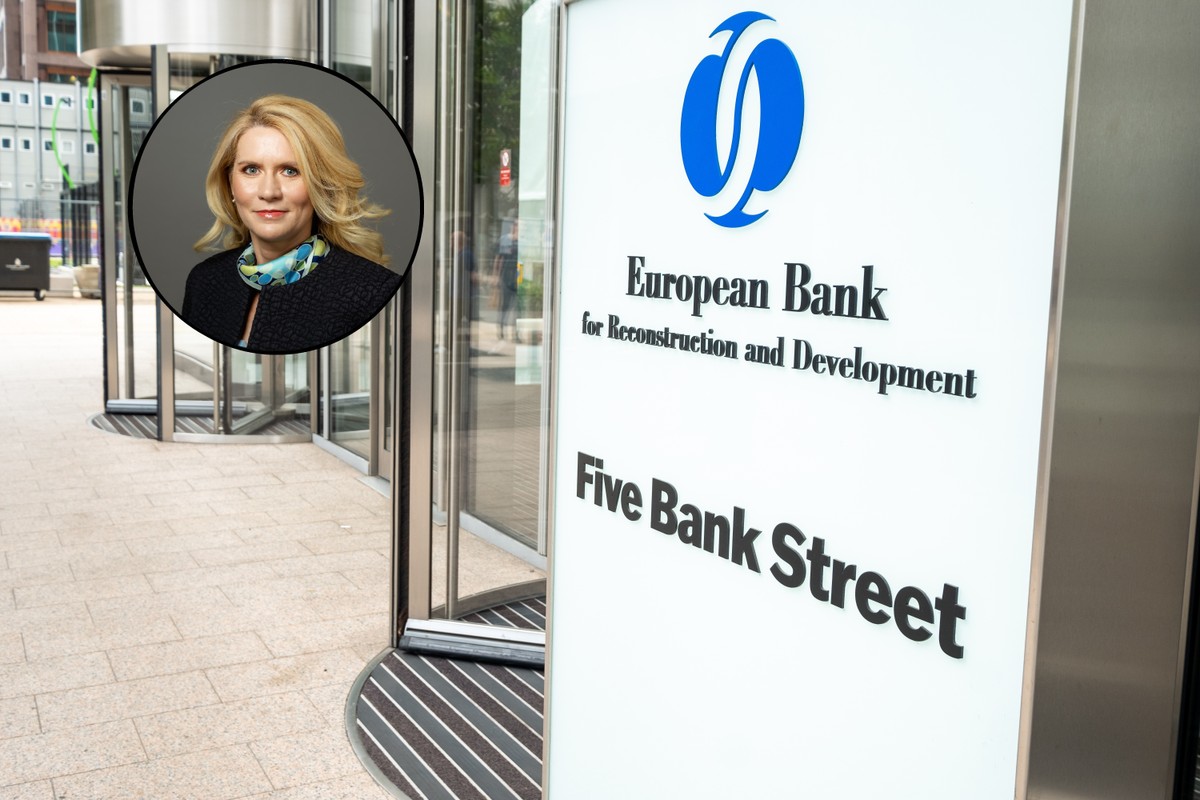
“After a record-breaking 2024, we expect this year that our commitment in Poland will remain at an equally solid level, in line with the bank's strategy for Poland approved last year, which is valid until 2029.” Moraru said.
She added that Poland remains a priority market for the EBRD, and a few weeks ago, the bank's first vice president, Greg Guyett, during his visit to Warsaw, emphasized that Poland is important due to its size, resilience, and the role it plays in the integration of the region.
These are the key EBRD investments in Poland
“So far, we have invested approximately EUR 1.2 billion in 39 projects in 2025, 70% of which is consistent with our goals for the transition to a green economy. We expect to end this year at approximately the same level as in 2024,” Moraru emphasized.
In 2024, the EBRD invested a record EUR 1.43 billion in Poland; Poland was among the five countries with the highest investments of the bank. “When it comes to investment areas, they are very diverse in terms of sectors. Of course, we continue to support the development of capital markets using various financial instruments, but also the energy, production and supply chain sectors,” said the EBRD Regional Director.
Among the key projects, she mentioned support worth EUR 200 million for an offshore wind farm Baltica 2, implemented by PGE and Ørstedthe largest offshore project in Poland, which reduces dependence on coal and CO2 emissions by 3.5 million tons per year.
“This is one of the most important projects that we have supported this year in the field of green transformation. However, for us this transformation goes beyond the energy sector alone. In this context, another interesting example of our involvement is the housing sector and a project implemented in cooperation with BNP Paribas and InvestEUin which we provided a guarantee for the amount of EUR 80 million, enabling us to obtain EUR 100 million to improve the energy efficiency of residential buildings,” explained Moraru.
This project included the installation of PV panels, building insulation and the installation of heat pumps. “Resi4Rent is another project that will be supported for many years. This is a platform where, through various investments, we have mobilized a total of over EUR 100 million to expand the base of sustainable apartments for rent with a goal of 10,000. apartments by 2026,” Moraru noted.
Among this year's other investments, she mentioned an investment of EUR 100 million in one of the funds of the regional equity fund for renewable energy Taaleri and a co-investment of EUR 50 million in the regional equity fund Mitiska, investing in green infrastructure.
“From the point of view of the capital market, we played a significant role in bank issues. We supported many MREL issues of Polish banks, as well as secured bonds. In the corporate sector, we cooperate with Żabka – we supported their first issue of sustainable bonds, worth PLN 1 billion,” she said.
In the area of equity investment, she indicated, among others: for an investment of USD 44 million in a robotics company Nomagic as part of a venture capital financing round, and in total, as part of equity funds and direct equity investments, the EBRD invested approximately EUR 200 million in Poland this year.
“In terms of direct equity investments, we have co-invested several times with private equity funds. We recently finalized an investment in a type of fintech ProService. Overall, Poland is a kind of innovation sandbox for us, where we test scalable solutions that we then implement in other countries, because Poland is such a developed market and the companies here are quite sophisticated,” she emphasized.
Strong economic growth helps.
By the end of the year, the EBRD intends to finalize several investments in Poland: in the development of the capital market, in bond issues and equity investments: direct and venture capital funds.
When asked whether Polish companies can benefit from the development of the renewable energy market in Ukraine, Moraru replied that for now Poland has large energy needs to meet.
“Hence the large number of renewable energy investments in Poland itself, but I am convinced that there are opportunities to export energy surpluses in the future and expand in general in Ukraine, but also in other countries in the region. Today, we can already see many Polish companies in the Baltic countries,” noted the director of the EBRD.
She emphasized that the reconstruction needs in Ukraine will be huge, and the EBRD has already invested EUR 8.5 billion there since the beginning of the war. Referring to the prospects for the Polish economy, she replied that the bank sees them as quite positive.
“We are pleased with the growth, which is forecast at 3.4%. in 2025 The driving force behind this growth are public investments from KPO, decreasing inflation, as well as growing consumption and wages. Poland is a strong economy, currently the 20th economy in the world. However, there are some challenges: investments remain volatile and their share in GDP is still quite low compared to the European average,” Moraru said.
Budget challenges and Germany's continued weakness
She also pointed to the environment of still high interest rates, low equity investments, a relatively underdeveloped capital market and the expected trade imbalance due to tariffs.
“This will indirectly affect Poland through weaker demand in Germany. On the fiscal side, the budget deficit is quite high – at around 6.9% of GDP. Much of this is driven by defense spending, but it is a necessary cost related to national security. From an investment perspective, we see Poland as resilient. Over the last 6-9 months, we have seen a slight improvement in investors' perception of Poland,” said Andreea Moraru.
She added that previously investors felt less comfortable looking at Poland through the prism of its proximity to Ukraine, but this mood improved due to the strong economic fundamentals.
When asked about the prospects for EBRD investments in the private sector in Poland next year, she replied that unless something “dramatic” happens, she does not expect any major changes.