Portugal has the cheapest energy in the EU in times of crisis. What is the secret of success?

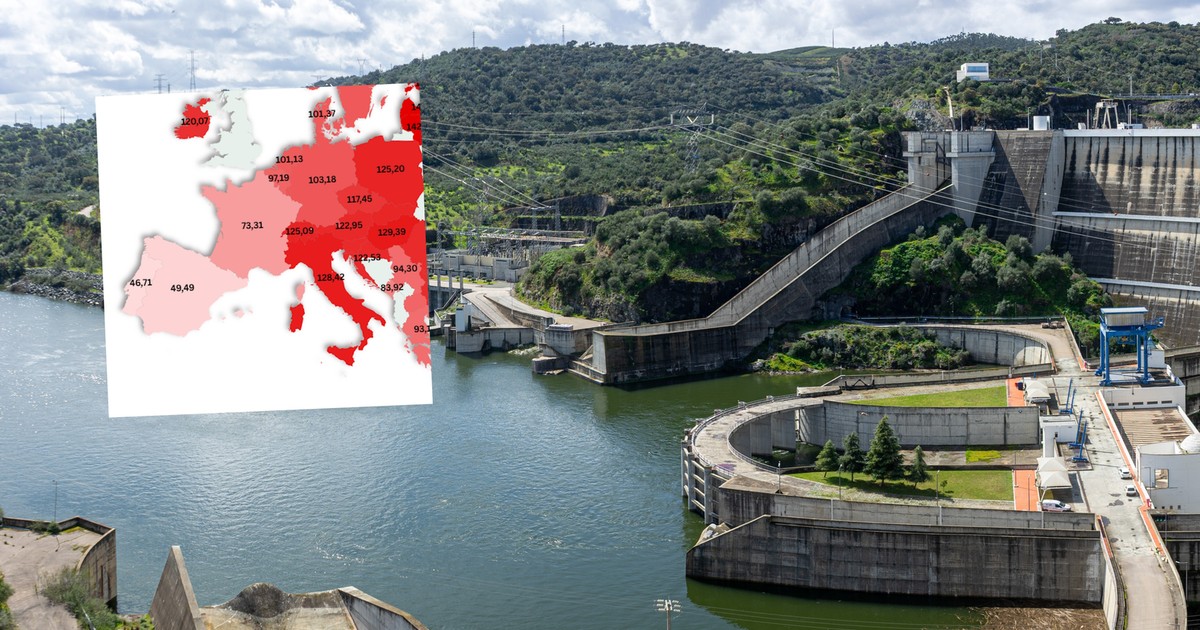
If an entrepreneur wants to sign a contract for the supply of electricity for the entire next year, and most energy in Poland is purchased under annual contracts, he must be ready to pay PLN 436 per MWh. This is over EUR 100, which is one of the highest rates in Europe.
EEX data shows that it is more expensive only in Ireland, Romania, Bulgaria, Croatia, Slovenia, Hungary and Slovakia. But not much more expensive. From an incomplete list of countries Spain has the cheapest price – EUR 56 per MWh. Portugal is not included in this list.
Read also: The real price of renewable energy? Deputy Minister of Energy: Time to discuss costs [TYLKO U NAS]
A large part of the transactions is settled not in annual contracts, but also on the day-ahead market, where the parties agree on the prices at which they will buy electricity for the next day at a specific time. As we calculated on the basis of average hourly prices, this year energy buyers in Poland had to pay an average of EUR 125 per MWh – according to the conversion of ENTSO-E data.
For comparison, the average price in Europe was 109 euros. The absolute leader in low prices is Portugal, where the average price was lower than EUR 47 per MWh.
Moreover, in Portugal electricity prices are lowered, not increased. A reader described his impressions to us.
“I live half and half in Poland and Portugal. On January 8, I received an SMS from the operator EDP, informing me about another reduction in electricity prices, this time by 4%. I remember how they celebrated the closure of the last coal-fired power plant three years ago. And I am always amazed how they do it. […] I receive a bill divided into energy sources and the percentage of renewable energy is given there, but it is still surprising,” said the reader.
Read also: February is bad for windmill owners. Photovoltaics did not help
“What surprised me the most was the position of hydroelectric power plants, because imagine that the Portuguese have much more water reservoirs than Poland and they know how to use them,” we read further.
Polish and Portuguese energy prices
According to the reader's Portuguese bill sent to us, 1 kWh of electricity costs EUR 0.1671. VAT on more than half (55%) of the bill is 6%, and on the rest – 23%. In Portugal, the consumption of the first 200 kWh per month is taxed at 6%, and above that – 23%.
Calculating the bill amount with all additions (mainly the distribution cost) and tax by consumption, the result is EUR 0.25 per kWh (EUR 84.55 for consumption of 332 kWh, taking into account that the service costs include an audiovisual fee of EUR 3.02 per month). Converted into PLN according to the current NBP exchange rate, this gives PLN 1.09 per kWh.
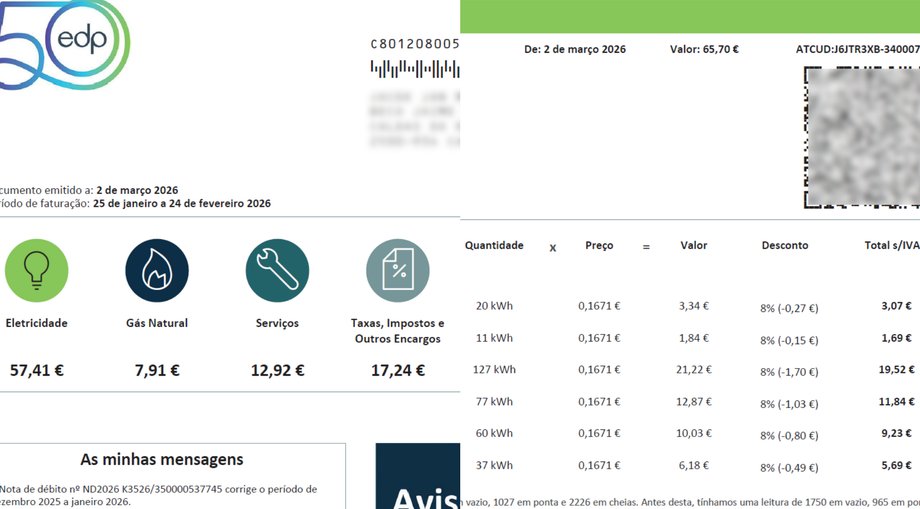
An electricity bill from Portugal sent to us by a reader
|
Business Insider
And in Poland? Without distribution and other extras, electricity costs PLN 61 gross per kWh (excise tax included) in accordance with the G11 tariff from the Energy Regulatory Office. The average annual electricity consumption in a household is 2,000 kWh, according to the Energy Regulatory Office. According to the price of PLN 0.61 per kWh, we would spend PLN 1,220 for energy alone. But there are other amounts added to energy.
We have fixed fees: subscription, network and power, totaling about PLN 33 per month, or PLN 396 per year. There is also a variable distribution fee, calculated per kWh, which is on average about PLN 0.40/kWh (PLN 35-48 depending on the distributor). We get PLN 800 a year from this.
Finally, there is a fee for the construction of renewable energy assets, which is PLN 0.0073 per kWh, and a cogeneration fee, i.e. a fee for investments that will also allow heat to be produced from energy, PLN 0.003. Total PLN 0.0103 per kWh. The total amount added to the bill is PLN 20.60 per year (2000 kWh x PLN 0.0103).
This way we get a total price of PLN 1.22 per kWh. And this by over 12 percent more than in the example from Portugal.
What are the reasons for lower electricity prices?
The above mentioned household bill. But from the point of view of economic development, the key factor is how much companies pay for energy. The cheaper it is, the cheaper it can be bread, frozen foods, all goods that require refrigeration for storage, i.e…. most food. The lower energy costs, the more freely the energy-intensive industry can develop, making it more competitive on the international market. Data centers that consume large amounts of energy will be more likely to be built in such a country. And since energy is much cheaper in Portugal or Spain, companies from the fields of artificial intelligence, heavy industry, building materials and chemicals will be even more interested in investing in this country.
While the difference in the bill for households is, as we calculated, 12 percent, the situation is different for enterprises. Here, with high consumption, fixed prices have a smaller impact on the total cost. What matters more is the cost of the energy itself.
And according to our calculations, this year in Portugal the average price paid for electricity was EUR 46.71 per MWh (on the day-ahead market), and in Spain it was EUR 49.49, while in Poland it was EUR 125.20, in Germany it was EUR 103.18 and in France it was EUR 73.31. As you can see, even France with its developed nuclear energy is unable to achieve better prices than those in Portugal and Spain.
What is the secret of success, since, as the reader writes, all coal-fired power plants have already been closed, and the price is completely unaffected by the sharp increase in gas prices, as can be seen from the data from the last two weeks? The Portuguese and Spanish energy sectors turned out to be insensitive to the war in Iran and problems with gas and oil supplies from the Persian Gulf region. Let's take a look at what electricity is produced from in the countries of the Iberian Peninsula.
How is electricity produced in Portugal?
The most important factor from the point of view of recent price increases in Europe were gas prices. Until February 27, on the eve of the US and Israel's attack on Iran, the prices of Dutch gas contracts on the ICE exchange were approximately EUR 32 per MWh. After the attack, the price immediately climbed above EUR 50, the peak was on March 9 with the price above EUR 60, and now the rate has fallen below EUR 50.
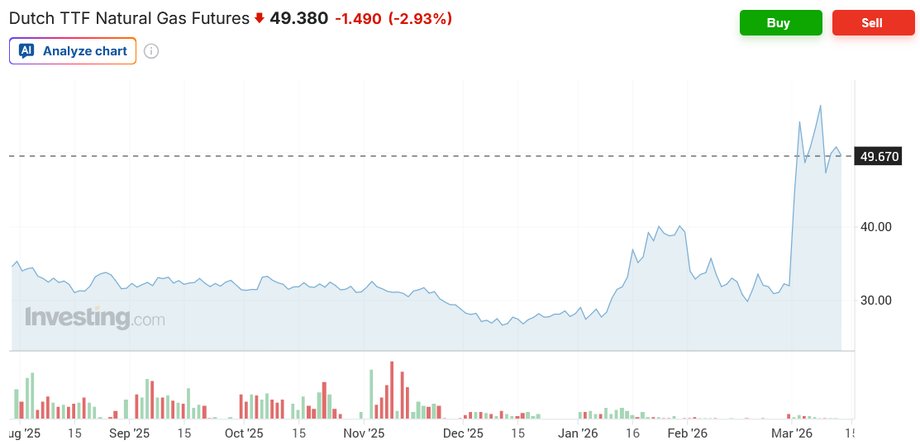
Prices of Dutch contracts for natural gas
|
ICE, investing.com
Which country has energy based on renewable energy sources and stabilized by gas has experienced a sudden increase in electricity prices. Poland suddenly stopped being the most expensive coal in Europe. Gas has become more expensive for the energy industry than coal, even taking into account the ETS tax (CO2 emission rights).
If it had almost no effect on Portugal, what does it produce its electricity from? It's a country focused on renewable energy, because as much as 80 percent energy this year was produced from emission-free sources. But the core of these sources were not windmills and solar panels as in Poland, but hydropower.
Water-powered power plants generated as much as 44 percent. energy in the system this year (until March 13)wind farms 31 percent (only terrestrial), and solar 5%. Hydropower is stable (unless there is a drought), so it is a good stabilizer for windmills and photovoltaics.
As the reader wrote, there are no hard coal-fired power plants in Portugal anymore, but there are gas-fired power plants. This year they gave 15.8 percent. electricity, i.e. a proportion almost identical to that in Poland (15.9%). This share did not significantly affect prices, because gas power plants offered increased power at 19-23 on many days in January and February. This did not have a significant impact on the average daily price, at least not enough to make it as expensive as in other European countries. There were days when gas power plants did not work at all between 8 a.m. and 7 p.m. Back then, prices were determined by hydroelectric power plants, mainly together with windmills.
In addition, 4 percent gives biomass. Portugal does not have nuclear power plants.
The high share of stable hydropower capacity means that the ETS tax applies to Portuguese energy only to a small extent. What's more, there is no capacity market thereso gas power plants must include the time when they are not in operation in their prices, because then it is unprofitable. They reflect this on prices, not on the capacity market, as in Poland. But they operate a few hours a day, so the average price does not increase significantly. Of course, the situation may be different during summer drought and windless weather, when both hydropower and windmills will have problems. Photovoltaics can then compensate for the losses.
Read also: Energy according to Czarnek. The deputy prime minister from the PiS government warns against the risk
Why does Spain have cheap energy?
Spain's energy is only slightly more expensive than Portugal, i.e. if we count the average hourly prices from the beginning of the year to March 13. The proportions of energy sources here are slightly different than in Portugal. Renewable energy sources accounted for 62% this year. Spanish energy mixof which hydropower contributed 20.5%, and windmills – exclusively land-based, as in Portugal – 28.5%.
Solar energy accounted for 12%. production. Apart from hydropower, the stabilizers of unstable renewable energy sources (windmills and photovoltaics) included nuclear energy (20%) and gas energy (17.1%). Potentially more expensive gas energy certainly influenced the average price, but, similarly to Portugal, only for part of the day. The highest energy generated from gas was on January 14, 16 and 19 at 18-23. In recent days, the gas units have been operating again with increased power, producing approx. 18-24 percent. energy in the system. This is the result of a reduction in the power of nuclear energy, which has dropped to an average of approximately 16%. in March.
What is the recipe for cheap energy? Hydropower and onshore windmills. However, for this you need to have appropriate conditions, i.e. high mountains with water flow and, for example, strong wind from the ocean on the shore, which allows you to achieve the effects of offshore windmills at the expense of land-based windmills. Poland does not have such mountains, and the investment in a hydroelectric power plant will take time.
We focus on more expensive marine energy. More expensive, because the investment is higher than in land-based windmills, and it has to be repaid by repaying the loans taken for its construction.
We have actually already achieved the level of gas stabilizer as in the optimal systems of Portugal and Spain. However, we lack a cheap component of stable energy.
We are giving up coal due to ETS costs. Nuclear energy will not be cheap for many years after construction, and much depends on the costs and time of construction. SMRs are a prospect for the second half of the 1930s. We have to wait until 2033 for the next pumped-storage power plant in Poland, Rożnów II from Tauron. What is the alternative? Maybe green hydrogen energy?
Green hydrogen as an alternative?
This can be produced by large-scale offshore windmills in the Polish Baltic Sea. If there is too much energy, it can be used to produce hydrogen. However, gas power plants can be adapted to produce electricity from hydrogen. The question is whether a technology will emerge that will reduce energy losses in production and at the same time improve the profitability of such activities.
At the end of last year, news appeared about the discovery of scientists from South Korea. They have developed a copper-magnesium-iron catalyst that converts CO2 into carbon monoxide at low temperatures with record efficiency.
Existing catalysts, mainly nickel ones, required very high temperatures (over 800 degrees C) and over time lost their efficiency due to particles sticking together. The new catalyst at a temperature of 400 degrees Celsius achieves performance exceeding commercial equivalents. It achieved 1.5 times higher efficiency than standard copper catalysts and 1.7 times faster speed.
Several technologies are being developed in parallel, which also provide opportunities to improve the efficiency of the process: semi-steam electrolysers, electrolyzers with 3D flow electrodes, quasi-gas electrolysers. The issue is that, like SMR, all this is an opportunity, but not yet a reality implemented on an industrial scale. And at this time, the Polish economy must face high electricity prices.
Author: Jacek Frączyk, editor of Business Insider Polska