“Mom is hypnotized.” Orban found a way to outsmart everyone


Taking advantage of voters' frustration with record inflation, economic problems and pervasive corruption, opposition politician Peter Magyar's campaign has transformed his previously small center-right Tisza party into a strong anti-Orban bloc that is now leading in national polls. His promises to build a “modern, European Hungary” appeal especially to young people. The older generation, however, is much less receptive to Magyar's call for change.
And this generational gap – younger voters fear – may prove to be a decisive factor in elections that promise to be the most important since the fall of communism. Hungarian Nyiregyhaza in the north-east of the country, where more than half of the inhabitants are over 50 years old, is the best example of this. — My mother, who will vote for Orban, is hypnotized, says one of POLITICO's interlocutors.
A stronghold of Fidesz for years, the city's residents hesitate to talk to the media and are reluctant to give their names, fearing online harassment, especially older supporters of the ruling party. However, some of Tisha's supporters were willing to share their views and regret that their older relatives remain attached to Orbán – like 27-year-old actor and former Fidesz voter Benji.
He asks that his name not be given for fear of online hate. — I support Tisha and I hope something will change. The country is heading in the wrong direction — both culturally and business-wise, he says in an interview with POLITICO. However, he adds, interrupting the short walk to the theater: – My mother is voting for Orban because of the war. And her friends too.
According to Benji, Orban's campaign, which focuses like a laser on the threats resulting from the country's involvement in the war in neighboring Ukraine, as well as presenting Magyar as a Brussels figurehead works like a charm on older Nyiregyhaza voters. The city is located only 70 km from the border with Ukraine. The argument that the country needs political stability and that only it can lead Hungary through these dangerous times is equally effective.
It is not only in Nyiregyhaza that the generational divide is a problem for Magyar and Tisza. The party is facing similar difficulties in other eastern and southern cities, because for years the traditional strongholds of Fidesz have been losing young people who leave for work and a better life in Budapest or abroad.
This wave of youth migration only strengthened Fidesz's regional dominance over the years. If Tisza wants to remove the long-time leader of Hungary from power, he must conquer at least some of these towns. However, having the advantage of the incumbent prime minister, domination over public media and favorable press from friendly businessmen against him, Tisza will only have a chance of winning if it takes traditional voters away from Fidesz.
The older generation of Nyiregyhaza residents are particularly reserved in conversation, but Katalin, a 70-year-old retired credit advisor, agreed to share her views. Once a loyal Fidesz voter, she now does what she can to convince her peers to vote for Tisha, although she admits that gaining support among her friends in her hometown is very difficult – especially because of the war.
I try to convince everyone I can to vote for the opposition. Unfortunately, there are Fidesz voters in my environment. I can't believe they don't see what this gang is doing
– says.
There are Fidesz billboards in the city, in which half of Magyar's face turns into the European Union flag. Other boards juxtapose his portraits, but also those of the President of the European Commission, Ursula von der Leyen, and the President of Ukraine, Volodymyr Zelensky, suggesting that they are one team.
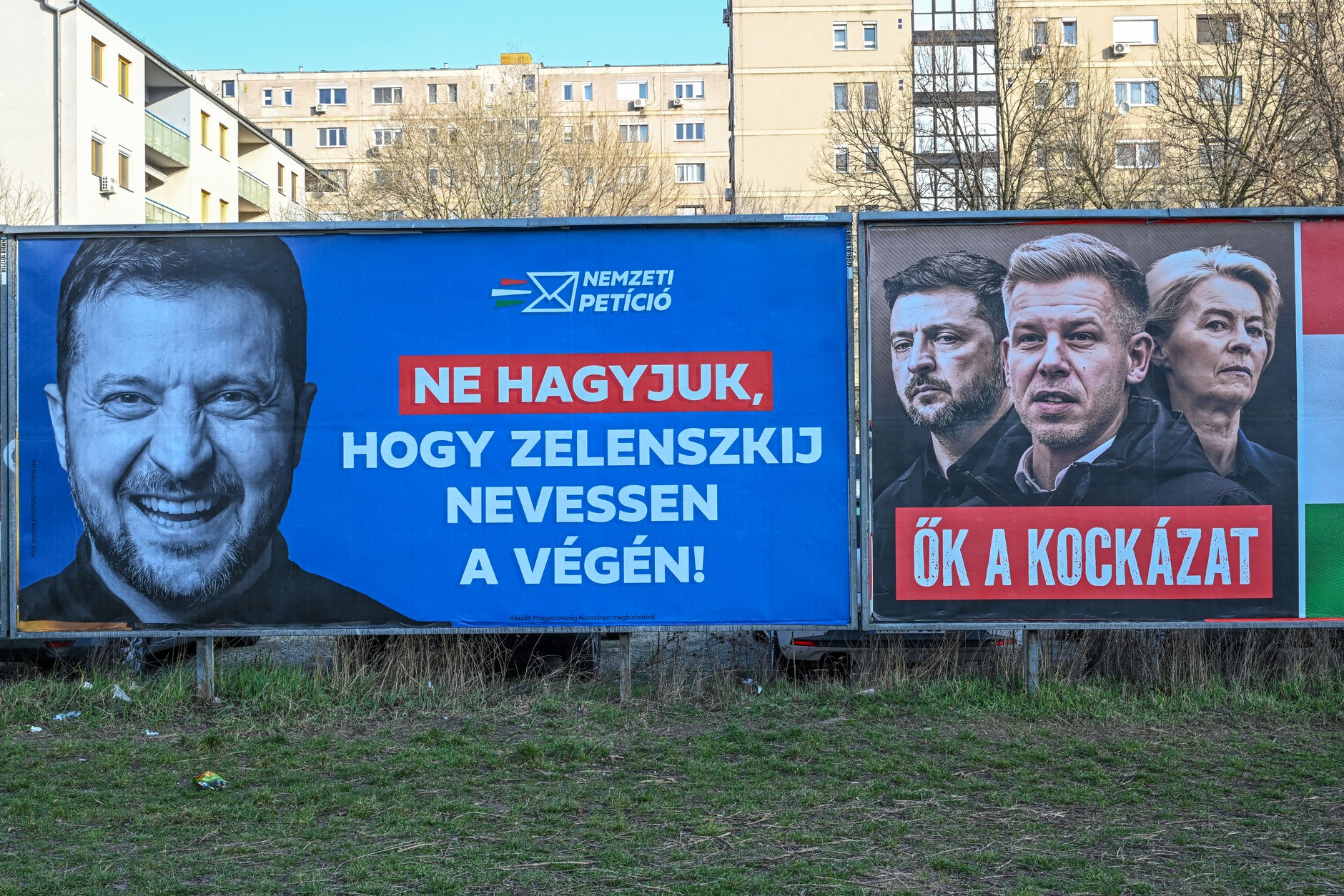
Pro-government billboards appeared in Budapest showing a portrait of Ukrainian President Volodymyr Zelensky (left) with the words: “Let's not let Zelensky have the last word,” as well as another billboard with European Commission President Ursula von der Leyen (right), President Zelensky (center) and Hungarian opposition leader Petr Magyar (left). Additionally, there is an inscription: “They themselves pose a threat”, March 3, 2026.Attila Kisbenedek / AFP
— When I talk to my mother about politics, I feel like she's hypnotized. I try to make her reflect and encourage her to start asking questions so that she can see what is hidden behind the media messages. My mother is 64 years old. But she and her friends will vote for Fidesz again, Benji complains.
Tibor, an IT specialist, faces a similar situation at home. — My grandmother is a big fan of the ruling party. One of my relatives works for Fidesz, so of course they will vote for Orbán, he explains. — I have no idea why anyone wants to vote for Fidesz at all. I have the impression that they are simply old and glued to the TV with government propaganda. They look very one-sided.
Tisza confident. Fidesz will not repeat the success of 2022.
– We have won such a victory that it can be seen from the Moon, and certainly from Brussels – Orban triumphed then. In the Szabolcs-Szatmár-Bereg region, the capital of which is Nyiregyhaza, Fidesz outclassed the opposition, winning 61 percent. votes – 7 pp (percentage points) more than in the entire country.
However, Tisza is convinced that this time it will be different, among other things because she exhibits here local star Laszlo Gajdos as the leading candidate. Hungarians vote twice – once for a party list and a second time for a specific candidate in a single-member constituency. Of the 199 seats in the National Assembly, 106 are filled by district winners, and the remaining 93 are distributed proportionally according to party lists. Gajdos, the extremely popular director of the Nyiregyhaza Zoo, competes in both categories.
Even commentators sympathetic to Fidesz, such as Mraz Agoston Samuel, director of the Nezopont Institute research center, predict that Tisza will win more seats from the national list.
— Opposition voters are very concentrated in cities, especially in Budapest. We estimate that Fidesz will win about 40 seats from the party list, says POLITICO. But the real fight will take place in single-member districts and there, in his opinion, Fidesz will win the majority again.
Tisza disagrees. Peter Lajos Szakacs, one of the party's candidates in Nyiregyhaza, tells POLITICO that he is confident of victory. — We will win in Nyiregyhaza with a crushing advantage. I am running in the second district, and Gajdos in the first. He will achieve a historic result. As for me, I'm tied with my rival for now. But we're working hard to retire him so he can finally spend time with his grandchildren, he says confidently.
But Magyar's local supporters interviewed by POLITICO are not so sure that the electoral fight in Nyiregyhaza is decided. “I wouldn't dare predict anything,” Benji comments cautiously. However, most of them believe that the election results will be very even. This in itself suggests that Fidesz is unlikely to repeat its 2022 success.
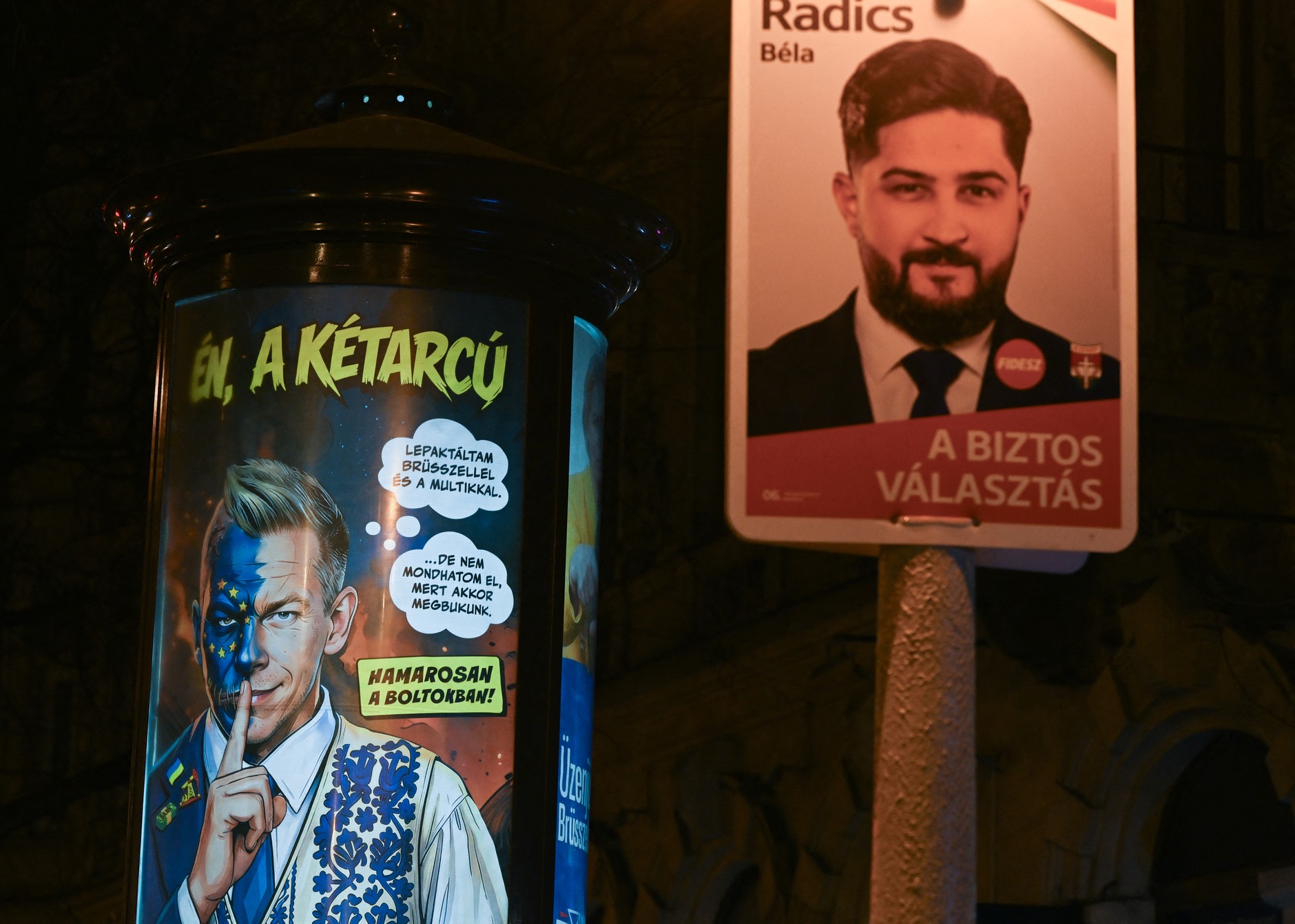
There are Fidesz billboards all over the city, in which Magyar is portrayed like Janus – half of his face turns into the European Union flagArtur Widak / NurPhoto / NurPhoto via AFP / AFP
Ultimately, apart from Budapest, everything will depend on whether Fidesz will again mobilize its voters and ensure a high turnout. In the past, the party coped with this very well, but in a recording from October, showing party activists during “warrior training”, Orban directly complained about the terrible state of the party's databases.
However, according to the 76-year-old store owner Julia, all predictions may turn out to be wrong. Unlike most of her peers, Julia believes that Hungary desperately needs change. — I don't want to say who I will vote for. My most important condition is that my children and grandchildren can stay here. So that they can live here with dignity, and I don't think that's possible without change. Then life will be easier, he wonders aloud.
Meanwhile, with political tensions increasing, her business is feeling the impact. Pointing to an empty street in the center of Nyiregyhaza, he says “everything is so quiet.” —We really feel it. People save money. They are afraid of what the future will bring.