After the triumph at the 2018 Salzburg Festival in the opera by Richard Strauss, the Lithuanian soprano Asmik Grigorian arrived after eight years at the Bayerische Staatsoper, to present to the public her creation in the title role in four evenings between February and March, also in an old show, dated 2019 but signed by the director Krzysztof Warlikowski. A co-production with the Théâtre des Champs Elysées in Paris. The production team included Malgorzata Szczęśniak (set and costumes), Felice Ross (lights), Kamil Polak (video), Claude Bardouil (choreography).
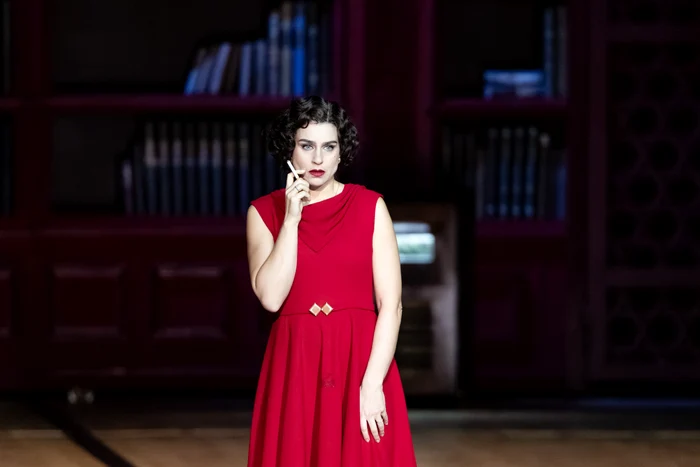
Asmik Grigorian. Photo © Geoffroy Schied
Of course, as happens everywhere these days, we witnessed a modern mise-en-scène, brought from the biblical years to those of the Nazi occupation of Eastern Europe (Poland, perhaps, if we think about the nationality of the director), with the horrors of the Holocaust that the Jews shun, hidden in a huge library that occupies three sides of the stage, the background included, reminding through the thousands of neatly ordered volumes, the millennia of civilization Jewish. In the center, the free plate. Basically, the unfolding of the Straussian musical drama conceived in 1905 on the libretto of the poet Hedwig Lachmann annotated by the composer with Oscar Wilde's play as its source can be imagined as a “theatre within a theater” in that true bunker of culture. The only set change occurs during Salome's famous dance, the “dance of the seven veils”, when the background of the stage becomes a huge projection of stained glass windows symbolically containing ancient architectural elements or silhouettes of mythical animals. Successful polychromy of the light and video design signatories! The costumes are obviously appropriate to the era of translation of the action, simple, elegant.
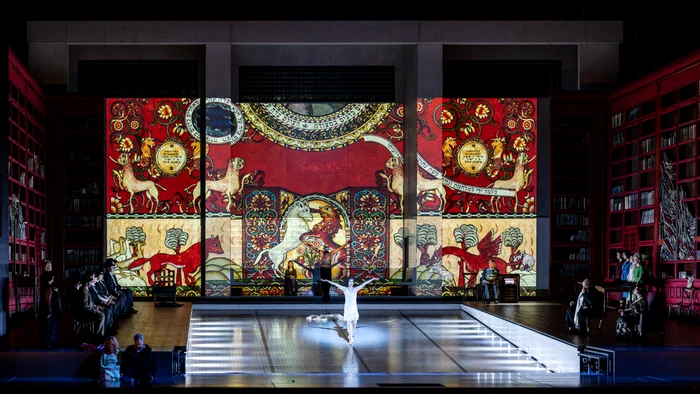
Asmik Grigorian in Dance of the Seven Veils. Photo © Geoffroy Schied
I have often commented on the tendency of the directors of the day to allow themselves to be attracted by the theatrical illustration of the overtures, to the detriment of the free perception of the meanings of the music. Well, there being no overture here, Warlikowski didn't give up and imagined himself a pantomime skit Prologue, inspired by Joseph Losey's film Monsieur Klein (1976) themed during the Nazi occupation of Paris and to music by Gustav Mahler taken from “Kindertotenlieder” (“Songs of the Dead Children”), heard over the loudspeakers. The sad lied no. 1 “Nun will die Sonn' so hell aufgehn” (“Now the sun wants to rise so strongly”) in the historic performance of the mezzo-soprano Kathleen Ferrier, accompanied by the Vienna Philharmonic, conductor Bruno Walter. The inclusion did not last long, a few minutes and the unique act of the opera began as composed by Richard Strauss, like the calm before the storm, announcing through the calmness of the initial atmosphere (“Wie schőn ist die Prinzessin Salome heute Nacht!” – “How beautiful is Princess Salome this night!”, says Narraboth ecstatically) and the strangeness of the moonlight described by the Page of Herodias, the tragic of the action that would follow.
The merits of the director were found in guiding the stage play of the performers, a rather easy task having at hand talented and experienced singer-actors such as Asmik Grigorian (Salomea), Wolfgang Koch (Jochanaan), Gerhard Siegel (Herod), Claudia Mahnke (Herodiade), Joachim Bâckstrőm (Narraboth), Avery Amereau (Herodiade's Page). Until the end, however, Warlikowski continued to shock, sometimes unclearly.
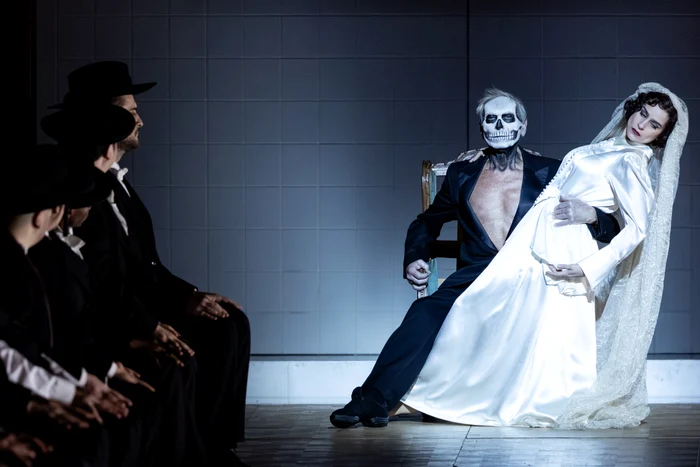
Peter Jolesch and Asmik Grigorian. Photo © Geoffroy Schied
Salome's Dance with Death
For the titular role, a dramatic soprano with enough lyrical exposition capabilities is needed, especially in the first part of the opera. Asmik Grigorian is one of the singers who can masterfully carry out the terrifying heroine's score. Straussian declamatory conversation is at his fingertips. Of course, the voice has no resemblance to that of the legendary Birgit Nilsson, whom we remember as ample, full-bodied, but the sharp penetration of the Lithuanian soprano's voice on the entire register, the equality of the emission, brings valid alternatives. Yes, Asmik Grigorian it is
Mentally possessed but also suave Salomea with addresses in pianissimo. The voice shines, sustains impetuous high textures with ease, acute attacks work, the middle register holds the same virtues and the low takes on disturbing dramatic resonances. The soprano masters the role with a suitable vocal.
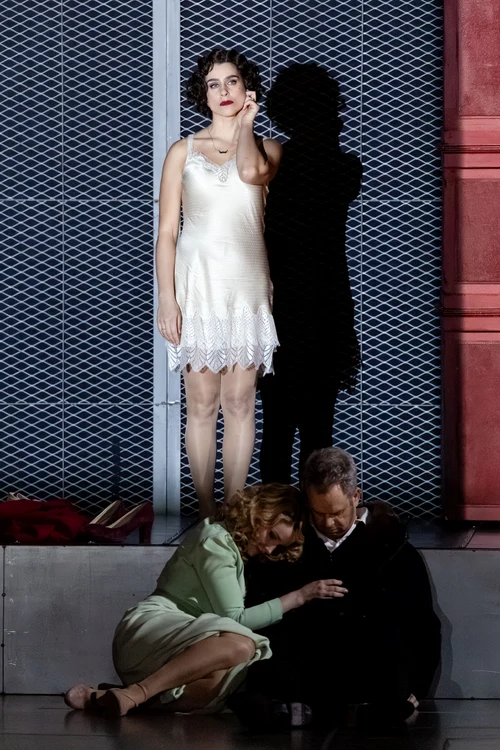
Asmik Grigorian, Avery Amereau, Joachim Backstrőm. Photo © Geoffroy Schied
But also the character, through attitudes and experience. First she appears as a perverted teenager in the scenes with Narraboth, then her sensuality and uncontrollable carnal desire subjugates her, fascinated by Jochanaan and his words, her steadfast stubbornness remains her obsessive trait that brings her to the brink of dementia in her relationships with Jochanaan and Herod. He plays fantastically, he expresses himself fantastically. With the support of the conductor, the 33-year-old Thomas Guggeis, utters the triple repeated requests addressed to Narraboth and Jochanaan or responds to Herod's similar ones (in two lines) with different voice colors to inhuman sonorities, creating special emotional states. A parenthesis. And Herod impresses in the same sequences, in the same manner. I also associated the conductor in these interpretation secrets, as I am convinced that he had an important role.
Asmik Grigorian, with a perfect figure slim-lineundulates wildly lasciviously in the dance commissioned by Herod, for which Warlikowski paired a dancer (Peter Jolesch) wearing the symbolic mask of Death. It is Salome's erotic dance with Death, who succumbs at the end. Death of Death.
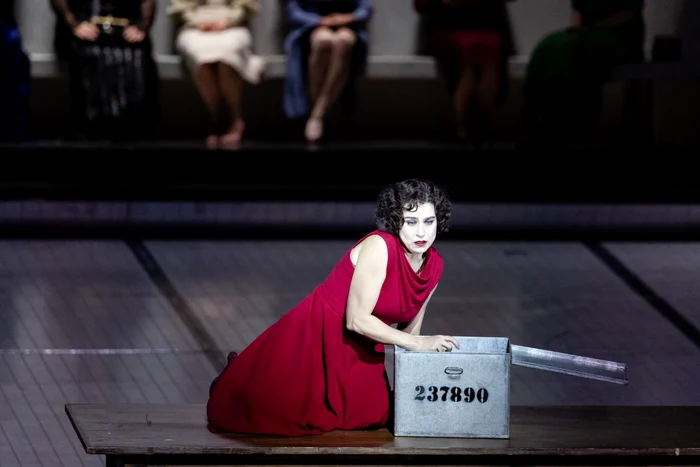
Asmik Grigorian. Photo © Geoffroy Schied
The last scene. Jochanaan's head is hidden in a numbered box (237890), alluding to the camp's sinister markings. Asmik gives her the much-desired kiss and dies with the box in her arms without being killed by the soldiers at Herod's command, as the libretto requires. The alternation of fulminant and soft sounds is the expression of the heroine's sensory contradictions, rendered to perfection. In fact, the director brings an ending far from the original. Narraboth and Jochanaan, already dead, reappear on the scene, the vast majority of the assistance succumbing…
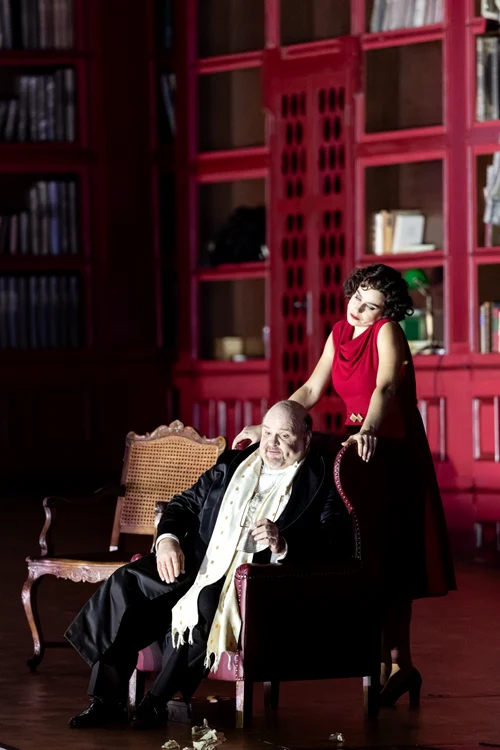
Gerhard Siegel and Asmik Grigorian. Photo © Geoffroy Schied
The partners of Salomea-Asmik
Heldentenor dedicated, Gerhard Siegel built with an authoritative voice a sarcastic Herod, dramatic in his lines, desperate in his addresses to Salomea, exasperated in the end, “Man tőtet dieses Weib!” (“Kill this woman!”).
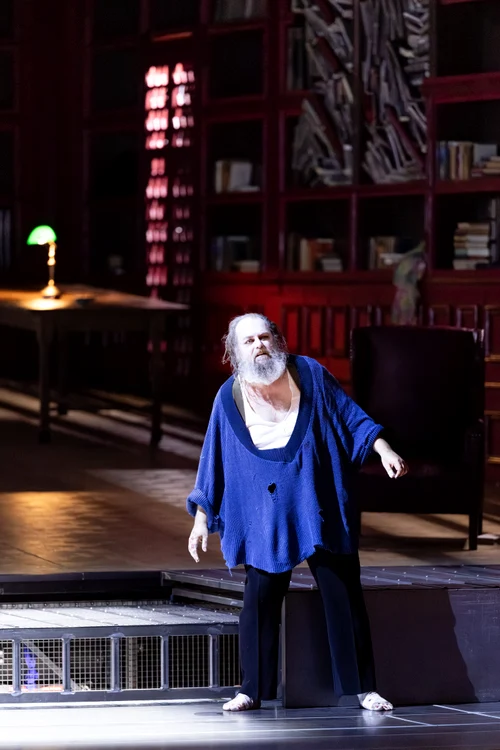
Wolfgang Koch. Photo © Geoffroy Schied
For the important character Jochanaan, baritone Wolfgang Koch exhibited a dark, deep timbre, a trembling voice with overwhelming prophetic utterances and dire imprecation to Salomea, “Du bist verflucht!” (“You're cursed!”) at her attempt to cling to him. Creator with old service states in the role, Koch is now no longer in the youth of his career and a nuisance wobbling (euphemistically speaking, emphasized vibrato) of the voice is felt. Some grave sounds (“Niemals!”, “Never!”) seem voiceless. But, paradoxically, the listener is left with the overwhelming impression of fulfilling the role.
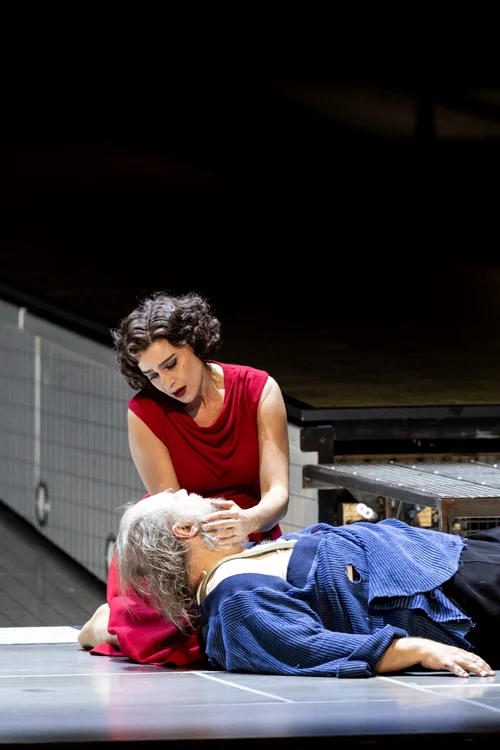
Asmik Grigorian and Wolfgang Koch. Photo © Geoffroy Schied
Dramatic and with Spark
in the high tirades was the mezzo-soprano Claudia Mahnke (Irodiada), although the voice did not have a great concentration of sound, being somewhat vibrant in the middle register.
The tenor Joachim Bâckstrőm (Narraboth) showed a high register approached with a spin which can recommend him for larger roles in the German repertoire, while the mezzo-soprano Avery Amereau brought a voice of pleasant color to Herodiadei's Page.
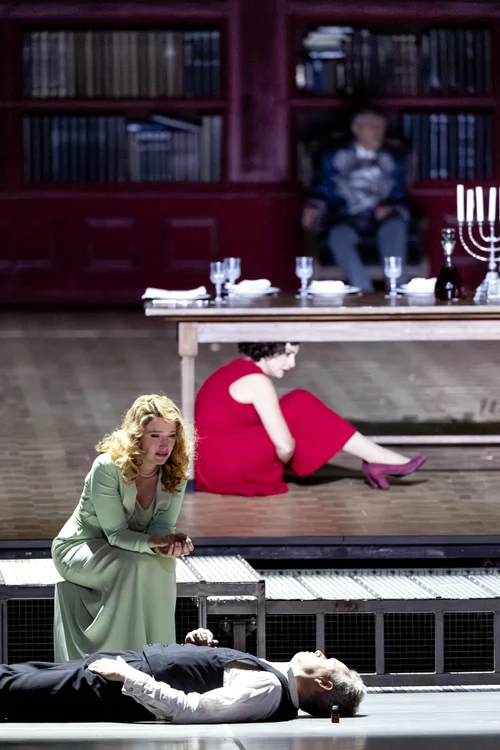
Avery Amereau, Joachim Backstrőm and Asmik Grigorian. Photo © Geoffroy Schied
In other roles, Ya-Chung Huang (First Jew), Tansel Akzeybek (Second Jew), Frederick Ballentine (Third Jew), Jinxu Xiahou (Fourth Jew), Roman Chabaranok (Fifth Jew), Wilhelm Schwinghammer (First Nazarene), Lucas van Lierop (Second Nazarene), Pawel Horodyski (First Soldier), Bálint Szabó (Second Soldier), Armand Rabot (A Cappadocian), Iana Aivazian (A Slave Girl).
I brought up the conductor Thomas Guggeis. Although he had chosen instrumentalists in exceptional form, the Bavarian State Orchestra from Műnchen, which possesses Straussian drama in its DNA, demonstrated its personality by giving the score violent impulses consistent with the dramaturgical moods, skillfully highlighting the leitmotifs of the main characters. The ensemble sounded both sumptuous and refined, in certain passages it even covered Jochanaan with sound, it gave captivating cursiveness to the melodic drawing, “Dance of the Seven Veils” accentuated the orientalism and sensuality of the music. The baguette sculpted energetically and achieved a reading of great plasticity, consistent with the tension of the opus and the symphonically scholarly orchestration.
The Bavarian State Opera Ballet and the body of extras, including children, gave their competition.