The war and blockade of the Strait of Hormuz hits Azoty. Fertilizer prices are soaring [ANALIZA]

An unexpected blow in the form of the war in Iran and the prolonged blockade of the Strait of Hormuz may ruin the plans of the Azoty Group, which has recently been struggling with the crisis. However, in response to Business Insider's questions, the company's new president, Marcin Celejewski, argues that the company sees light at the end of the tunnel.
Grupa Azoty has not yet managed to cope with the old problems that have been dragging it down so far, and an external threat is already appearing on the horizon, which will may be a strong blow to the state giant, which is struggling with serious financial problems.
The rest of the article below the video:
The blockade of the Strait of Hormuz affects Azoty
The war in Iran and the blockade of the Strait of Hormuz shocked not only the energy raw materials market, but the entire chemical industry. The conflict has driven up the prices of oil and gas, which is the main fuel for the entire sector and at the same time strongly shook the fertilizer market.
Read also: The Middle East is on fire and commodity prices are skyrocketing. Will food also become more expensive?
— The Strait of Hormuz is a key source of fertilizers responsible for up to 10-30 percent. global demand, depending on type – estimates Jakub Szkopek, analyst at Erste Securities.
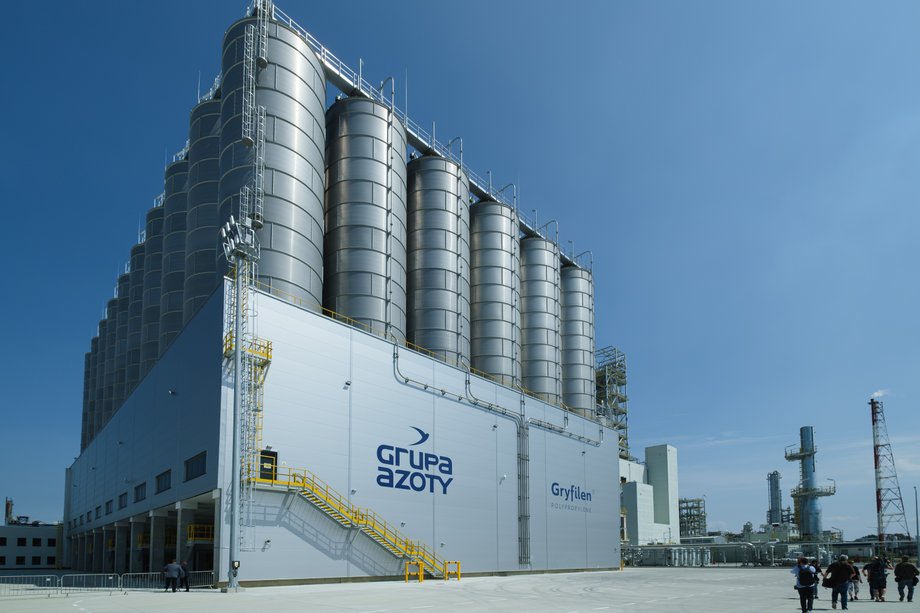
The Polimery Police project still weighs on Grupa Azoty
|
Dariusz Gorajski / Forum / Forum Polish Photographers Agency
Its blockade has already triggered a chain reaction leading to a global increase in fertilizer prices. — Türkiye has already banned the export of urea. We assume that China, as a leading global exporter, will make a similar decision in the coming days. It has already suspended the export of fuel and refinery products, so this would be a natural next step, the analyst adds.
This is reflected in prices. Just a few weeks ago, urea cost PLN 2.5 thousand. PLN per tonne. Now it's about 3 thousand. zloty. – We do not live in a vacuum, companies around the world must respond to this – he points out.
This will not bypass Grupa Azoty. — Grupa Azoty announced a price increase of several percent, but in times of such great turmoil this may not be enough. The war in Iran reduces profitability at a time of general financial problems for the company and may make it much more difficult for it to recover, notes the analyst.
A partnership between the market and farmers. And government pressure
On the other hand, it is no secret that Azoty is under political pressure not to increase fertilizer prices. The company's temporary suspension of accepting new orders right after the outbreak of the war in Iran triggered a strong reaction from the Ministry of Agriculture.
“The Minister of Agriculture and Rural Development, Stefan Krajewski, asked the Minister of State Assets, Wojciech Balczun, for clarification on this matter and taking action to restore the current market supply of fertilizers, while not increasing their prices. At the same time, the Ministry of Agriculture and Rural Development, expressing its concerns, presented comprehensive arguments and hope that the situation will be resolved by Grupa Azoty SA very urgently and to the benefit of farmers,” said the ministry's announcement last week, hinting that price jumps would be the subject of a major battle within the government.
Jakub Szkopek admits that it is objectively an extremely difficult moment to increase fertilizer prices — spring is beginning, and farmers must now take into account the skyrocketing fuel costs in their cost estimates.
— Farmers who are just going to the fields because the fertilizer application season is starting must face more expensive fuel. And these costs will also reduce their ability to purchase fertilizers – says Szkopek.
Azoty will therefore have to maintain demand. — In Q1, we won't see an impact on margins yet, because the company has been working at full capacity since the end of the year and still has stocks. But then problems may begin, predicts Jakub Szkopek.
The Ministry of State Assets emphasizes in its response to Business Insider that it is in constant contact with Grupa Azoty and monitors the situation in the company and on the fertilizer market. “The information obtained from the group shows that there is no threat to the supply of the domestic market,” the ministry emphasizes and assures that the current geopolitical situation does not threaten national energy security.
Prolonged transaction
Even without the war in Iran, Azoty has a lot of problems to solve. The company is getting closer to selling Polimery Police to Orlen. The company from Płock has just presented an updated offer to purchase the installation, which – according to the company's authorities – Azoty cannot afford to maintain and run at full capacity.
Read also: The PLN 7 billion state project is not working and is becoming cheaper dramatically. It was poorly executed
Orlen is to pay PLN 1.14 billion. — Finalizing the transaction with Orlen will straighten out the situation to some extent, but it will not in itself solve all the problems. Azoty spent over PLN 7 billion on the project, and the Group is currently writing off its loans granted to the daughter company for the implementation of the project. The remaining creditors will have to do the same because they will not get their money back. This is an extremely difficult situation – says Jakub Szkopek.
Moreover, the whole process takes noticeably longer. A letter of intent in this matter was signed already in September last year, and then the deadlines for the non-binding offer were extended. According to the current plan, the transaction is expected to be finalized by the end of June.
There is also another risk hanging over the company. He fears that The European Commission in the light of the tense situation on the fertilizer marketwill soon decide to loosen customs duties on fertilizers from Russia and Belarus – and this would mean abandoning the regulations to which Poland had difficulty convincing the EC last year.
In response to the difficult financial situation, the company will be recapitalized by the state treasury. — Recapitalizing the company is a necessary decision. It is worth noting that PLN 600 million is the amount that means that the state treasury will not exceed 50 percent. and will not be obliged to carry out a tender offer. In the future, financial institutions and the government would increase their exposure, comments Jakub Szkopek.
Nitrogen calms down
Azoty emphasizes that they have resumed accepting orders and revised their price lists up by several percent. The president was asked by Business Insider Grupa Azoty Marcin Celejewski assures that the market situation remains tense, but the company sees a chance for stabilization.
— Recent weeks have brought high volatility on the natural gas and nitrogen fertilizer markets, largely in response to geopolitical tensions in the Middle East. However, it must be remembered that energy commodity markets often react to such events very impulsively. Historically, periods of rapid price increases are usually followed by a correction and gradual stabilization, says the president of Grupa Azoty.
And he assures that the company will not change the company's long-term approach to business development. — From our perspective, the current turmoil does not constitute a reason to change the strategic development directions of the Azoty Group. At the same time, as one of the largest fertilizer producers in Europe and a company of significant importance for Polish agriculture, we cannot operate in isolation from market realities. That is why we make decisions that, on the one hand, take into account production costs and, on the other hand, contribute to maintaining the stability of the domestic fertilizer market – emphasizes Marcin Celejewski.
All chemistry in Europe has problems
In Business Insider, we described the crisis situation in the chemical industry across the continent. According to its representatives, expensive gas and EU climate regulations cause a loss of competitiveness and a decline in production and employment.
Jakub Szkopek emphasizes that for the stable development of Azoty, a change in the EU policy paradigm would be necessary. — In the long term, the issue of conditions for the development of chemistry in Europe will be crucial. The vast majority of installations shut down across Europe after the crisis in 2022 have not yet returned to use. Now we see another shock. Today, there is no reason to believe that Polish plants will stop or significantly reduce production. Nevertheless, without a fundamental change in the conditions for doing business in Europe, the chemical sector will be under increasing internal pressure and external competition, says an Erste Securities analyst.
He believes that such a change is not impossible. — Chancellor Friedrich Merz makes it clear that he is ready to subsidize CO2 costs in the European chemical industry to regain competitiveness, the analyst sums up.
Grzegorz Kowalczyk, journalist of Business Insider Polska