“Since the 1970s, this has been considered an apocalyptic scenario.” Iran used the big guns


Reports that G7 countries may put some of their oil reserves on the market have lowered prices somewhat. However, the consequences of the war with Iran go far beyond the energy sector, affecting the entire global economy.
In the case of crude oil, the effects are immediate – Germany saw a huge increase in heating oil prices on Monday. According to the Heizoel24 website, 100 liters currently cost over EUR 150 (PLN 638). Petrol and diesel prices may also rise further.
“Apocalyptic Scenario”
— Closing the Strait of Hormuz has been an apocalyptic scenario since the 1970s — says Tatiana Mitrova from the Center for Global Energy Policy at Columbia University. Currently, the world is less dependent on oil and gas from the Middle East, but still 20 percent. oil supplies and as much as 25 percent liquefied natural gas (LNG) shipments pass through the Strait of Hormuz.
Today, virtually no ships pass through it. In the past, there were about 130 trips a day, now only a dozen or so ships pass through, says Alexander Geisler, managing director of the Central Association of German Maritime Brokers. Charter rates for tankers have increased to PLN 400,000-700,000. hole. (PLN 1.5-2.6 million) per day. “However, it is important to remember that these rates are theoretical because the ships do not actually sail,” he adds.
Some of the region's oil may still be exported via pipelines from Saudi Arabia to Egypt and from there through the Mediterranean Sea. However, the export of gas and most oil by ship has been suspended.
Germany is feeling the effects of the crisis due to price increases, but it is not suffering from an oil shortage. According to the Federal Statistical Office, last year Germany imported 6 percent. crude oil from Iraq, the United Arab Emirates, Saudi Arabia and Israel. In the European Union, the share of imports from this region was 13%. The most important suppliers were Saudi Arabia and Iraq.
More serious problems on the gas market
The fact that the price of oil initially increased relatively little last week was due to the current market situation. As Mitrowa said during a webinar organized by the Federal Association of German Industry and the World Energy Council, there was an excess supply of 3.5 million barrels of oil per day on the global market. Initially, this inhibited price increases. Now G7 finance ministers could further ease the situation by releasing oil reserves. They are considering introducing to the market from 300,000. up to 400 thousand barrels per day, which is approximately 25 percent. reserves. “The mere announcement of this discussion has already caused a drop in the price of oil,” she said.
From the point of view of Mannat Jaspal from the Observer Research Foundation in Dubai, the bigger problem concerns gas. There are no other pipeline routes, like for oil, for gas from Qatar. “The gas market is less flexible than the oil market,” says Jaspal. The United States and Australia also have almost no spare LNG production capacity to offset losses. Therefore, prices on the world market are rising, and rich regions – Europe, Japan, China – are purchasing increasingly scarce resources.
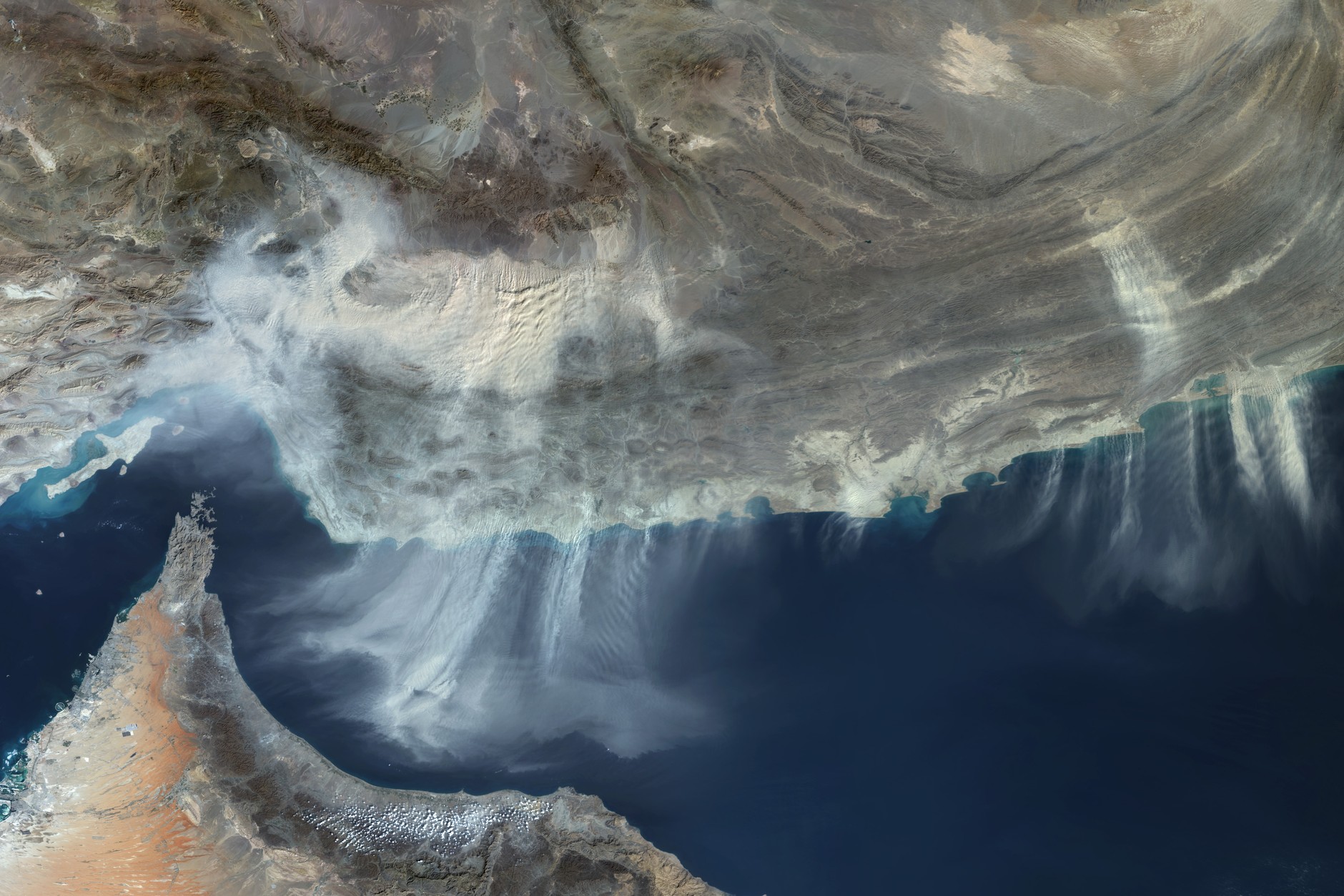
Satellite view over eastern Iran and southern Pakistan, over the Gulf of Oman, November 4, 2025.Gallo Images/Contributor/Getty Images
In Europe, the wholesale price of gas has doubled since the outbreak of the war – and this applies to future supplies. — Markets are preparing for a longer crisis, says Gregor Pett, chief analyst at gas trading company Uniper. However, demand is currently low due to mild weather and weak industrial production. The level of gas reserves in Germany, around 20%, is not bad for this time of year.
In addition to higher fuel costs, the war also affects other sectors of the economy. For example, a large part of the production of urea, which is the basic raw material for the production of fertilizers, comes from the Persian Gulf. The current lockdown will therefore also impact agriculture, especially in India and Australia, says Jaspal.
Finally, European customers will have to wait longer for orders from Asia. This is due to the costs of not only sea transport, but also air transport. Its volume between Asia and Europe fell by 22%. – says Frank Ewald, head of the strategic risk analysis department at the logistics giant DHL. This is because the huge airports in Dubai, Doha and Bahrain, which usually handle huge volumes of air freight, have now largely suspended operations. “Our cargo planes can no longer use these hubs,” says Ewald.