The machines are starting to take over the war. Russian soldiers surrendered to a Ukrainian robot – not knowing they were fighting a machine


Russian soldiers surrendered after hearing gunfire, not realizing they were being attacked by a robot.
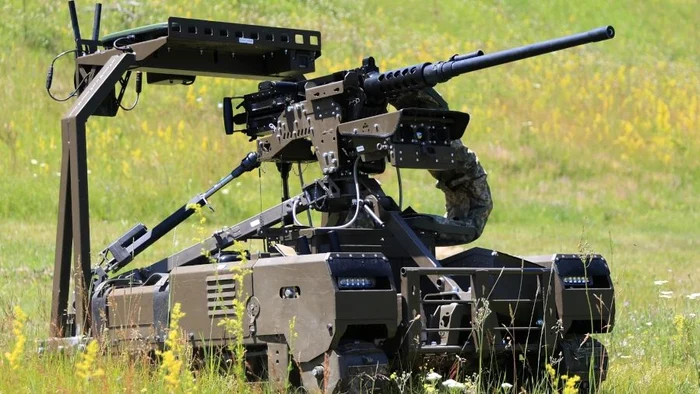
Ukrainian fighting robot/PHOTO:X
According to the Ukrainian military, Russian fighters heard machine gun fire nearby and decided to surrender. Only later was it discovered that the fire came from an armed ground robotic complex. The information was presented by the head of the combat training group of the 131st Independent Reconnaissance Battalion, known as Mengel.
Heavy versions of these ground systems can carry up to 500 kilograms of equipment and travel tens of kilometers over difficult terrain. Their functionality is constantly expanding: the platforms are used for logistics operations, the evacuation of drones or their delivery, without endangering the lives of the military.
The incident took place in the direction of Guliaipole. This is not the first case in which Ukrainian soldiers capture Russian soldiers with the support of ground-based robotic systems.
Reconnaissance Tactics: Combined Patrols with Robotic Support
“It didn't matter who was firing that machine gun at them. It was enough for them to make the right decision.”Mengel explained.
The Ukrainian military has used ground robotic complexes in clearing operations, both as independent combat units and as part of tactical groups.
“Behind this robotic complex were our soldiers who took these fighters under fire control and brought them into captivity”said a Ukrainian military.
The capture of enemy soldiers is considered important to Ukraine because it helps to increase the “swap fund” needed for the release of Ukrainian prisoners of war.
“We have teams operating on foot. They conduct reconnaissance and search missions in the localities where the enemy has managed to penetrate and establish positionsMengel added.
Ground robots are changing combat operations
During these reconnaissance or mopping-up missions, enemy positions are exposed and contact with fire becomes almost inevitable.
In such situations, fighting breaks out, and the opponent is either temporarily neutralized or realizes the situation and surrenders. The Ukrainian military says accepting the surrender is also important to maintain the possibility of prisoner exchanges.
Ukraine is developing new robotic systems
A robot can evacuate the wounded from the battlefield, while the operator controls it remotely from a command post.
Ukraine's Defense Ministry says that while many states are just beginning to adapt to the use of interceptor drones developed by Kiev, Ukraine has already switched to using operators for a new generation of ground-based robotic systems. These specialists manage logistics, evacuate casualties and control combat drones without being in direct danger.
Heavy-duty versions of the platforms can carry up to 500 kilograms of cargo and travel tens of kilometers over rough terrain. They are used for logistical transport, drone recovery and battlefield deliveries.
The Ministry of Defense emphasizes that modern warfare imposes an increasingly clear rule: “machines fight, not people“.
High-tech control stations
The ground drone operator's station resembles a small technological command center. Equipment includes tracked or wheeled drones, control consoles, ground stations, and rugged laptops or tablets equipped with navigation systems.
Operators monitor and control systems in real time, using batteries, charging stations, portable power units, and communications systems—radios, antennas, and relay devices. Crews are also equipped with electronic warfare systems, repair kits and tactical gear.
Advanced observation equipment
Each ground platform is equipped with day and night cameras, communication systems and data transmission channels, which allows efficient operation in almost any conditions.
According to the ministry, operator training begins with basic military training, followed by an intensive professional stage, which includes:
-advanced tactical medicine;
– operation of hardware-software systems, navigation and radio communications;
– intensive control exercises of different types of drones;
-additional training in camouflage and the use of power and communications equipment.
The control console, the central element of the system
The main interface for operating the platform is the control console, which manages the drone's movement, communication channels and data transfer.
Key features include:
-ergonomics and ease of use;
-autonomous power supply for long-term operations;
-stable communications with minimal latency;
-protection against enemy interference for safe operation near the front line.