The diabolical plan with which Iran can ruin the world with all the opposition of the US. NATO General: “All they need are some boats and me”


General (r) Virgil Bălăceanu explains why no force is able to fully guarantee the security of ships in the Strait of Hormuz, despite the superiority of the Americans. Because of this, traffic will continue to be disrupted and fuel and gas prices would continue to rise.
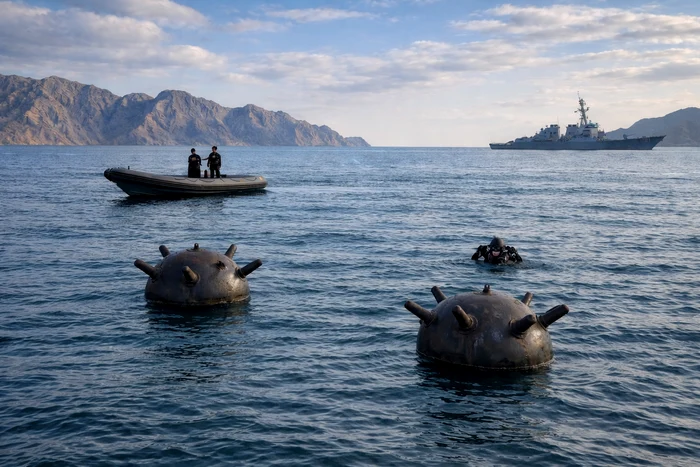
The Iranians can mine the Strait of Hormuz and block it for months. PHOTO: AI
The war in Iran causes problems that are felt at the global level, and those of an economic nature are the most pressing. Oil and gas prices have exploded, especially in Europe, since last week, even before the Iranians blocked the Strait of Hormuz. The rising trend was maintained on international markets, even though experts urged caution and blamed the emotional reaction. The situation is also complicated in Romania, where the price of fuel at the pumps increased immediately after the start of the war, and there are no savior solutions in sight.
The situation is even more complicated as marine insurance companies have increased the price of insurance, and the traffic of oil tankers and vessels carrying liquefied gas has reduced since the first days by more than 70%. And as if that wasn't enough, after insurance companies raised premiums for ships transiting the area, insurers soon announced that war risk coverage had been canceled in Iranian and adjacent waters as of March 5, according to The Guardian.
Americans can't do miracles either
In the face of jittery markets, US President Donald Trump has offered assurances and guarantees for ships transiting the Strait of Hormuz, but it does not seem to be enough.
As liquefied gas and oil tankers are forced to detour thousands of kilometers or simply give up for fear of Iranian retaliation, prices threaten to rise to dangerous levels for the global economy. Concretely, with the explosion of energy prices there is a domino effect that leads to increased inflation at the global level and compromises the very idea of economic growth.
The last hope is that either the war will end soon, or the Americans will follow through on their promise and manage to secure transportation to the Strait of Hormuz area.
Reserve General Virgil Bălăceanu represented Romania at the NATO Command in Brussels and was head of the Multinational Brigade in South-East Europe. In his opinion, the situation is more than complicated, and the assurances given by the US Navy cannot completely solve the problem.
“We are witnessing a destabilization of the area, and the fears are that it will be a long-term or even very long-term state of instability. The problem that affects the energy system — the export of oil and gas — is the closing, the blocking of the Strait of Hormuz. As long as the Iranians continue to control it, threatening the Strait of Hormuz with various means, things can get complicated“, says the general.
Iran can mine the area
The Iranians can ensure that the area will remain closed for the long term if they decide to mine the strait.
“Although the Iranian fleet has been damaged, if they move to mine the strait, who will allow themselves to transit that area? Even if the Iranian fleet is more underwater than on the water, but there are other means, as I said earlier: mining the strait. And then it will be closed for quite a long time. To reopen it, you have to take control of that area, start demining activities, which take weeks or months. During this time it is obviously no one will be able to use that area, that transit, because it is subject to major risks”says General Bălăceanu.
The Americans and the coalition tending to form against Iran find themselves in a delicate situation. The Iranians can even use small vessels or boats to mine the area, which makes American intervention very complicated and much less effective.
The example of Ukraine, which mined its territorial waters in the Black Sea to keep the Russian fleet at bay and managed to do so even with modest means is the best example. The Ukrainians not only avoided a Russian landing in Odessa, but managed to sink Russian warships far superior on paper to everything Kiev had. Ukrainian mines, torpedoes and maritime drones kept the Russians at bay. And it is known, Iran has this arsenal and can cause huge problems.
“The United States, in particular, has naval forces in the Arabian Sea and the Persian Gulf. It's just that the Iranians have solutions to mine the area, and the huge force of the Americans does not ensure their success. To bring their plans to fruition, the means of the Iranians are diverse: from mines that can be “planted” even by boats, they can also be “planted” by mini-submarines, they are very difficult to stop, very difficult to For nothing the Americans have a much stronger fleet, it is very complicated, very difficult to secure the whole area. All the Iranians need are some boats and some mines“, adds General Bălăceanu.
You don't need super weapons to ruin the global economy
In addition, the Iranians can hit any ship that ventures into the area, even if they don't mine the strait. And in this case, the means at their disposal are diverse and difficult to counter. Anti-ship torpedoes and drones can sink any oil tanker.
“The Iranians can still use anti-ship missiles and drones, they can also use kamikaze boats, they can use small naval assets, but with anti-ship missiles on them. There are many ways of a military threat to the strait, and it is not easy to neutralize them, even eliminate all of these assets. In fact, it is very difficult, almost impossible, and total security cannot exist as long as this war lasts.”explains General Virgil Bălăceanu.
The situation could deteriorate even more if Iran were to be engulfed in a civil war and various factions, including some terrorist ones, would be at war in the area. Already, according to the Financial Times, the oil market is preparing for the price of a barrel to exceed the psychological threshold of $100, especially since countries such as Saudi Arabia, the United Arab Emirates, Iraq, Kuwait and Iran have announced that they will reduce production or even completely close oil fields.
The main causes are the lack of security of the area and the threat of drones and missiles that can cause huge damage, but also the fact that the stocks created, after blocking navigation, risk exceeding the volume of the storage tanks. Thus, a civil war in Iran would only be the “icing on the cake” and would almost completely block the area.
“We have the prerequisites of civil wars, which means destabilization in the area for a long or even very long period of time. And under the conditions of the civil war, Iran would no longer be able to deliver oil and gas. Or if it does deliver, it will be very small quantities and there will be very frequent interruptions. China being the main beneficiary of oil and liquefied gas from the Gulf area and from Iran in particular, it would run out of energy, and this would lead to an even more serious destabilization of the economy“, claims General Virgil Bălăceanu.
The dimensions of the disaster are difficult to predict, but it is clear that the global economy would face a crisis of proportions. While European industry, already underperforming due to huge energy prices, will reach the edge of the precipice, China's economy would take a slide, facing a lack of energy resources. With this cocktail of problems, a dramatic situation could be reached for months or even years, economists also warn.
And if some have pinned their hopes on Venezuela, which will in principle be able to export more oil, the situation is complicated by the fact that huge investments are needed in the production of the South American state, investments that cannot be made overnight. At the same time, the United States of America cannot fully compensate for the energy deficit on the market, and the alternative green energy resources so promoted in the European Union cannot save the situation.