How attractive is working night shifts: “Free time seems more, but it's not productive at all”


Since ancient times, the night has been reserved for sleep, but the modern era has changed this natural order of people's lives. Night shift work has become a common phenomenon, and after years spent working this way, many Romanians say that their lives have changed profoundly.
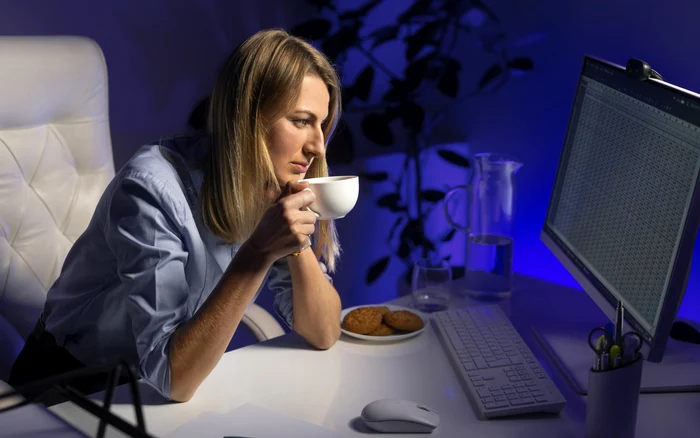
Working long night shifts can affect your health, some studies show. Photo: Freepik.com
In Antiquity and the Middle Ages, night work was the exception or, more often, was limited to a short interval of one to two hours during the midnight sleep break, during which people did housework or cared for and checked on household animals.
The night, reserved for sleep since ancient times
The Romans were proud of the habit of waking up early, which they considered a virtue; moreover, activities in the empire's settlements began at dawn. With the sunset, however, most were preparing for sleep, which they considered beneficial.
“As night fell, the time for bodily recreation and relaxation came to an end. Sleep acted as a transition, preparing men for the new demands of the early morning. An episode of insomnia or a feast that lasted too late into the night could be very injurious to health. Sleep gave the soul a degree of peace and allowed the body to regain its strength. Those tormented by a charged consciousness, whose souls were disturbed by remorse, regrets, or desires, or who thought too much of the past or the future, did not sleep much. In the end, they fell ill as surely as those who woke up every time a noise was heard in the street. They arrived exhausted, and their bodies were ruined.” noted the historian Florence Dupont, in the volume Daily Life in Ancient Rome.
In the Middle Ages, the night was reserved for sleep, and activity after dark was exceptional; only a few activities could be practiced at night. Among them were civil and military guarding, milling and baking, journeys of merchants or sailors, care of the sick, prayers and religious rituals or prostitution.
Industry and caffeine changed the work schedule
The industrial age gradually changed the way night work was viewed and practiced. From the 18th century, with the development of factories and continuous production, working after dark became more common. The impact of this transformation was amplified by the spread of drinks and foods used to maintain wakefulness, such as coffee, caffeinated teas or chocolate.
“Humanity's knowledge of caffeine is surprisingly recent. But it is no exaggeration to say that this molecule has remade the world. The changes produced by coffee and tea have occurred at a fundamental level – that of the human mind. Coffee and tea have brought about a change in mental condition, sharpening minds that had been clouded by alcohol, freeing people from the natural rhythms of the body and the sun, thus making possible entirely new kinds of work and, no doubt, new kinds of thinking,” notes Michael Pollan, journalist and author of several books on nutrition.
In Romania, in the 20th century, working in day and night shifts became widespread in industry, but also in other fields. During the communist decades, many factories operated in a continuous flow, and night work was often praised in the party press.
“Although the last light had gone out and the silence of the night had settled over the working town of the tractor builders, the workers were working very skillfully and diligently. It was the night shift at the “Ernst Thälmann” Works. The steelworkers started their work determined to give as much steel as possible for the tractors. The work balance of the night shift was particularly fruitful (…) The night shift at the “Partizanul” factory Roșu”, who weaves fabrics of different colors and designs, works with the same enthusiasm as the day shift”, informed, in 1958, the Drum Nou newspaper from Brașov (at that time, the Stalin region).
After 1990, night shift work continued in industry, energy, transport, health and public order, but also in services such as retail, call centres, IT and logistics.
Numerous Romanians, affected by exchange 3
Numerous Romanians who have worked night shifts for years have recently reported their experiences and how their lives changed after adopting this program.
“I haven't slept at night for almost 24 years. Yes, it sounds dodgy, but it's true. Right after I finished college, I took a job where I worked strictly at night, from 11:00 p.m. to 6:00 a.m., every day, less on the weekends. When I get home, I go to bed around 7 a.m., and no matter what I do, I can't sleep more than 11-12 at the most. That's “the night.” The problem is that my body is stuck like this: on weekends or holidays I can't sleep at all at night.” said a Romanian on the Reddit platform.
He adds that, although he has reached 45 years old, he does not feel that he is visibly affected by such a program, a fact questioned by other Romanians.
“I'm not in pain, I don't feel constantly exhausted, I don't look older than others my age (at least I think so), I'm doing my job, life is going. But I'm starting to wonder: in the long run, does this program really leave no marks?”he adds.
Other Romanians reported, in their turn, how working long hours during the night affected their lives. Some claim to have noticed benefits as well.
“I'm glad that I have days off during the week and I can solve my problems, go shopping or just relax – for example at the pool or skiing – during the time when most people are working, so it's much freer everywhere.” states one of them.
Another admits that after four years of working night shifts, he gave up such a schedule for good.
“The free time you have seems like more, but it's not productive at all because you don't really have the energy to do anything. It took me about three months after the switch to be able to sleep at night, and I wouldn't go back to a schedule like that unless I had no choice.” add this one.
A nurse complains that, in a 12-hour shift at the Emergency Department, she barely has time to go to the bathroom or take a few minutes to breathe.
“Now it's a miracle if at night we manage to empty the service and stay for a while with stories – that's around 5-6 o'clock, until 7, when patients start coming again”, states this.
A Romanian tells that, being a security guard, he doesn't have too many problems caused by nighttime activity, because he manages to sleep on the job.
“I work at night, and now I have an increased sensitivity to sunlight. Sometimes I'm short-tempered, aggressive with those around me, especially when I'm trying to sleep, but I can't,” supports another Romanian.
Some have noticed clear negative effects of disorganized sleep.
“I've been working night shifts for 20 years. I sleep almost all day, wake up at 5-6 in the evening. I've tried to regulate my sleep, get through the day, but it doesn't work,” says another Romanian.
One woman says her health has been affected by this program. “Now I take three sleeping pills, two pieces a night, and after 3-4 hours I can't get back to sleep at all. It's hard,” she adds.
Another Romanian told that, when he starts the night shift, he manages to sleep only 4-5 hours a day.
“Then I pick up the kids from daycare and school and there's no way to sleep. I'm practically a zombie that week and for the first two nights I can't sleep properly even if you spank me. My weight and physical appearance fluctuate from day to day: I wake up puffy in the face, bloated, dry in the face, dark circles, flat stomach. I eat once a day and still gain weight that week. Energy for children: almost zero. Irritability, mood for nothing. That's why I'm looking for another job, just two shifts, but it's hard to find something that pays the same.” he states.
How night work can be better managed
Recent studies paint a worrying picture of the potential negative health effects of unconventional work schedules, which affect between 15% and 30% of workers in the US and Europe, including factory and warehouse workers, police officers, nurses and other emergency services workers, notes Harvard Women's Health Watch, in an article on sleep.
So-called shift work disorder mainly affects people who work at night, very early in the morning or who have rotating shifts, explains Eric Zhou, an assistant professor in the Division of Sleep Medicine at Harvard Medical School. It is characterized by significant difficulty falling asleep, staying asleep, or sleeping when the person wants to. The reason is that shift work disrupts the body's normal alignment to the 24-hour sleep-wake cycle, known as the circadian rhythm.
“People who work a classic 9am to 5pm schedule are usually awake when it's daylight, which is aligned with their internal biological clock. For shift workers, their work and sleep times don't coincide with their natural wake or sleep signals. Basically, they're working against the natural inclinations of the universe, not just their own body,” says the specialist, quoted by Harvard Women's Health Watch.
According to the publication, a 2022 analysis published in the Journal of Clinical Sleep Medicine associates shift work with an increased risk of serious health problems such as heart attack and diabetes. Other research looks at the negative effects of rotating schedules, some attributed to irregular and more frequent eating, but also to eating unhealthy foods at inappropriate times.
Eric Zhou offers some recommendations based on scientific evidence for those who want to reduce their problems caused by shift work. One of these concerns the management of light exposure.
“Workers finishing their shift in the morning should reduce light exposure after leaving work if they intend to sleep immediately”it shows.
Another tip is for people to allocate enough time to sleep on their days off. It is also important to maintain a work schedule as constant as possible.
“Also try to reduce the number of consecutive days you work difficult shifts,” the specialist recommends.