The mysteries of one of the biggest stars in the Universe. The transformation that amazed scientists


An international team of astronomers has observed for the first time one of the largest known stars in the Universe during an extremely rare transformation: its transition from a red supergiant to a yellow hypergiant, an unstable phase that most likely precedes the violent end of its stellar existence and transformation into a black hole. This observation provides a unique opportunity to understand how the largest stars in the universe evolve and die.
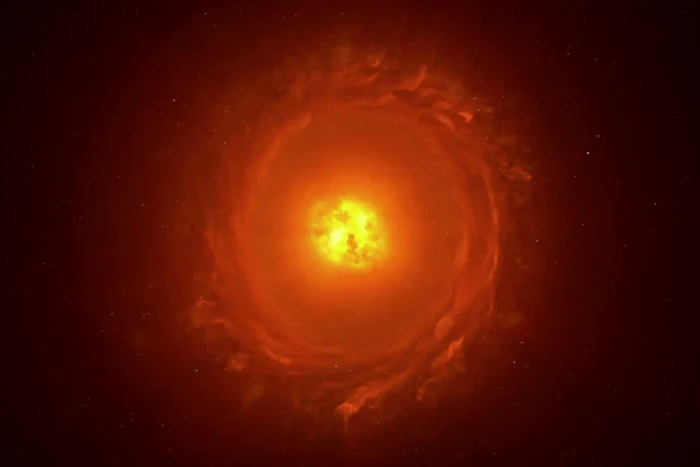
The celestial body has been named WOH G64 Image source: New Scientist
An incredibly large star
WOH G64 is in The Large Magellanic Clouda close satellite galaxy of the Milky Way, about 163,000 light-years from Earth. Because it is about 1,540 times the diameter of the Sun, if it were placed at the center of our solar system, its surface would extend almost to the orbit of Jupiter.
In terms of luminosity, this star radiates about 282,000 times more energy than the Sun, making it one of the brightest known stars.
Transformation, rare and mysterious
Astronomer observations show that the star has increased its surface temperature and changed color, suggesting that it went from being a red supergiant to a yellow hypergiant, an extremely short and unusual stage in stellar evolution. All without a violent flare, which is surprising for standard star models. This transformation began to be observed as early as 2014, but only now have scientists been able to monitor it on a large scale with modern telescopes.
In cosmic terms, the transition happened quickly, which raises even more questions and shows us how much we still have to discover about the mysteries of the universe.
“None of the current models of stellar evolution can fully explain these changes. (…) Typically, the evolution of a star takes place on a time scale of the order of billions of years“said astronomer Gonzalo Muñoz-Sanchez, a researcher at the National Observatory of Athens and lead author of the study on the star published this week, quoted by Reuters.
What's also interesting is that WOH G64 is about 10 million years old and appears to be nearing the end of its lifespan. The Sun, on the other hand, is about 4.5 billion years old and is estimated to have another 5 billion years before it reaches its end.
Another novel aspect is that WOH G64 is not alone: the data suggest that it is part of a binary system with a smaller companion star. This gravitational interaction could influence the giant star's atmosphere and explain some of its unusual behavior.
What scientists are looking for
For stars with a mass between 8 and 23 times that of the Sun, scientists expect them to evolve into red supergiants and eventually explode as a supernova. The fate of stars between 23 and 30 times the mass of the Sun is less clear. It is not yet known whether they will explode as supernovae, directly collapse to form a black hole, or evolve from a red supergiant phase to a yellow hypergiant stage before ending their lives.
“The WOH G64 could be the answer to that question,” says Muñoz-Sanchez.
Scientists will continue to follow the evolution of WOH G64 in hopes of better understanding the final stages of stellar life.
The discoveries about this star not only challenge classical theories of the evolution of massive stars, but also remind us how little we still know about how the cosmos writes its stories.