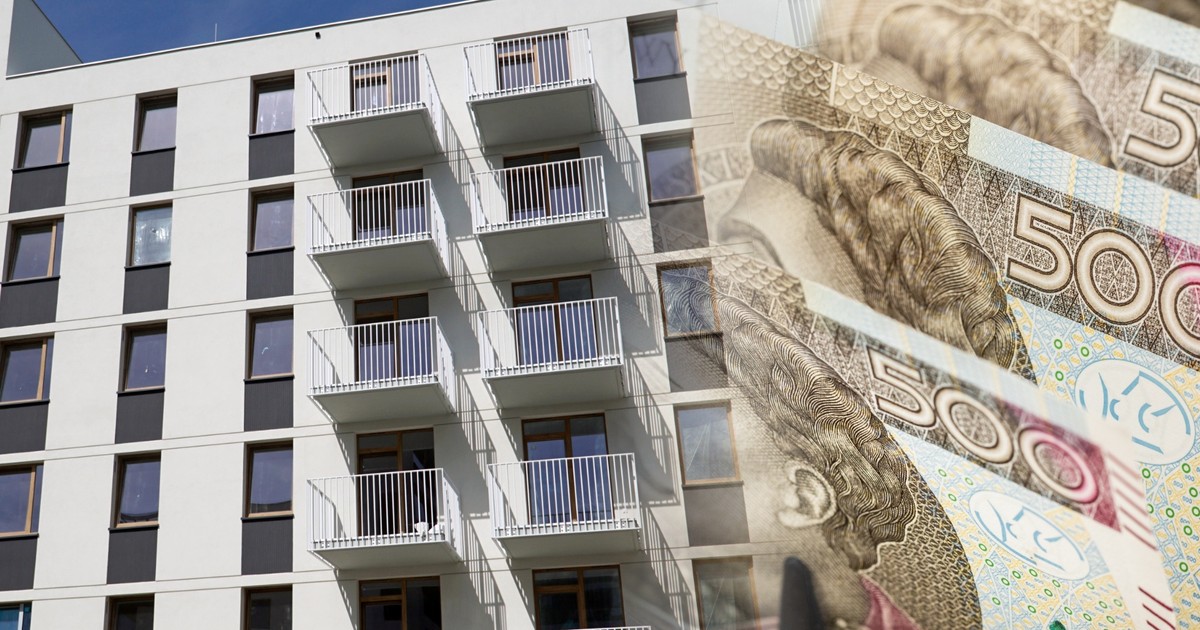
Safe Credit Program 2%. was one of the strongest demand impulses in recent years. It reduced the real cost of financing and loan installmentsso it hit the biggest purchase barrier. After it expired, the situation of buyers changed dramatically.
Today, support exists, but it is of a different nature: instead of interest subsidies, assistance in the field of own contribution prevails. And it's not the same.
Loan 2 percent — how it changed the market
During the program, thousands of people accelerated their decision to buy a flat. Demand exploded especially in the largest cities, and developers quickly felt increased interest.

If you have creditworthiness but do not have savings for your own contribution, the state – through BGK – guarantees part of it
|
PawelKacperek / Shutterstock
Read also: Apartment prices in February. Where do they grow the fastest and where do they decline?
The effect was twofold:
- increased creditworthiness thanks to lower installments,
- increase in apartment prices because a larger group of buyers could enter the market.
After the program ended, there was a natural decline number of loan applications. Three factors became crucial again: the level of interest rates, household income and own contribution.
Family Housing Loan – the main support program
Today, Bank Gospodarstwa Krajowego is responsible for the most important systemic support instrument, i.e. the Family Housing Loan, operating in the “Apartment without own contribution” formula.
What is the program about?
The mechanism is simple: if you have creditworthiness but do not have savings for your own contribution, the state – through BGK – guarantees part of it. Program rules:
- the guarantee may cover up to 20%. (and in certain cases 30 percent) of the investment value,
- up to 200 thousand zloty,
- the minimum loan period is 15 years,
- the loan can cover up to 100%. the price of an apartment or the cost of building a house (including finishing).
The program is aimed at people who do not have a flat – except for families with at least two children, for whom square footage limits apply. (e.g. 50 sq m for two children, 75 sq m for three children, 90 sq m for four children).
Importantly, There is no age limit or size limit for the purchased apartment. However, they are valid price limits per square metervarying depending on location and market (primary/secondary).
BGK data: scale of the program
According to the information provided to us by BGK, as of December 31, 2025, 33,015 borrowers took advantage of the program, and 398 people received the so-called family repayment.
These are important numbers, but much smaller than the scale of interest generated by the 2% Loan.
Family repayment – an additional incentive
If the family grows during loan repayment:
- for a second child – BGK will repay PLN 20,000 PLN capital,
- for the third or subsequent period – PLN 60,000. zloty.
This is a one-time reduction of the loan capital, which actually reduces the debt. The condition is that there is no other apartment at the time the support is granted.
The Family Housing Loan solves the problem of own contribution. However, it does not lower the interest rate or installments. And this is the biggest barrier for many households today.
Family Care Capital – indirect support for abilities
The Ministry of Development and Technology and other state institutions run family programs that, although not housing related, affect creditworthiness.
Family Care Capital this:
- 12 thousand PLN for the second and subsequent children,
- paid for 12 or 24 months.
The benefit may:
- increase your current creditworthiness,
- help in collecting some funds for finishing the apartment,
- improve the bank's assessment of the family's financial stability.
That's it though indirect support — is not dedicated to the housing market.
Interest rates – informal support program
Market experts, including: from Rankomat, RynekPierwotny.pl or Otodom Analytics, emphasize that Today, interest rates have a real impact on the availability of apartments.
Their decline means:
- lower installment,
- higher creditworthiness,
- greater availability of credit.
In practice, several rate cuts can improve the situation of borrowers as much as point-based support programs.
Banks' offer – fight for customers at 2%.
After completing the program, 2 percent banks began to compete more strongly for customers. This can be seen in the offers:
- periodically reduced margins,
- promotional fixed interest rate for 5 years,
- simplified capacity assessment procedures,
- faster credit decisions.
This is not a systemic state program, but an element of the market game for customerswhich became more demanding again.
How much money do you have to earn today to buy a flat?
After extinction, 2 percent the question of income became crucial again. At the current price level in the largest cities, the loan installment for 50-60 sq m often exceeds several thousand PLN per month.
In practice this means that:
- a single-person household has significantly limited possibilities,
- a couple with two salaries has a clearly greater chance,
- large families can additionally benefit from family repayment in the BGK program.
See also: Behind the scenes of renting premises on Airbnb. “But we had three really bad experiences.”
Housing loans: will there be a new program?
This is one of the most frequently asked questions by readers. For now, there are no official announcements of a program on a scale comparable to the 2% Loan.
The market is waiting for a solution that:
- will reduce the cost of the installment,
- will increase your creditworthiness,
- will not cause a sharp increase in prices.
The strongest thesis today is clear: the 2 percent program. was unique because it lowered the cost of credit. Current instruments mainly solve the problem of own contribution, but not installments.
And it is the installment that is the number one barrier for most Poles.
Can currently available programs actually replace the 2% loan, or is their impact on the market much smaller? In the opinion of many analysts – smaller. The scale of impact is limited and the effects are spread over time.
So the housing market returned to a more “classic” model:
- prices depend on supply and demand,
- demand depends on creditworthiness,
- capacity depends on interest rates and income.
State support still exists, but has today point nature. This means that the decision to buy an apartment again depends to a greater extent on the individual financial situation than on government subsidies.