
US ground attack in Iran or peace negotiations? Washington's plans, decrypted by experts: “There are three realistic scenarios”


The illusion of a lightning war in Iran is over: although it has been talked about for several days, American and Israeli officials are now coming up with other options. General (r) Adriean Pârlog and expert Raluca Moldovan reveal the darkest scenarios.
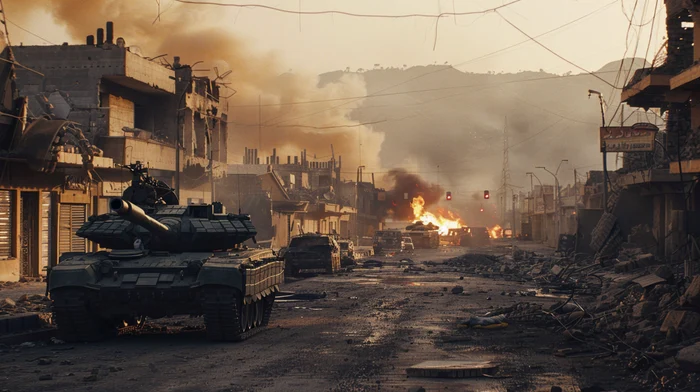
A US ground offensive in Iran would be difficult to pull off, not impossible. PHOTO: Freepik
The war in Iran is protracted, and the Israeli army's estimates speak of a few weeks, while in the US it is more like a month.
Recently, Nadav Shoshani, a spokesman for the Israeli army, said that the war should not last more than a few weeks. He also added, however, that it is still too early to be certain. Instead, Donald Trump spoke of four weeks of war, after initially speaking of only a few days of offensive until success. The beheadings of Iran's leadership gave hope that the war could end quickly, but that turned out to be far from the case.
There are estimates that the bombing may not be enough and the US military may have to prepare a ground offensive. Among those who have said so is Democratic Senator Richard Blumenthal. At the same time, Donald Trump and Pete Hegseth, the US Secretary of Defense, made it clear that any discussion regarding a possible ground offensive remains current.
This raises two important questions, which are difficult to answer. The first relates to the duration of the war, and the second to the possibility that the United States of America will have to resort to a ground offensive to achieve its objectives.
The “truth” discussed on this topic with the political scientist Raluca Moldovan, from the Babeș-Bolyai University, an expert in the Middle East, and with General (r) Adriean Pârlog, former head of the Romanian intelligence services within the army.
Raluca Moldovan is a lecturer at Babeș-Bolyai University and an expert in the Middle East. In her analysis, she advances three possible scenarios regarding the duration of the war between the United States of America and Iran.
“At the moment the conflict is only in its early days, but its evolution depends on several major strategic variables: the real objectives of Washington and Tel Aviv, Iran's ability to resist militarily and politically, and the degree to which the war expands in the region. From an analytical point of view, there are three realistic scenarios for the duration of the current conflict“, says the expert.
scenarios
In a first scenario, the war should continue as it started, in which case it may last several months.
“In the first scenario, the war remains relatively limited, dominated by airstrikes and missile attacks. This is how operations began: bombing Iranian military infrastructure and Iranian retaliation with missiles and drones against US bases and regional targets. If the US objective is only to degrade Iran's nuclear program and military capabilities, the conflict could last weeks to months. Even then, however, tensions could continue for a long time in the form of sporadic attacks and an indirect confrontation”says Raluca Moldovan.
An even more negative scenario is the second, and things already seem to be moving in that direction.
“The second scenario, considered more likely by many analysts, is the transformation of the war into a regional conflict. Iran is not only fighting through its conventional forces, but also through a network of allies and armed groups in the Middle East. Missile and drone attacks have already occurred in the Gulf area and other states in the region, and energy and maritime infrastructures are affected. In this context, the conflict could last months or even several years, as it would involve several fronts and resemble with a regional war rather than a limited military campaign”she adds.
But there is an even more complicated scenario. In this case, the fighting would end up lasting for years.
“A third scenario – the most radical – would arise if the strategic goal becomes regime change in Tehran. Some political statements in Washington suggest this possibility, especially after the removal of Khamenei and discussions about the future of the Iranian leadership. If the war were to develop in this direction, the conflict could last for years, because it would involve not only the destruction of the Iranian military apparatus, but also the management of a very large and populated state. The experiences of Afghanistan and Iraq show that the military phase can be relatively short, but further stabilization may take a decade or more“, claims the expert.
The strategic complications of such a war would be considerable, says Raluca Moldovan.
“One of the most important would be the possibility of blocking or disrupting traffic in the Strait of Hormuz, an essential transit point for Gulf oil exports. Iran has invested for years in asymmetric naval capabilities – sea mines, anti-ship missiles and drones – precisely to be able to threaten navigation in this area. Even a temporary disruption of oil transport would have global economic consequences, by rapidly increasing energy prices. In parallel, Iran could strike bases with missiles American companies from the Gulf states, such as Qatar, Bahrain or the UAE, which would automatically expand the theater of operations”she explains.
Another complicating factor would be the global geopolitical dimension of the conflict, the expert adds.
“Russia and China would probably not intervene directly, but would have significant interests in the evolution of the conflict. Russia could support Iran indirectly, although so far they have not done so, through military technology transfer or strategic cooperation, while China – a major importer of Gulf oil – would likely try to limit escalation and promote a diplomatic solution to avoid destabilizing energy markets.”
she claims.
Although there is so much talk about a scenario in which the United States of America would move to a land invasion, Raluca Moldovan believes that this is rather unlikely, although it cannot be completely ruled out.
“As for the idea of a ground offensive, sometimes invoked in American political discourse, it is considered by most military experts to be highly unlikely. Iran is a very large country, with a population of about 90 million, and a geographically difficult territory. The Zagros mountain range and desert areas in the country's interior would greatly complicate any invasion operation. In addition, Iran has a large armed forces and paramilitary structures such as the Guards The revolution, which has developed over decades a doctrine of asymmetric and guerrilla warfare. A ground intervention would likely require hundreds of thousands of troops and risk a protracted insurgency similar to or even more difficult than the American experience in Iraq. For these reasons, most Western strategic planning focuses on options such as airstrikes, naval operations, and economic pressure. The dominant conclusion in the strategic literature is that a direct war between the United States and Iran would likely be short in the initial phase, but with a major risk of regional expansion and global economic destabilization, especially if regional actors and great powers were indirectly drawn into the conflict”summarizes Raluca Moldovan.
General (r) Adriean Pârlog was in top positions at the level of the Romanian military intelligence services. Pârlog was deputy of the Directorate of Military Intelligence in Romania. He also does not believe that the United States of America will choose a ground offensive in Iran. In his view, Washington would need a formidable force to attack with ground troops, and his estimate is that it would have to mobilize several hundred thousand troops. After the unfortunate experience in Afghanistan, the Americans should think twice, he says, especially since Iran has a vast territory, with landforms that would obviously advantage the troops on the defensive. In addition, Iran could field about a million well-trained soldiers accustomed to operating in an environment familiar to them.
“It seems to me that especially after the withdrawal of the United States from Afghanistan, after the lack of strategic, politico-military and strategic military performance in Iraq, a decision by the United States in connection with a potential introduction of ground combat forces on the ground would not necessarily be indicated. And unlike the offensive in Iraq, now it is not clear who would join the Americans. Because, remember, Germany and France refused ab initio a co-participation in the intervention in Iraq in 2003. Also, Turkey refused to provide the use of the Incirlik base, an allied military asset. So the complications of such a decision lead us to a completely different strategic problem at the moment.”the general believes.
General Adriean Pârlog also recalls the extreme conditions in which the troops from Siol should operate. In his opinion, the problems would be even bigger than in Afghanistan.
“It is extremely difficult to imagine a ground force in an extremely difficult area, comparable to Afghanistan in terms of geography, as Iran is”points out the general.
In addition, the population of this country gives the impression that they are willing to fight against any invader, so that the well-known popular grievances fade into the background during a war.
“I don't know if the population of Iran will be happy about a foreign military presence. I'm not convinced at all. I too look at the relative decrease in the social unrest that Iran used to know. We see that these days it's quiet compared to the domestic Iranian social unrest a year ago“, says General Adriean Pârlog.
Instead, the general talks about the fact that the belligerents may decide sooner than it might seem possible to return to the negotiating table.
“There are some signs of that. I've seen the Republican Party say it's a targeted and limited combat operation, not a war, with Iran. That means it's possible to get back to negotiations and the war won't last. It makes sense to look for early negotiations.”concludes General Adriean Pârlog.


