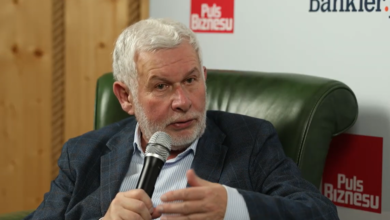
The Monetary Policy Council reduced interest rates by 25 basis points, Adam Glapiński announced on Thursday during a press conference. The National Bank of Poland made the decision after a two-day meeting that ended on Wednesday. The previous reduction was introduced in December last year.
See also: War threatens with famine. These are the consequences for Middle Eastern countries
“In the short term, the main risk for inflation is, of course, the recent escalation of the conflict in the Middle East; the impact of this conflict on oil and gas prices. (…) Today it is difficult to say how long it will last. Moreover, the increase in oil and gas prices is an external supply fact. So, on the one hand – if it will last, there are different opinions on this subject – it will drive up prices,” Glapiński said at Thursday's press conference.
The text continues below the video
The National Bank of Poland announced on Wednesday that according to the new projection, inflation in 2026 will increase from 50%. is likely to be in the range of 1.6-2.9%, and GDP growth this year will amount to 3.1-4.7%.
“The projection shows that the return of inflation to a low price level is permanent. According to this projection, inflation is to remain in line with the NBP target until the end of 2028. (…) The permanent return of inflation to a low level is also confirmed by all forecasts of external centers, international and domestic,” Glapiński emphasized during the press conference.
Will inflation increase in 2026? Expert forecasts and market signals
At the same time, experts – such as Jakub Rybacki, an economist at mBank – point out that the war in the Middle East has shaken optimism about the Polish economy. Questions arise as to whether the current situation is more like the years 2017–2018 or the period after the outbreak of the war in Ukraine.
Oil and raw material prices have a direct impact on inflation and economic growth. The war in the Middle East has caused shocks on the oil market, although their scale is smaller than in 2022, when crude oil prices reached $110-120 per barrel. Currently, the price of Brent crude oil fluctuates around USD 80, but the risk of further increases remains real.
The text continues below the video
The blockade of the Strait of Hormuz may limit oil exports from Saudi Arabia and the UAE, which would be unfavorable for Europe. China, the largest buyer of Iranian oil, currently has high inventories, which is cushioning the effects of the shock for now. However, the risks associated with rising commodity prices still prevail in the short term.
Will the war in the Middle East increase inflation in Poland? Expert analysis
According to Jakub Rybacki, under normal conditions, higher oil prices encourage Saudi Arabia to increase production. Currently, production has increased to 12 million barrels per day, but the blockade of the Strait of Hormuz is hampering transportation. Pipelines bypassing the strait have limited capacity, so a long-term blockage could seriously disrupt the global market.
Poland benefits from EU funds and moderate investment growth, and global demand is not high enough to cause strong inflationary pressure. Supply chains are less clogged than in 2021-2022, and companies are better able to cope with disruptions.
See also: US attacks benefit the Chinese. Americans are spending money on key weapons that they have less and less of
As mBank's expert notes, the greatest risk remains disruptions in supply chains in the EU. Simulations show that even moderate logistical difficulties can increase inflation by 1.5 percentage points, and a repeat of the shocks from 2022 threatens double-digit inflation. However, currently the global environment favors disinflation rather than price increases.
Experts agree that a sustained increase in energy prices could change the global economic situation. However, a global inflation shock for 2021–2022 is currently not forecast. Businesses have learned to cope with disruption, and new delivery routes and expansion of the transport fleet reduce the risk of a repeat of the past. However, the key will be how long the conflict will last and whether it will cover key trade routes such as the Strait of Hormuz.