publication
2026-03-05 22:05
Thursday's session on the New York stock exchanges brought moderate declines in the main indices. It seems that the American stock market is unable to assess the impact of the war with Iran on the prospects of the global economy and the future profits of listed corporations.
The S&P500 ended Thursday's session at 6,830.56 points, which meant a decline of 0.57%. It is worth noting that at the end of trading, the New York benchmarks made up for a large part of their previous losses. Thanks to this, the Nasdaq Composite returned only 0.26%, although it had previously fallen by as much as 1.3%. The Dow Jones industrial average, after losing 1.61%, finished with a score of 47,954.50 points.
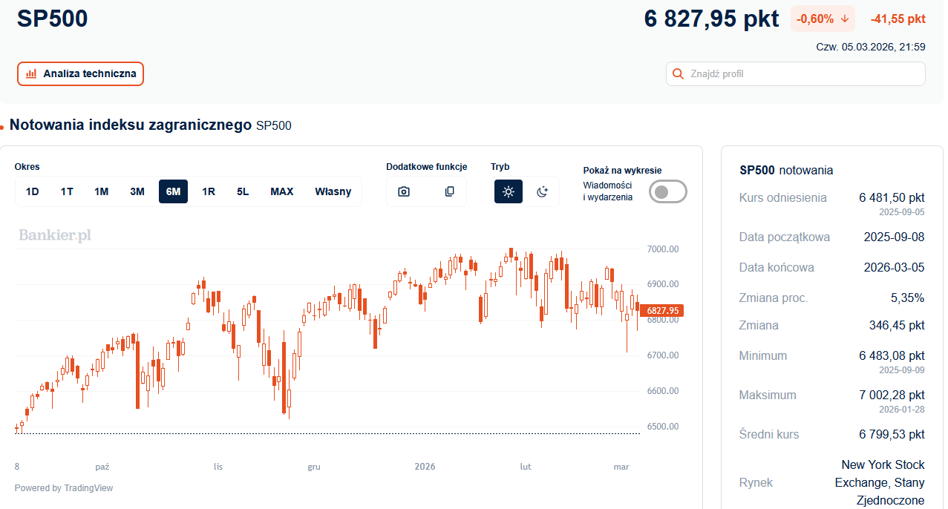
Wall Street's reaction to the US-Israeli attack on Iran is increasingly visible. The first reaction on Monday was basically neutral (and even slightly upward). On Tuesday, serious declines were mitigated, and on Wednesday the stock indices were pushed up slightly. Thursday, however, was marked by moderate declines and significant daily fluctuations in the New York indices.
Advertisement
Behind us are six days of bombing Iran and further missile and drone attacks by Tehran. The Strait of Hormuz remains blocked, paralyzing nearly 20% of the world's oil and natural gas supplies. The conflict is spreading to other countries in the region (including Lebanon and Azerbaijan), and Brent oil now costs almost USD 85 per barrel. It's not looking good.
“Today, look at the oil market – it tells you everything you need to know about why stock markets went down,” said Michael Antonelli, market strategist at Baird Private Wealth Management, speaking to Reuters. It is the threat of an oil and energy crisis that is currently paralyzing investors.
For now, most market participants hope that this will be a short war and that everything will return to normal in a few or a dozen or so days at the latest. As happened during the previous bombings of Iran in June 2025. However, at that time the declared goal of the US and Israeli authorities was to destroy the Iranian nuclear program. And now we are talking about “demilitarization” and regime change in Tehran. This is roughly the same thing that Russia wanted to do to Ukraine in three days four years ago.
– We believe that stock markets underestimate the importance of the conflict in the Middle East. Unfortunately, this may change quickly due to negative events. We do not believe in the scenario of a quick end to this war. This is a completely different level than the events of last year – said Kamil Cisowski from Opoka TFI.
The very tense situation on the fuel markets caused the market to postpone expectations for another interest rate cut by the Federal Reserve. Futures quotations show that the next Fed rate cut is expected in July at the earliest, and the probability of such a move is estimated at barely 50% (and almost 70% until the September FOMC meeting).
Meanwhile, reassuring data came from the American labor market. After the much better than expected (but objectively still very weak) ADP report on Thursday, the Challenger Report indicated only 48.3 thousand. planned layoffs in the corporate sector. This is more than half less than 108.4 thousand. recorded in January. The number of applications for unemployment benefits also remained at a very low level (213,000).
The publication contains affiliate links.