Historical restoration at the Corvinor Castle. The floor of the Hall of Knights, redone after 130 years at the same factory in Hungary


Corvinir Castle has gone through the most extensive restoration process in its history and has regained its brilliance and authenticity. Some interventions were completely unusual, aimed at faithfully preserving the historical appearance of the medieval monument.
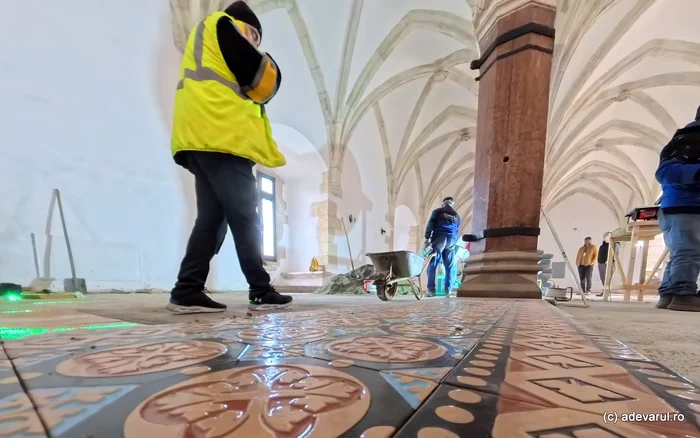
Hall of Knights. Photo: Daniel Guță. TRUTH
For over six years, the Corvinilor Castle in Hunedoara has gone through extensive restoration works, financed with European funds attracted by the municipality. Meanwhile, the historical monument “shaken off” the dust and industrial ash that covered its facades for a long time, giving it a dark, reddish color.
Its towers and walls have returned to the white color of the limestone blocks with which it was built six centuries ago, and the plaster applied during previous works has been removed, giving it an authentic appearance. In addition, the medieval paintings and frescoes that adorned its walls and towers were also restored and regained their color.
Most of the more than 40 spaces of the castle have been rehabilitated and returned to tourism, the towers have also been reopened to visitors, the roof and installations have been restored, and a coherent visiting circuit, laid out in the restoration project, helps tourists to use their time to visit the castle efficiently and contributes to maintaining a suitable climate to protect the monument.
The restoration work started in 2019 opened the way to important historical discoveries: from unknown underground spaces, to rooms hidden for centuries, rare notes and mysterious paintings brought back to light from under old layers of plaster.
Interventions for the first time in the restoration of the Corvinor Castle
But one of the most important aspects of the restoration aimed at preserving the authenticity of the historical ensemble. In the Hall of Knights, this was achieved through a first in the restoration of medieval monuments in Romania.
The sumptuous hall on the ground floor of the Corvinor Castle is restored to its late 19th century appearance with the same materials used in the restoration since then: ceramic tiles made in the Zsolnay factory in Hungary, established over a century and a half ago. The old pieces that made up the floor of the Hall of the Knights were removed, to be replaced with identical ones, made by the same manufacturer that delivered the ones installed almost a century and a half ago, when the Corvinor Castle underwent the most extensive restoration in its history.
“So the time has come to repave the Hall of Knights, after a series of settlement stabilization works were carried out beforehand, because under the floor of this hall there were a series of voids filled in the past with rubble, which settled. At the moment we are nearing the end of it, and the tiles made by the company Zsolnay from Pécs, in Hungary, have arrived. It must be said that it is the same company that executed them and on those installed more than 130 years ago. The technology is the same, the molds are the same, as for the restoration company, they consulted with the tile manufacturer as well, so we are very optimistic that at the end of this work, the former grandeur of this hall will be restored.” archaeologist Sorin Tincu, director of the Corvinilor Castle Museum in Hunedoara, declared for Adevărul.
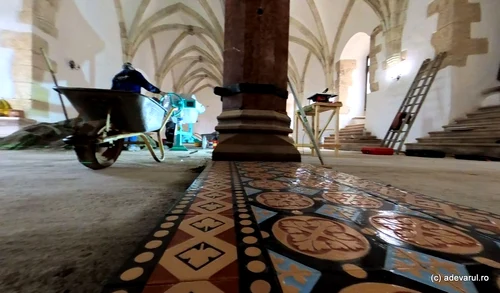
Image 1/10:
Castle of the Corvins Hall of the Knights Photo Daniel Guță THE TRUTH jpg
Almost 8,000 ceramic tiles are used to pave the Hall of Knights, all of them being handmade, using the same methods, by the same Hungarian company that provided, between 1868 and 1917, decorative pieces – especially ceramic tiles – for the restoration of several components of the historical monument.
The restoration of the Hall of Knights was started by Ferenc Schulz, in 1868, after the devastating fire of 1854, which consumed a large part of the edifice. It was completed only after 1890, the year in which the architects responsible for the work, Antal Khuen and István Möller, made the drawings based on which the ceramic tiles used to floor the Knights' Hall were manufactured by the Zsolnay factory in Pécs – Hungary.
A factory from the 19th century continues to produce flooring
The Zsolnay factory was established in 1853 by Miklós Zsolnay in Pécs, Hungary. Ten years later, his son Vilmos Zsolnay joined the company and led it to international recognition, presenting innovative products at world fairs and international exhibitions.
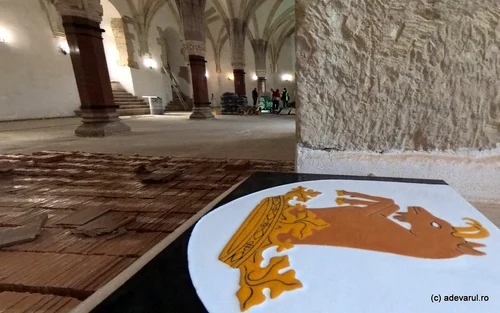
Image 1/10:
The Corvinor Castle under restoration, March 2026 Photo Daniel Guță THE TRUTH (26) jpg
The workshops produced building ceramics, which became increasingly popular from the mid-1880s onwards. Zsolnay products reached Vienna and other cities in Austria after Vilmos Zsolnay made friends with some of Hungary's leading architects.
In the years 1884–1885, the factory participated in extensive reconstruction works of some historical monuments: at the Mátyás church in Buda, together with Frigyes Schulek; at the cathedral in Kassa (Košice); and at Corvinilor Castle in Hunedoara, together with Imre Steindl. In these restorations and reconstructions, not only original architectural details were used, but especially roof tiles and ridges.
In 1885, experiments with frost-resistant construction ceramics – what was later called pyrogranite – began, and in parallel Vilmos Zsolnay continued research to enrich the colored glazes of the “Iranian” style tiles. The resulting material in the first stage was called “Steindl”, after the famous architect who restored the Corvini Castle between 1870 and 1880 and the Parliament Palace in Budapest at the end of the 19th century.
Starting in 1894, Imre Steindl used this material for the exterior and interior decorations of the Hungarian Parliament. To meet the growing demand, in 1895, a factory specialized in the production of pyrogranites was established on the site of the Pécs mine. At the beginning of the 20th century, Zsolnay building ceramics became a landmark of urbanization, being used in town halls, post offices, exhibition halls, large stores and even private buildings.
Seven years in the construction site
The restoration work, started in 2019 and financed by European funds, is to be completed in 2027.
“Corvinilor Castle is currently in the most extensive restoration, conservation and enhancement process in recent decades. The first stage was carried out through a project worth 5 million euros, carried out with the support of ADR West, through the Regional Operational Program 2014-2020. Currently, the second stage is being implemented – a project worth 6.6 million euros, co-financed by the National Recovery Plan and Resilience”, said the mayor of Hunedoara, Dan Boboutanu.
The second project, currently ongoing, includes the restoration of several interior and exterior frescoes, the replacement of the flooring in the Hall of the Knights, the restoration of the two access bridges, the restoration of the Bear Pit and its integration into the visiting circuit, the creation of a floor on the Artillery Terrace, the restoration of the Knight's armor at the top of the Mace Tower, the repair of the roof (where necessary), the cleaning of the fountain in the inner courtyard, the modernization electrical and lighting installations, as well as the implementation of a unitary video surveillance system, equipped with wireless cameras.
The restoration of the medieval ensemble is being carried out under the supervision of archaeologists and historians, say museum representatives. At the end, most of the defining elements of the styles that marked the evolution of the edifice will be highlighted: Gothic, Renaissance, Baroque, Classic, Neo-Gothic, with romantic influences and elements specific to medieval military architecture.