Wednesday's session on Wall Street ended with gains, and investors are less concerned about the conflict with Iran and its consequences for raw materials and the global economy. However, there were concerns that the war in the Middle East might postpone the reduction of interest rates in the US
The Dow Jones Industrial was up 0.49% at the close. and amounted to 48,739.41 points. The S&P 500 increased by 0.78% at the end of the day. and amounted to 6,869.50 points. The Nasdaq Composite rose 1.29%. up to 22,807.48 points The Russell 2000 mid-cap index is up 1.18%. and amounts to 2,639.06 points. The VIX index fell by 10.14%. up to 21.18 points
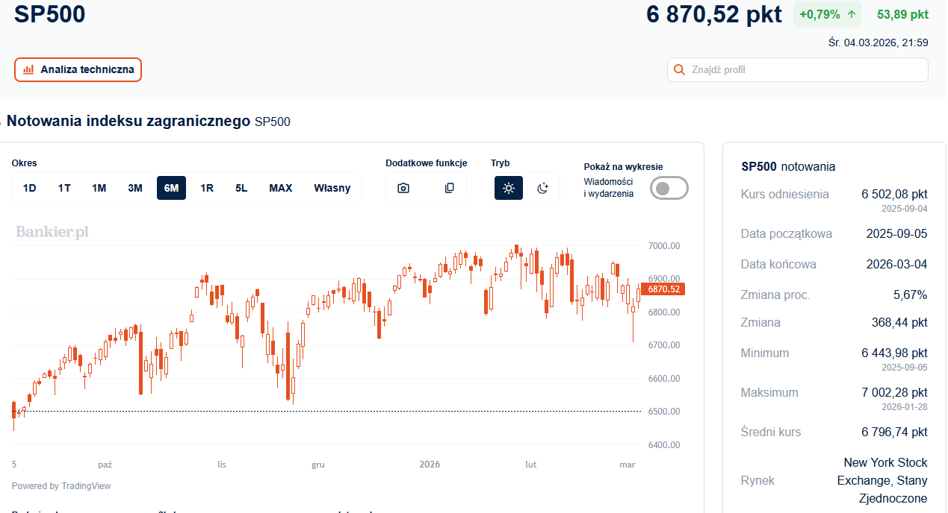
Some strong economic data was released on Wednesday, boosting investor sentiment. ADP reported that private sector companies created more jobs than expected in February. Moreover, the U.S. non-manufacturing services sector recorded stronger-than-expected growth last month, while inflationary pressures eased.
– Concerns about a weakening labor market that may at least turn into a deteriorating one are now being somewhat questioned. The US economy is on solid ground, said Anthony Saglimbene, chief market strategist at Ameriprise.
Advertisement
– If the situation in the Middle East becomes more unstable, we will see more serious side effects on global markets, asset prices and perhaps the economic outlook – he pointed out, adding that “it is too early to make such assessments.”
Meanwhile, Trump's global tariff of 15% announced at the end of last month. will be implemented this week. This was announced by Treasury Secretary Scott Bessent. However, he believes that U.S. tariff rates will return to levels prior to the Supreme Court's decision to invalidate the president's tariff policy “within five months.”
Israeli and US forces carried out another wave of attacks on Iran and Lebanon on the night from Tuesday to Wednesday. In retaliation, Tehran attacked Gulf states, including the United Arab Emirates and Qatar, and a refinery in Saudi Arabia.
Tehran's threat to attack ships passing through the strategic Strait of Hormuz has raised transport costs, with concerns about oil prices that could reach a worrying level of $100 a barrel. Several Middle Eastern countries have also temporarily suspended oil and gas production.
President Trump's announcements regarding U.S. naval escorts for oil tankers through the Strait of Hormuz and risk insurance provided some relief to the market. The president of the Federal Reserve in New York, John Williams, said on Tuesday that the US economy has proven to be resistant to price shocks on the energy market.
– We are currently focusing on following the news headlines, and yesterday's news changed market sentiment from hour to hour. From a market perspective, the main problem is no signs of de-escalation by either sideon the contrary, it looks like the situation is still getting worse – wrote Jim Reid of Deutsche Bank in a report on Wednesday.
Stocks rose after the New York Times reported that Iranian intelligence agents indirectly contacted the CIA the day after the attacks, but U.S. officials remain skeptical about the Trump administration's or Iran's willingness to de-escalate in the near future.
– This is the headline everyone wants to seebecause the thought that the war will last four or five weeks, at least according to American estimates, does not favor the markets. But you have to be very careful to believe that, said Chris Beauchamp, chief market analyst at IG.
– The increase in risk sentiment following the New York Times report seems uncertain, given that investors have many reasons to be cautious. The report itself says that US officials are skeptical and that the actions mentioned took place several days ago. Such doubts are reflected in the moderate decline in oil prices, said Bloomberg strategist Conor Cooper. Analysts say that markets are afraid of a renewed increase in inflationary pressure.
– For the US, this is an obvious inflation push, which is why the market is reassessing whether the Fed will be able to make any interest rate cuts this year. – said Andrew Lilley, chief interest rate strategist at Barrenjoey.
“We are becoming increasingly aware that a prolonged conflict could depress global economic growth and re-introduce inflationary pressures,” said Joseph Tanious, chief investment strategist at Northern Trust Asset Management.
Israeli and US forces carried out another wave of attacks on Iran and Lebanon on the night from Tuesday to Wednesday. In retaliation, Tehran attacked Gulf states, including the United Arab Emirates and Qatar, and a refinery in Saudi Arabia.
Tehran's threat to attack ships passing through the strategic Strait of Hormuz has raised transport costs, with concerns about oil prices that could reach a worrying level of $100 a barrel. Several Middle Eastern countries have also temporarily suspended oil and gas production.
Fed officials believe the conflict will complicate the Federal Reserve's monetary policy outlook, and Goldman Sachs President David Solomon said financial markets may need some time to fully understand the long-term repercussions of the war.
Investors have postponed their expectations for a 25 basis point interest rate cut. to September from July, taking into account potential energy costs and US tariffs that threaten to increase inflationary pressures.
The ISM index of activity in services in the US in February was 56.1 points. vs. 53.8 points in the previous month. Analysts expected the index to reach 53.5 points.
The PMI index, determining the economic situation in the American service sector, prepared by S&P Global, amounted to 51.7 points in February. compared to 52.7 points in the previous month – given in the second calculation. This value was initially estimated at 52.3 points.
The PMI composite index in the USA, prepared by S&P Global, amounted to 51.9 points in February. vs. 53.0 points in the previous month – given in the second calculation. This value was initially estimated at 52.3 points.
US crude oil inventories last week increased by 3.48 million barrels, or 0.8 percent, to 439.28 million barrels. Gasoline stocks fell by 1.7 million barrels, or 0.67 percent, to 253.13 million barrels during this time. Reserves of distilled fuels, including heating oil, increased by PLN 429,000. barrels, or by 0.36 percent, to 120.78 million barrels.
On the oil market, WTI contracts for April are up by 0.90%. to 75.22 per barrel, and May Brent futures increase by 0.34%. up to USD 81.70/b. (PAP Business)
pr/
The publication contains affiliate links.