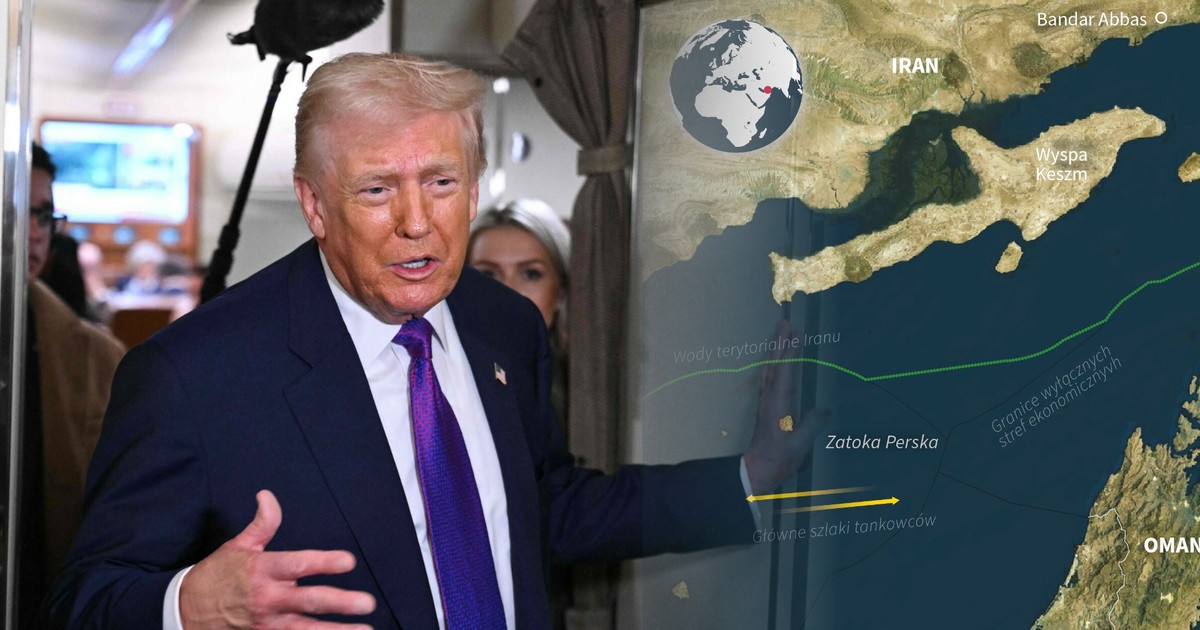
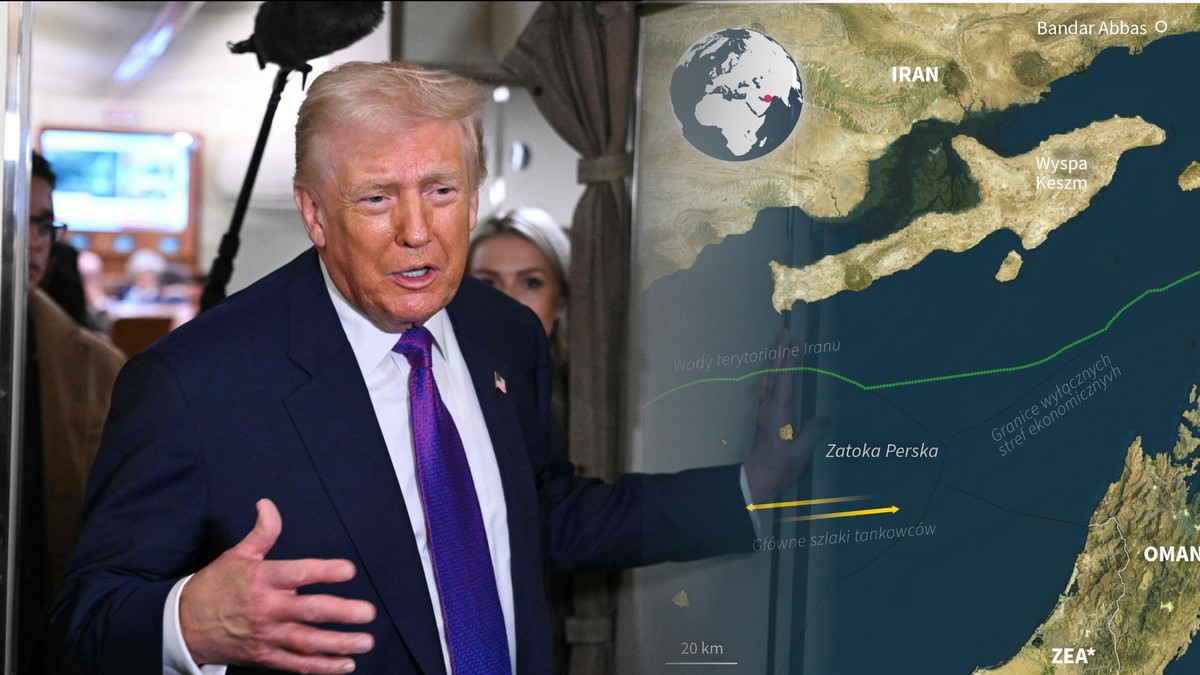
The US and Israel attacked Iran. The conflict could potentially be a shock for the entire global economy. Iran's location is strategic.
War in Iran in the worst-case scenario, it could paralyze the global oil trade. Approximately 19-20 million barrels of oil and petroleum products flow through the Strait of Hormuz daily, which is approx. 27 percent global oil trade.
Possible hostilities resulting a trade halt would be a global shock. The market had already taken this into account to some extent before the attack – prices increased by approximately 10 percent. compared to the previous month and exceeded $70. per barrel. The industry is aware that the raw material flowing through Hormuz simply cannot be replaced.
— The scale of volumes passing through Hormuz is so large that if transit is completely suspended, there is practically no real alternative. In oil alone, we are talking about about 16 million barrels a day, which would have to be replaced by other directions. Saudi Arabia and the United Arab Emirates have pipelines bypassing the strait, but their capacity would only cover part of their needs. Blocking Hormuz for a longer period would mean a clear, almost immediate increase in oil prices, explains Rafał Zywert.
Political destabilization in Iran may make it more difficult to export oil from Iran itself. Today, it is mainly aimed at China, but at the same time it increases the overall supply of the raw material in the world. JP Morgan analysts calculated that eight regime changes in oil-exporting countries contributed to price jumps at peaks (by 76 percent on average) and long-term increases of approximately 30 percent.
The rest of the article below the video:
Poland under energy pressure
Suspension of trade across the strait would harm Orlen's interests. More than half of oil supplies to Poland come from Saudi Arabia. — A possible deterioration of the situation in the region could translate into Orlen's operational activity, but in the short term, inventories are a shock absorber — mandatory, agency, commercial and what is already physically in tanks and stations – explains Rafał Zywert.
In addition to the problems with oil, there would be problems with transporting LNG, mainly from Qatar, which supplies approximately 12 percent of the country's demand. European needs, and at the same time is an important supplier to the Polish port in Świnoujście. When winter is still taking its toll and market prices are susceptible to weather changes, a temporary blockade of the strait would result in significant turbulence. According to data Gas Storage Poland Currently, Polish gas storage facilities are 54% full. The return of severe frosts would increase this pressure.
Tensions on the gas market have in the past been reflected in the increase in the costs of all logistics and production. And this ultimately results in an overall increase in inflation. How tall would he be this time? The prospect is too distant to speculate, emphasizes Rafał Benecki, chief economist at ING. — Oil market reaction However, for such a large geopolitical event it is surprisingly small, which suggests that only a lasting or prolonged increase in raw material prices could have a clearer impact on inflation. – said the analyst last week.
Rafał Zywert also reassures that the vision of a sudden increase in fuel prices at gas stations in Poland is unlikely.
Run to gold? Iran is part of the trend
However, the prospect of an escalation of the conflict may discourage investors from taking risks and return them to safe havens. And this would mean, for example, a return to the rising price of gold after recent corrections. We asked analysts about forecasts for gold prices last week, when the US was preparing to attack Iran.
According to Rafał Benecki, chief economist at ING, bullion prices were already very high, so there may be no room for further price increases.
— The shift of capital towards gold and other metals, associated with the undermining of confidence in the dollar and in traditional currencies in general in conditions of growing geopolitical uncertainty, has largely already happened. Financial markets have played out this scenario in recent months, with the current conflict surrounding it Iran does not fundamentally change the picture of the situation, but only confirms the direction in which the financial world has been heading for at least half a year – said Benecki.
The economist also does not see any major risks in terms of exchange rates. — The reaction of the euro, dollar and commodity markets to recent events is visiblebut small, and at the same time there are a number of other, more important signals favoring the zloty. Foreign capital is beginning to flow more and more boldly into Poland, which was visible both on the stock exchange and the bond market, and the argument of relatively strong economic growth – continuing regardless of whether we have a boom or stagnation in Europe – additionally supports our currency – Rafał Benecki analyzed last week.
China and the US will not allow a shock
Galloping oil prices would not be in the interests of the powers – neither China nor the US. Donald Trump often boasted about reducing raw material prices on global markets. Beijing, as the largest importer of raw materials in the world, would also like to see price declines. This unique convergence of US-Chinese interests reduces the likelihood of an economic cataclysm.
At the same time, Iran itself would not want to block the strait – its trade provides significant budget revenues for the economy burdened by sanctions.
– Such a blockade would be a problem for the entire region and the global economy, so it is difficult to assume that the international community would allow it in a time horizon of months – emphasizes Rafał Zywert.
A chance for Poland? Safe haven
The analyst points out that the countries of the region have already dealt with supply disruptions. The same could be the case with Poland. — In practice, temporary suspensions of deliveries – counted in weeks – do not necessarily mean supply problems on the retail market. The Czech Republic and Slovakia are good examples, where Russian oil has not flowed through the Druzhba pipeline since the beginning of February, and the market is still functioning thanks to stocks and alternative supplies, says Zywert.
And Rafał Benecki even emphasizes that tensions in the Middle East may translate into an increase in the attractiveness of Poland as a safe market. — From the Polish perspective, this is another reminder that keeping at least part of production closer to Europe makes sense, because in an unstable world, extended supply chains are much more risky. Maintaining production in Europe or elsewhere Central Europe is simply safer than relying solely on very distant destinations – says Benecki.
— For now, looking at the behavior of the Polish stock exchange and investor sentiment towards riskier assets such as private equity, we can see that we are perceived as a candidate to ultimately benefit from global unrest, being an important, defensive bridgehead in a sensitive point in the world – sums up ING's chief economist.
Grzegorz Kowalczyk, journalist of Business Insider Polska