Mark Kaufman
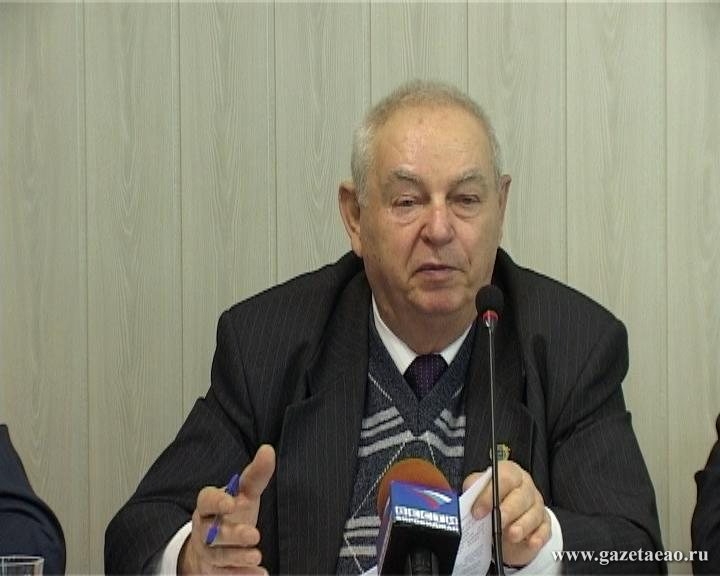
Photo: Newspaper “Birobidzhan Star”
March 1, 1932
Honorary citizen of the Jewish Autonomous Region Kaufman Mark Matveevich was born on March 1, 1932 in the city of Dnepropetrovsk.
Graduated from the Dnepropetrovsk Institute of Railway Transport Engineers. After graduation, he came to Komsomolsk-on-Amur, where he worked at the Amurlitmash plant.
In 1959, he was sent to the Birobidzhan Power Transformer Plant, where he worked as chief engineer, and from January 1971 as plant director.
With his active participation, the building of the regional philharmonic society, the Birobidzhan-Khabarovsk highway, water intake and treatment facilities in Birobidzhan and many industrial enterprises were built.
Three times Mark Matveevich was elected as a deputy of the Supreme Council of the Russian Federation.
MM. Kaufman was awarded many awards: orders, medals, a memorial sign, a Certificate of Honor from the Federation Council of the Federal Assembly of the Russian Federation, and insignia.
On November 1, 2021, Mark Matveevich Kaufman passed away.
March 1, 1935

Clippings from the newspaper “Birobidzhan Star”. Photo: Photo: Regional Library
The newspaper “Birobidzhan Star” (12+) on March 1, 1935, in the “News in Brief” section, wrote that a children's consultation would be open at the antenatal clinic in Birobidzhan from March 8. The same newspaper contains information that 100 thousand rubles were allocated by the regional council of physical education for the construction of a stadium and a sports club in the city.

At the skating rink of the Regional Trade Council. Photo: Photo: state
“A skating rink has opened at the Detal factory on the Bira River. Boots and skates are available for rental.”
The same newspaper posted an announcement that on March 1, a joint plenum of the Birobidzhan City Council and the Birobidzhan District Executive Committee, together with the plenums of the city committee and the Birobidzhan district committee of the All-Union Communist Party of Bolsheviks, would be held in the premises of the state theater. In which members of the regional executive committee, shock workers of enterprises, chairmen of village councils, shock workers-collective farmers and representatives of the Red Army will take part.
March 1, 1950
A regional meeting of leading agricultural workers was held. It was attended by collective farm chairmen, foremen, team leaders, livestock breeders, and representatives of various branches of collective farm production.
At the meeting, the tasks of regional agricultural workers to fulfill the requirements of the party and government for the development of the vegetable, potato and meat and dairy food supply in the Khabarovsk Territory were discussed. At this meeting, special attention was paid to the need to introduce high-quality farming, develop new forms of crop rotation, and increase livestock productivity.
In conclusion, the meeting participants accepted the socialist obligations of agricultural workers in the region for 1950.
March 1, 1990

Oncological dispensary. Photo: Photo: From the personal archive of Mark Kaufman
The academic institute in Birobidzhan was created thanks to the long-term joint efforts of the leadership of the Jewish Autonomous Region and the Presidium of the Far Eastern Branch of the USSR Academy of Sciences.
On March 1, 1990, President of the USSR Academy of Sciences, Academician G.I. Marchuk signed Resolution No. 423, adopted by the Presidium of the USSR Academy of Sciences, on the organization of the Institute of Regional System Research.
In the resolution of the Council of Ministers of the USSR dated May 26, 1990 “On the socio-economic and national-cultural development of the Jewish Autonomous Region for the period until 2000,” signed by the Chairman of the Council of Ministers N.I. Ryzhkov, the newly created institute was given a new name, which has actually remained to this day: Institute for Comprehensive Analysis of Regional Problems.

IKARP is actively developing a scientific direction, including complex analysis and modeling of the development processes of natural and natural-economic regional systems. The institute's traditional geological work continues, and economic-geographical, ecological, floristic and faunal research has intensified.
The Institute carries out work under the Programs of the Presidium of the Russian Academy of Sciences, the Observatory of Natural Sciences of the Russian Academy of Sciences and the Department of Public Health of the Russian Academy of Sciences, competitive projects of the Far Eastern Branch of the Russian Academy of Sciences, grants from the Russian Foundation for Basic Research, the Russian Humanitarian Fund and regional programs.
March 1, 1994

Oncological dispensary. Photo: Photo: Regional Library
On March 1, 1994, the regional oncology clinic began its work – a specialized treatment and preventive institution.
The oncology clinic accepts patients from the Jewish Autonomous Region. The dispensary is engaged in highly qualified treatment of tumor diseases and pre-tumor conditions, development of new effective methods for diagnosing and treating cancer, carrying out medical examinations of cancer patients, and conducting preventive medical examinations of the population. Since 2007, the direction of oncourology began to develop at the dispensary.
In 2014, the oncology dispensary participated in the federal program for providing oncological care to the population, thanks to which the dispensary received new equipment not only for the inpatient departments and clinics, but was also able to open a histology laboratory. In 2015, a pathological laboratory was opened to conduct histological and immunohistochemical studies, which is one of the best laboratories in the Far East; in March 2016, a new clinical diagnostic laboratory was opened.
On November 1, 2017, modern high-tech equipment began operating – a magnetic resonance imaging (MRI) scanner and a multispiral computed tomography (MSCT) scanner.
In March 2018, the oncology clinic received a license to provide high-tech medical care and acquired the status of a 3rd level medical institution.
March 1, 1997
The connection of Birobidzhan consumers to the global computer network has begun, connecting users of computer networks and individual computers. Since that time, the Internet began to turn into one of the most popular sources of information and gradually acquired a modern appearance. In Russia, by 1997, the first online newspapers had already appeared, the search engine Yandex.ru had appeared, and hackers began to operate.