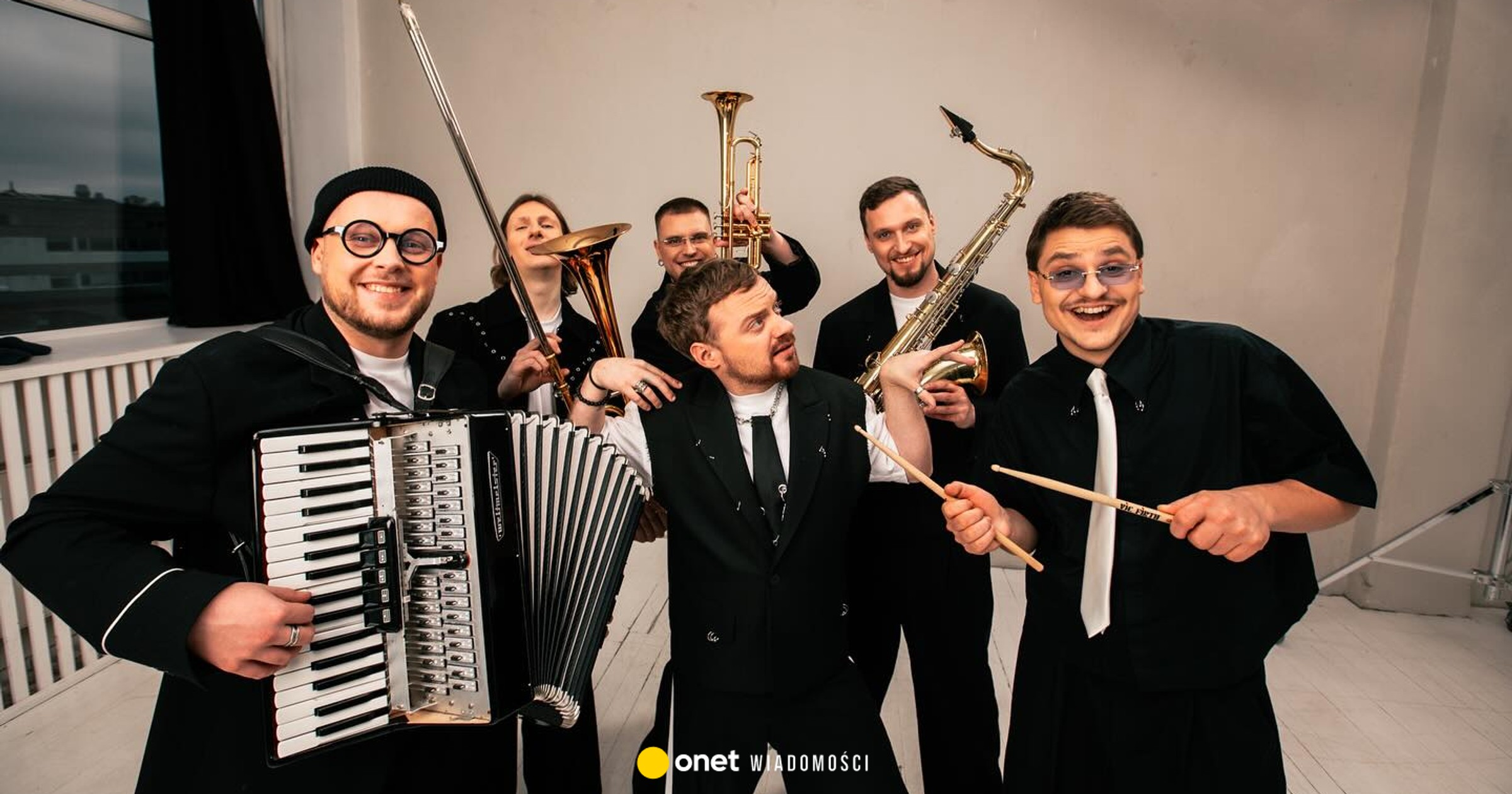
We present a fragment of the chapter “Do you think in Polish or Lithuanian?” from the book “With a view of Poland. Neighbors, Stalin's thumb, Czech debt and the KGB”
I meet with Vitalij Walentynowicz in a charming cafe combined with a bookstore on one of the main streets in Vilnius. Vitaly is one of the founders of the eight-person band Black Biceps, which was established in 2012, a frontman and a songwriter. From the moment I entered, I was struck by his radiant smile and great openness.
— “Depozito” was seen by all of Lithuania. It was the banger of the summer and we really became famous. We didn't expect this. We had a lot of concerts later, but we finally realized that people forget quickly, it's a natural thing, he says.
After great success came flauta. The clash with reality was all the more painful because even before the big hit “Depozito”, Black Biceps took part in the program “Lietuvos talentai” (the equivalent of Poland's “Got Talent”) in 2013 and 2017. They even reached the superfinals, so they were recognizable in Lithuania even before the parody of the Latin summer hit. However, 2020 came. Pandemic, canceled concerts, lack of money.
“We started to wonder whether making a living from music makes sense at all,” says Vitaly Walentynowicz.
To change something, they took part in the Polish edition of the program “Must Be the Music. Only music” with the song “Luba Ty moja”. The band is composed of people of Polish and Lithuanian nationality, and Witalij Walentynowicz and Edgar Krivelis, the founders of Black Biceps, were born in Niemenczyn into Polish families, so they speak Polish very well and decided to perform a song in this language in the program. They entered the stage confidently and moved the audience from the first sounds. Dawid Kwiatkowski, one of the jurors, said: “Oh, Enej has arrived.” Natalia Szroeder nodded. In fact, Black Biceps and Enej have a similar number of men on stage, energy and playing the accordion. After the performance, Dawid Kwiatkowski said: “If you sang in Polish, I would really think it was Enej playing.”
[Reklama] The text comes from the book “With a view of Poland. Neighbors, Stalin's thumb, Czech debt and the KGB”. This is an opportunity to look at our country from a previously unknown, intriguing perspective through fascinating reportages. You can order it here!
With a view of Poland. Neighbors, Stalin's thumb, Czech debt and the KGBOnet
Black Biceps sang in Polish, or rather in the Vilnius sociolect. The team didn't make it through – only two jurors said yes.
The guys did not slow down, Vitaly started writing a song for the Eurovision preselections in the hotel room.
The article continues below the video
Why do Lithuanians love Eurovision so much?
Lithuanians approach the competition with pomp. First there are the semi-finals, then the final and the super-final. Each stage is broadcast by Lithuanian public television. The final and superfinal take place at the Zalgirio Arena in Kaunas. It is the largest arena in the Baltic countries. For comparison, the Polish preselections for Eurovision 2025 were organized at the TVP headquarters at Woronicza.
In the Lithuanian semi-final in 2025, Black Biceps received a record number of votes from viewers, but initially they did not advance because the jury only gave them third place, which ultimately excluded them. After an avalanche of protests not only from Black Biceps fans, Lithuanian television changed its mind and gave the band a “wild card”, thanks to which they performed at the Kaunas arena among 12 other participants. We were a bit unlucky again. The boys from Black Biceps took fourth place, and the band Katarsis received the honor of representing Lithuania at Eurovision.
The final of the Eurovision pre-selection usually takes place in February. Later, Lithuanians wait four months for the grand final of the European competition. Lithuania really lives Eurovision. In one of the largest parks in Vilnius, in the Bernardine Garden, a large telescreen is set up on a specially built stage so that Vilnius residents can watch a TV show together. Food trucks are set up all around.
People also gather in pubs and bars to watch the semi-finals and finally the grand final. Some people choose to stay at home and fill out special cards while watching, writing down their ratings for their performances. They also play Eurovision bingo. At this time, empty city buses with slogans cheering for the Lithuanian representatives are rushing through the streets of Vilnius. In 2025, the vehicles had the inscription “TAVO TAVO”, a line from the chorus of a song by Katarsis.
Katarsis syndromeKeystone / KeystoneSU / PAP
Vasily has his theory about Lithuanians' love for Eurovision. — Our pre-selections take place probably in the most depressing period, after Christmas and New Year. It's gray, wet, there's almost no sun. Basketball season hasn't started yet, and as you probably know, basketball is the national sport for Lithuanians. And these pre-selections are the only event that gives some light in this gloomy time.
In 2021, The Roop band fought for the crystal microphone, wearing characteristic yellow costumes and representing Lithuania with the song “Discoteque”.
— They had a great chance of winning. Lithuanians started to feel again that the Lithuanian team could win or be high in the table. Our highest result was in 2006, when the band LT United won sixth place with the song “We Are the Winners”, adds Vasily.
Back then, the most famous monuments in Vilnius were decorated with yellow and disco accents. At Cathedral Square, Gediminas held a disco ball in his hand, a yellow cape fluttered on his shoulders, and Mindaugas, the 13th-century king of Lithuania, was wrapped in a canary scarf.
Ultimately, Lithuania took eighth place, and the winner was the rock band Måneskin from Italy with the song “Zitti e buoni”. However, a year earlier, the Lithuanian The Roop with the song On fire had even better ratings. According to bookmakers, Lithuania was the second country with the best chances to win Eurovision 2020. However, due to the COVID-19 pandemic, the competition was canceled for the only time in history.
Vasily has to go back to the recording studio, I'm going for a short walk. I walk along Wileńska Street, passing the monumental Baroque Church of St. Catherine. However, what catches my attention is the huge queue across the street. It appears to be over 20 meters long. I quickly realize that the target of the young people standing there is the Vasaros Terasa music club. I check the list of events and I already know. A concert of the band Katarsis, this year's Lithuanian representative at Eurovision in Switzerland, is to be held here. Tickets sold out.
I’m Ashley Davis as an editor, I’m committed to upholding the highest standards of integrity and accuracy in every piece we publish. My work is driven by curiosity, a passion for truth, and a belief that journalism plays a crucial role in shaping public discourse. I strive to tell stories that not only inform but also inspire action and conversation.