The gradually growing popularity of Chinese models is a fact that cannot be disputed – if only because Qwen from Alibaba recently overtook the Llama model from Meta in terms of the number of downloads. At least on Hugging Face, a specialized platform that is the default place for publishing most LLMs. This does not mean that it is automatically better – just more popular. Although, according to a report prepared by Stanford University, there are more parameters in which Chinese AI overtakes Western ones.
Of course, we are only talking about open, free models – most Western solutions, especially the globally most popular ones, are intensively monetized. Both models of market functioning are difficult to directly compare, but one thing is beyond doubt – competition in this field between American and Chinese entities will continue.
Jumping into the deep end
One of the main contenders to overthrow the dominance of Western big tech was DeepSeek. Although the first products actually began to be made available in 2024, a breakthrough was made at the beginning of 2025 with the release of the R1 model, built on the basis of the V3 version. Although there was a lot of false evangelism and distortion at that timeprophesying a complete change in the paradigm and balance of power in the world, the propaganda filtered in subsequent entries and posts gained a lot of ground, one thing must be said about DeepSeek – it was at a level similar to the GPT-o1, GPT-4o and Claude models of the time, and all its shortcomings disappeared in the face of the fact that it could be run completely locally, i.e. without connecting to the network. Combined with the fact that it was free, it was a very tasty treat not only for advanced individual users, but above all for companies.
See also: Feudalism of the 21st century. Bezos and Huang want you to have nothing
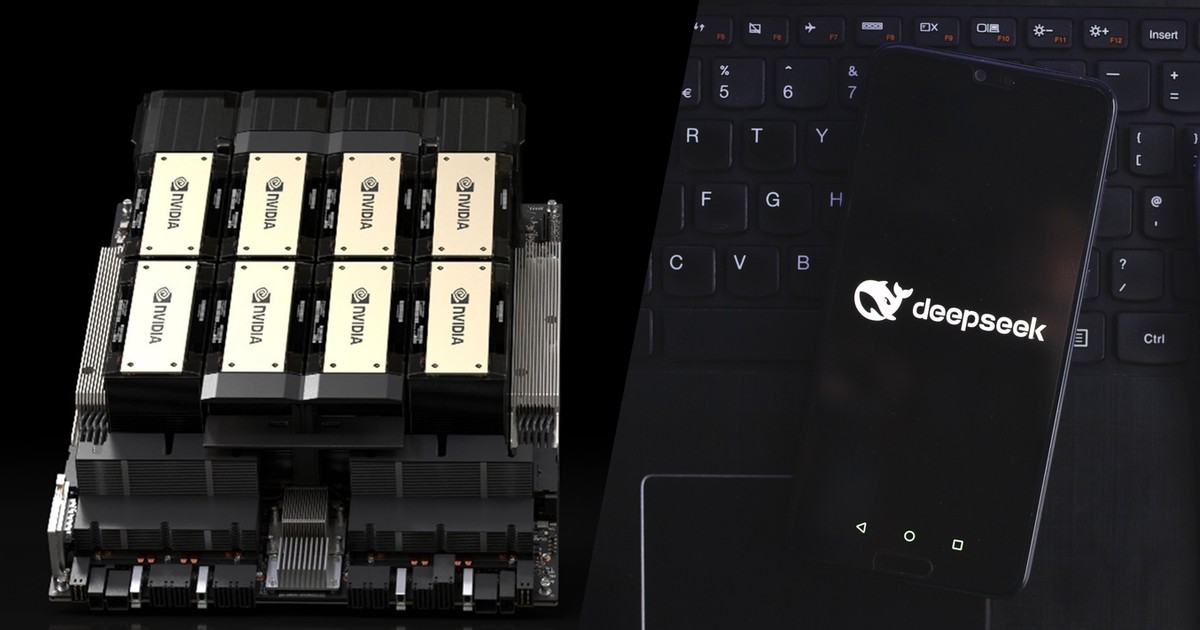
If DeepSeek followed suit and released subsequent, clearly improved versions of the same model, there could actually be market turmoil. The key to initial success was using the Chinese infrastructure model from Nvidia to train. Although not the newest one due to the trade restrictions imposed by the Biden and Trump administrations, but sufficient for the tasks entrusted to them. The huge clusters built, consisting of over 2,000 Nvidia H800 units (simplified and slower than the original H100), were powerful enough to train an impressive model. And even if the method of obtaining training data was controversial, the world turned a blind eye to it.
Chinese technological thought versus reality
DeepSeek's huge success and the momentum with which they entered the main stage of the AI industry slowed down sharply a few months later. All thanks to the Chinese People's Party strict policy related to the use of foreign components. Chinese companies, including technological ones, are expected to use primarily Chinese solutions in the eyes of power. The not entirely subtle suggestion to abandon Nvidia components in favor of Chinese technological ideas was, of course, accepted by DeepSeek and work on the next R2 model was carried out in a different way. Although updates for previous models are made available (the latest version 3.2 debuted in September 2025), they are gradually losing out to the market leaders and in most rankings, at best, they barely qualify for the TOP10. This R2 was supposed to be another powerful blow to the West.
This is where the company's biggest problems really began. For the reasons discussed above, it was decided to train further LLMs use no longer Nvidia's infrastructure, but chips from the Huawei Ascend series. On paper, it should work, as assurances from China indicated that the Ascend 910 series models might be as good as the H100. Of course, as always, you have to take propaganda corrections to this type of reports, but the effect… was much worse than could be expected even in the worst-case scenario. The Financial Times, taking a closer look at this matter, found reports indicating that the R2 training encountered technical blockages each time, and the entire process simply could not be completed.
This is an unprecedented situation in the industry – the model training process usually takes longer in case of certain difficulties. The “inability to complete training” is practically unheard of and means so very serious problems with the stability of all equipment and infrastructure. In an article by Eleanor Olcott and Zijinga Wu of the Financial Times, they wrote: – Industry insiders report that Chinese systems are struggling with stability problems, slower inter-chip connectivity and inferior software compared to Nvidia products.
DeepSeek with a dose of green oxygen
Pressure from the Chinese authorities to use Chinese components has resulted to a real halt in progress and a complete remodeling of the calendar. In the original version – DeepSeek R2 was scheduled for release in May 2025four months after the R1's debut. Huge problems with training the model on Huawei's infrastructure forced the company to make significant delays… and look for compromise solutions that combine the requirements of the People's Party of China and market realities.
The hybrid, in the form of combining Huawei and Nvidia's infrastructure, was a step that pushed the entire project in the right direction again, but the key decision for the entire process was made only at the end of January. As Reuters reports, that's when Chinese authorities have given — after months of resistance — formal consent for DeepSeek to purchase new Nvidia chips. H200you are up to 45% more efficient. compared to the H100s on which R1 was trained is exactly what the company needed. Of course, the purchase itself has not yet taken place, but it is most likely a matter of the next few weeks.
Importantly, a moment earlier, other Chinese entities, such as Alibaba, ByteDance and Tencent, also received consent to make similar purchases. In total, the Chinese have permission to purchase as many as 400,000. Nvidia H200 chips. The fact that this happened at all is the result of two events in recent weeks – the Trump administration's decision to loosen trade restrictions on chips… and intense lobbying by Jensen Huang, the head of Nvidia, which culminated in meetings with both American and Beijing authorities.
Where the US and China fight, Nvidia benefits
Nvidia has achieved its goal and can sell advanced chips to selected Chinese partners (taking into account a 25% government subsidy). For the “greens” it is a huge injection of additional cash, amounting to billions of dollars. For China – a chance to shift into a higher gear in terms of developing its own artificial intelligence. Of course, real acceleration will not happen overnight, but when more powerful infrastructure enters China and is integrated with existing systems, we will probably start to observe a situation similar to last year. After a break of about a year, Chinese solutions may return to the spotlight again in our part of the world, as there are many indications that they will continue to be distributed in the free open weight model. China does not make money from this, of course, directly, but in the ongoing competition with the USA and American companies, After all, it's not about who makes more money – it's about who brings the other down.
China hopes that in this way it will be able to disrupt the dominance of Western big tech, on which a significant part of the American and European economy is based. The US, in turn, hopes that by allowing its technology to be sold, it will slow down the development of its own production capabilities on the part of China. In other words, although allowing the sale of Nvidia's most powerful chips may seem risky, The US hopes that in this way it will make the Chinese new technology sector dependent on itself. And this way they will be able to control him.
Both sides risk a lot, especially since only one of them can be right. We may start seeing the first symptoms of someone who has had their way in the coming months.
See also: Forget about how you used the Internet so far. Google Chrome is introducing the biggest change in its history