Such research by the Central Statistical Office is a field for analysis by many institutions, including the National Bank of Poland, but also by political parties. Their results may even decide whether members of the Monetary Policy Council decide to cut or refrain from cutting it at the March meeting, but they may also change election polls.
The Central Statistical Office conducted 1,351 surveys with detailed and standardized questions for years, and the answers paint a picture of the consumer market.
The financial situation of Poles is improving
And the latest research shows that in February we improved both compared to the same month last year and January this year. The current consumer confidence index increased by 5.7 points. year to year and by 0.5 points. month to month. Unfortunately, this does not mean that it is already positive.
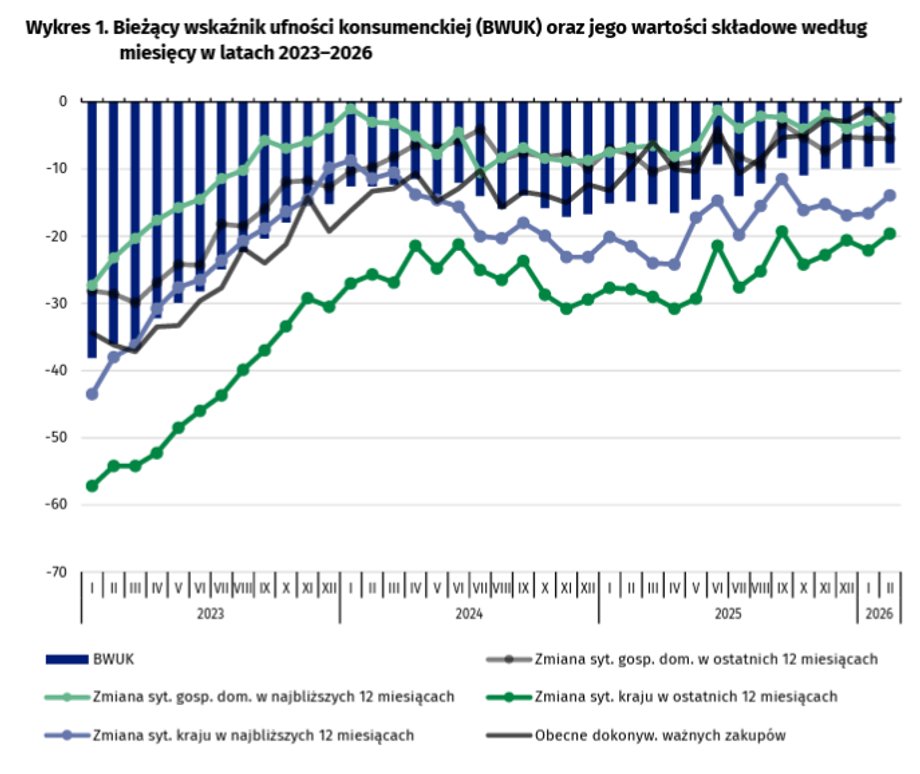
Current Consumer Confidence Index
|
Central Statistical Office, own study
In February it was calculated at minus 9.1 points, so it still is more pessimists than optimists. On the plus side, the advantage of the former over the latter is decreasing for the fifth month in a row. Recently, there was less pessimism among consumers in September last year.
The worst reading of the indicator was in October 2022. A year later, PiS lost power. Our best assessment of reality was in September 2019 (10.2 points). In 2019, PiS won the elections and the results gave it an independent government majority. It can be said that the Central Statistical Office surveys are a good measure of economic sentiment, based on which people judge whether the government is governing well or whether a new government is needed.
We judge the future slightly better than the present because the leading consumer confidence index was minus 7 points in February. That's 0.3 points. worse than in January, but by 3.8 points. more than in February 2025.
We were at the bottom of anxiety about the future at the beginning of the pandemic in April 2020 (-47.7 points), and we had the best predictions less than a year earlier, in June 2019 (+7.5 points).
How is the financial situation of Poles changing?
When asked about the change in their financial situation in the last 12 months, 18.6 percent gave positive answers, including 2.5 percentage points. with great improvement, and 26.5 percent — negative answers, including 5.6 percentage points very negative. The share of dissatisfied people decreased by 0.8 percentage points. y/y, and increased by 1.8 points. month to month, and those who were satisfied increased by 1.6 points. percent year to year and 1.7 percentage points month to month.
When predicting changes for the next 12 months the share of pessimists decreased by 6.8 percentage points. during the year to 21.2 percent, and month to month by 1.6 percentage points. The percentage of optimists remained almost unchanged both year-on-year and compared to January and amounted to 19%.
What about the economic situation?
She improved significantly assessment of the current economic situationalthough it is still negative. In February, 17.3 percent had a positive opinion about it. respondents, and negatively – 45.4 percent However, 1.8% say that the situation is much better. Poles, and much worse – 12.9 percent. Very good grades, although not many, nonetheless the highest since January 2024
Expectations have also improved. 17.5% expect the economic situation to improve. respondents, and deterioration – 37.6 percent The former increased by 2.6 percentage points during the year, and the latter decreased by 8 percentage points. 1.7% think it will be much better. of us and this is the best result since April 2024.
This data will be of interest to the Monetary Policy Council
And most importantly – what do we expect from inflation and unemployment and whether we plan to increase purchases with our growing salaries. These results may influence the RP's decision.
And they are positive. The advantage of people who expect an increase in the price growth rate is decreasing or maintaining it over those who think that inflation will fall, or prices will not change in 12 months, or that they will even fall. Inflation expectations are an important factor in examining the prospects for price changes – just because we expect them to accelerate, it can cause this acceleration.
5.8% are afraid of an increase in inflation. of us, i.e. by 3.4 percentage points. less than a year earlier, and by 0.2 percentage points. more than in January. The largest group is the group waiting for inflation to stabilize at recent levels, 48.7%. people, i.e. by 1.1 percentage points. more y/y and by 2 percentage points. less mdm. As much as 19.5 percent respondents believe that prices will not change at all during the year, i.e there will be no inflation and this is the highest result since September 2023.
In the case of unemployment, there is also a potential signal for a reduction in interest rates. As many as 40.8% are afraid of an increase in unemployment. of us, i.e. by 1.7 percentage points. more y/y and by 1.2 percentage points. more mdm. This highest measurement since March 2023 The more difficult the labor market is for an employee, the smaller the raises employers will give, and the smaller the raises they give, the less purchasing pressure from consumer demand for prices.
It all connects with ours plans for “larger purchases”i.e. furniture and electronics/household appliances. Here only 12.4 percent believes that it will be able to buy more in the next 12 months than in the last 12 months. This is by 0.4 percentage points. less y/y and 0.7 percentage points less than in January. The most, 35.6 percent. believes that their large purchases will neither increase nor decrease, by as much as 8.5 percentage points more year-on-year.
As you can see, the signals for the Monetary Policy Council are positive, i.e. indicating that a reduction in rates is advisable when inflation is low.
Moreover, the number of people planning to save is growing. There were 45.7 percent of them. in February, of which