
publication
2026-03-12 21:07
The continuing blockade of the Strait of Hormuz has once again pushed Brent oil prices above one hundred dollars a barrel. Wall Street investors are increasingly impatient with the war with Iran and sharply discounted U.S. stocks and Treasury bonds on Thursday.
The times have come when the financial world starts and ends the day by looking at oil prices. And on Thursday, the price increased by almost 10% and in the case of Brent it costs over USD 100 per barrel again. This is a psychological pain line that, when crossed, puts the global economy at risk of recession or stagflation. All the more so since nothing has yet come of the US Navy's announcement of tanker convoys, which was to deny shipowners protection in the Strait of Hormuz.
And all because of Iran's blockade of the Strait of Hormuz. The number of merchant ships attacked near the strait increased to five. Traffic through Hormuz has practically stopped (only tankers with Iranian oil use it), which deprives the world of approximately 15% of oil production. Donald Trump himself added fuel to the fire. The US president wrote that “when oil prices go up, we make a lot of money.” But this “we” refers to American oilmen, not American consumers who pay more and more for increasingly expensive fuels.
Advertisement
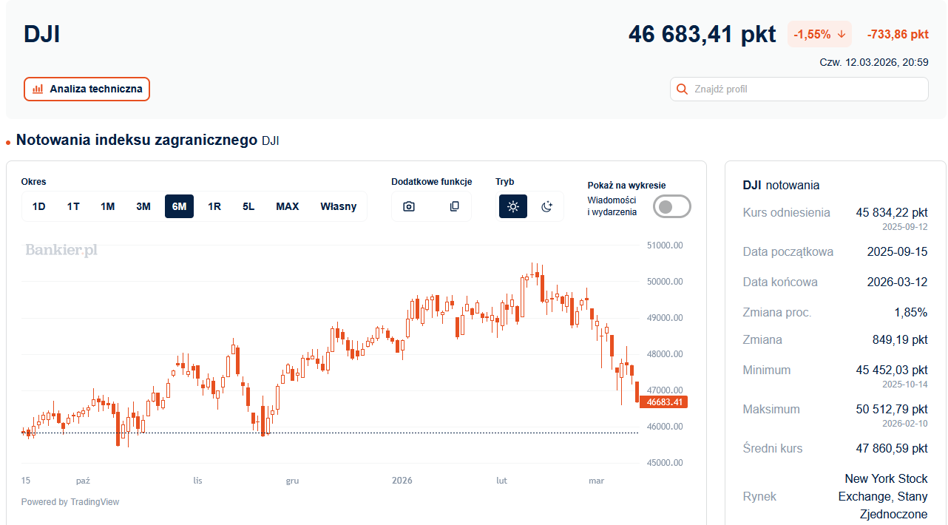
In such circumstances, it is hardly surprising that Thursday's session on Wall Street ended with significant declines. The Dow Jones lost 1.56% and stopped at 46,677.85 points, marking the lowest closing price since November. The same as the S&P500 index, which dropped by 1.52% and finished with a score of 6,672.62 points. The Nasdaq Coposite, after falling by 1.78%, stopped at 22,311.98 points. The VIX volatility index jumped by almost 12%, to 27.06 points.
Almost all sectors of the US stock market were glowing red. Among the 500 largest companies, only the shares of a few technology companies, the shares of the cheapest retail chains (Wal Mart and Costco) and producers of basic consumer goods, as well as the shares of oil companies (Exxon and Chevron) and public utility companies increased.
But the most interesting thing is that bonds issued by the US government also became cheaper. The yield of 10-year Treasuries rose to 4.26% and reached the highest level in over a month. The yield on 2-year US government bonds reached 3.75% and was the highest since August. This suggests that the debt market (i.e. the one larger and “smarter” than the stock market) is slowly losing hope for any further reductions in interest rates from the Federal Reserve.
Although the futures market estimates one 25-point cut by the end of 2026 at 60%, this is clearly less than before the Israeli-American attack on Iran. The stagflation scenario is slowly becoming more and more realistic, in which increased inflation and unreduced interest rates are accompanied by stagnation in the economy and growing unemployment. This is one of the worst-case scenarios for stock markets.
Additionally, there were new warnings about the growing crisis in the private debt market. Swiss private equity firm Partners Group has warned that the default rate in this sector of the credit market may double in the coming years. This is not the first report of this type warning against a wave of failures on a market with a capitalization of over two trillion dollars.
The publication contains affiliate links.