During the Munich Security Conference, which has just ended, Emmanuel Macron, Friedrich Merz and Keir Starmer discussed the European nuclear deterrent.
The big question is: can Europeans continue to trust the United States with their security? Under President Donald Trump, this issue is becoming increasingly important. Even Britain, whose nuclear forces are largely dependent on the US, has doubts.
As Starmer emphasized, this is why Great Britain is “deepening nuclear cooperation with France.” — For decades, Britain was the only nuclear power in Europe to use its deterrence to protect all NATO members. In the future, every adversary must know that in the event of a serious threat, they will face common armed forces, he said.
However, there is still a long way between intention and implementation. Nuclear weapons are a symbol of national sovereignty. France, the second nuclear power in Europe after Great Britain, is therefore thinking less about integration and more about a new direction. Unlike London, Paris is implementing its deterrence policy without American help.
Decades of distrust
In Munich, Macron said he wanted to integrate a “national doctrine,” guaranteed and controlled by the constitution, with selected partners — through cooperation, joint exercises and shared security interests. He confirmed that this would be the first action of this type with Germany. Macron also announced that he would soon deliver a speech on the nuclear doctrine.
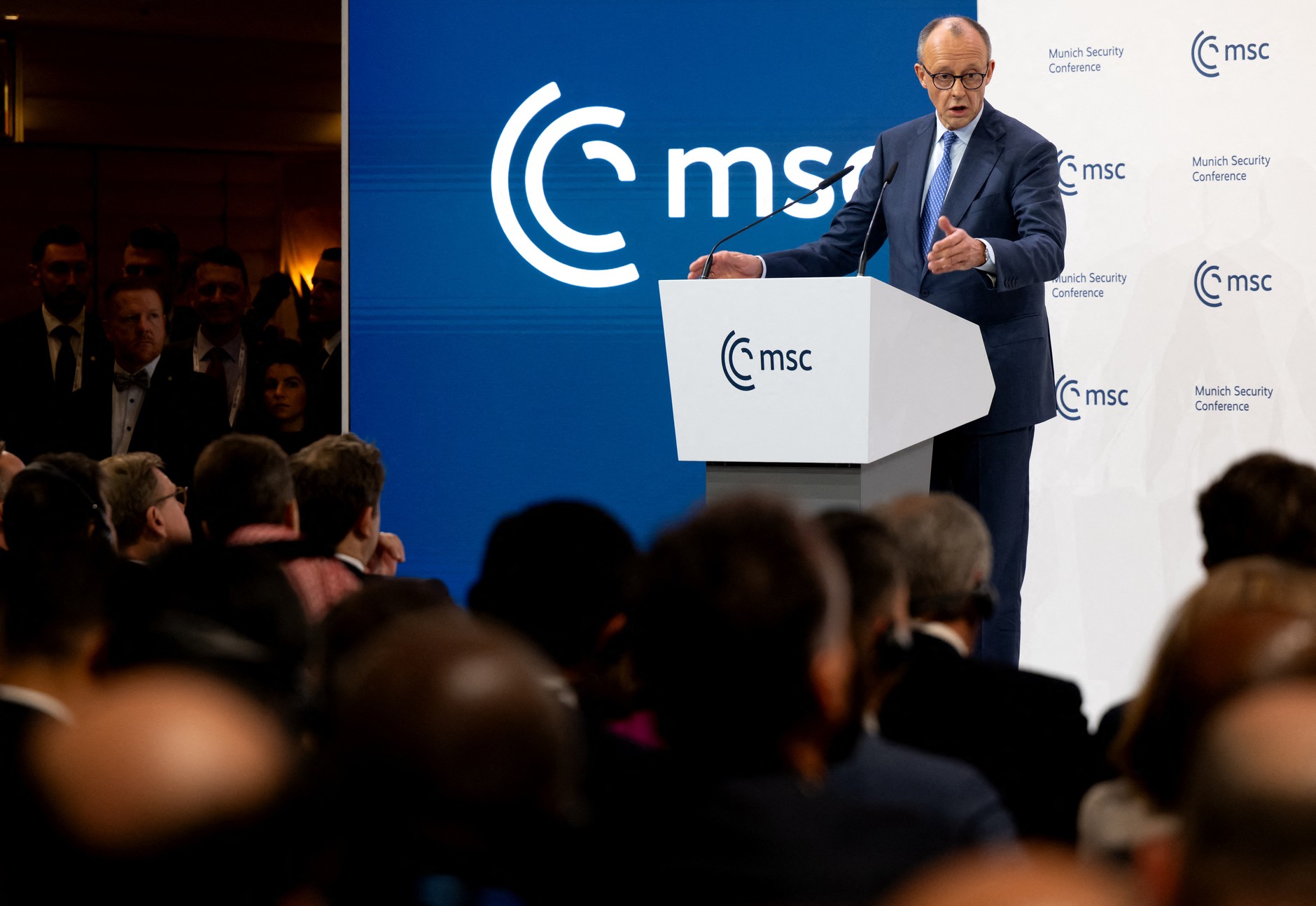
In turn, in his speech during the Munich summit, Merz emphasized that has already started “confidential talks” with France on European nuclear deterrence.
Two obstacles remain: the secrecy around these weapons and the political will to leave the final decision to individual countries.
The article continues below the video
— Deterrence is national. Moreover, decades of mistrust have strained relations between Paris and London. The British nuclear industry has long been dependent on the United States, notes French General Francois Chauvancy, an expert in geopolitics and editor-in-chief of Defense magazine.
So how can deterrence be Europeanized? Most likely because France – with deliberate ambiguity – will reformulate its strategy and will include the territory of the European Union and close partners such as Switzerland.
Five deterrence scenarios
There is also an idea circulating in Berlin that Germany could co-finance the French nuclear industry — it costs approximately EUR 6 billion (over PLN 25 billion) annually. Merz promised in Munich that he would make the Bundeswehr the strongest army in Europe.
Additional tension during the Munich security conference was introduced by the Pentagon's highest-ranking security policy official, Elbridge Colby. He stressed that the US wants Europe to provide the bulk of the continent's conventional deterrence in the future, while the US would remain responsible for the nuclear weapons umbrella.
German Chancellor Friedrich Merz speaks at the 62nd Security Conference in Munich, February 13, 2026.SVEN HOPPE / DPA / dpa Picture-Alliance via AFP / AFP
The report of the European Nuclear Research Group presented at the Munich conference presents five directions for Europe – and at the same time warns: none of them is perfect, none is cheap, none is without risk.
The options are as follows:
continued reliance on U.S. nuclear deterrence
strengthening the role of British and French nuclear forces in European deterrence
developing a common European deterrence system
creation of new national nuclear deterrence systems
relying solely on conventional forces.
The time for complacency is over
However, one thing is certain. The report clearly warns that Europe can no longer delegate nuclear deterrence to Washington. The time for strategic complacency is over.
The new security environment forces European governments to address the role of nuclear weapons quickly and soberly – and to provide the necessary resources.
In short: the problem has been recognized. The solution is no.
I’m Ashley Davis as an editor, I’m committed to upholding the highest standards of integrity and accuracy in every piece we publish. My work is driven by curiosity, a passion for truth, and a belief that journalism plays a crucial role in shaping public discourse. I strive to tell stories that not only inform but also inspire action and conversation.