An irrational decision that changed the destiny of Russia. What did “Bloody Sunday” mean and what a chain reaction it caused


In 1905, the first Russian revolution, considered by some to be the real Russian Revolution, broke out in Tsarist Russia, before it was seized, 12 years later, by the Bolsheviks. It represented the alarm signal of an oppressed, impoverished and humiliated people, which the Tsar failed to understand.
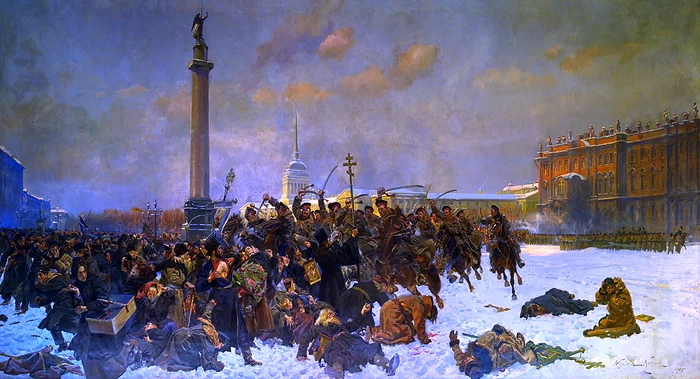
Bloody Sunday PHOTO wikipedia
On November 7, 1917, the Bolsheviks seized power in Russia. And this after since the beginning of the year revolutionary movements have gripped Russian society. The tsar had abdicated in the spring, and Russia was turning into the world's first communist state. An event that would radically change world history and influence the destinies of many peoples, including Romania.
Little known to the general public is the fact that the Bolsheviks probably would have had less of a chance in 1917 if Czar Nicholas II and the Russian aristocracy had managed to connect to the reality of early 20th century Russia and especially if they had understood the alarm signal raised by the population 12 years earlier. And that's because the first Russian revolution took place in 1905, when a bizarre decision by the Tsar and his men blew up an entire country and paved the way for the formation of soviets. Those soviets in which the Bolsheviks will nest in 1917 and create the mammoth state that kept the peoples of Central-Eastern Europe under the Iron Curtain.
“An Empire on the Brink”
To understand what happened in 1905 in Russia, we need to take a general look at this huge empire at the beginning of the 20th century. By the beginning of the First World War, the Tsarist Empire was one of the largest states in world history, occupying an area of approximately 22.8 million square kilometers.
It stretched from Eastern Europe, crossing Northern Asia (Siberia), to the Pacific and Bering, also including Central Asia and the Caucasus. From the middle of the 18th century until the middle of the following century, the Tsarist Empire represented one of the most important European powers. At the beginning of the 20th century, Tsarist Russia was just a giant with feet of clay. An autocratic monarchy led by Nicholas II, a tsar completely detached from the realities of his age. The Tsar held absolute power and democratic institutions were limited or non-existent. And this at a time when Europe had already entered the second industrial era, with great technological advances, but also at the level of mentalities and civil liberties.
The majority of the population was represented by poor, illiterate peasants who worked small plots of land and paid heavy taxes. The agrarian reform of 1861, like Cuza's in the Principality, had not given them sufficient autonomy or land. In the industrial cities, a new class had formed, that of the workers.
Most of them came from peasants who came to the city. Russian workers lived in inhumane conditions, in dirty and poor slums, with low wages and long hours of work. The only privileged class was that of the secular and religious aristocracy. Nobles and priests owned most of the lands and privileges. There was also a bourgeoisie concentrated mainly in Moscow and St. Petersburg, but much less developed compared to Western Europe. It was a country groaning with social problems, with a medieval form of government, in a modern Europe.
Beyond the increasingly dystopian world of the Russian aristocracy, perfectly captured in Chekhov's plays, Russian society was changing. They were talented people who wanted the Russian Empire to keep pace with the modern world. Especially the students, some with studies abroad, were bringing the wind of change. The discontent of the population was amplified by several factors starting in 1901.
The workers' unions were ticked by Police informers, which led to discontent among the proletariat. At the same time, Russia began to be affected by the global recession. That is, unemployment increased, working conditions became tougher and wages were getting lower. Russian workers could no longer survive. The factories had become veritable powder kegs, in which the revolution smouldered. Last but not least, the Russian defeats in the Russo-Japanese War of 1904-1905 further damaged the Tsar's prestige. Especially in the context in which Russia had lost Port Arthur, one of the most important Russian naval bases in Manchuria. “Russia at the beginning of the 20th century was an empire on the brink: social tensions, state inefficiency and participation in war created the conditions for the most radical revolution of the century”,
“Bloody Sunday”
All this time the Tsar was effectively cut off from reality. As evidence, the absolutely irrational decisions that, in fact, sealed his fate. And to him, and to Russia, and to the world as will be seen later. It all started with a peaceful gathering of workers in St. Petersburg on January 22, 1905. In short, a crowd of workers and their families, led by Father Gheorghe Gapon, wanted to present a petition to the Tsar asking for reforms to improve their lives. Gapon had already formed a union of factory workers in St. Petersburg, called the Assembly of Factory and Mill Workers of Russia. Gapon's petition had an impressive 150,000 signatures. Among the demands were a more representative system of government and greater freedom of expression.
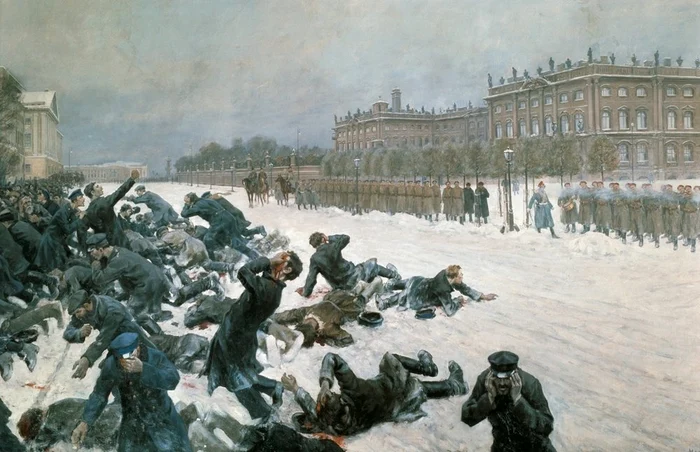
Bloody Sunday PHOTO wikipedia
Workers wanted the right to form unions, eight-hour days, better wages and accident insurance. In addition, the workers were not happy with the interference of the secret police in the unions. At the same time, the peasants wanted more land and cheap credit to buy it, a fairer tax system and better conditions for their children, especially easier access to education. The crowd was unarmed and many even carried portraits of the Tsar. The Tsar would neither listen to them nor read their petition. The officers of the Winter Palace Guard asked the crowd to disperse. When they saw that the people were determined to protest, the soldiers opened fire as the workers approached the Winter Palace. Later, the workers, among whom there were also many women accompanied by children, were charged by the Cossack cavalry. More than 1,000 people were killed and many more were seriously injured. The incident became known as “Bloody Sunday”.
Russia thrown into chaos
The attitude of the tsarist authorities towards the peaceful workers caused a shock wave in Russian society. It was increasingly clear to people that things had to change radically. The situation was extremely serious.
In retaliation, on February 17, 1905, the Tsar's uncle, Grand Duke Sergei Alexandrovich of Russia, the Governor-General of Moscow, was assassinated. A socialist revolutionary threw a bomb into the Grand Duke's carriage and killed him instantly. Russian society was paralyzed by strikes and riots. The world had had enough and what had happened on “Bloody Sunday” had scandalized them beyond measure.
The workers in St. Petersburg were the first to go on general strike. They were followed by the students and pupils who effectively closed the universities and high schools. The icon of the tsar, as God's anointed and righteous ruler, was shattered for good for the workers. “On this day I was born a second time, but now not as an indulgent child but as an embittered man, ready to fight and triumph“, said a worker who had escaped with his life after “Bloody Sunday”. In October, workers from all over Russia went on strike.
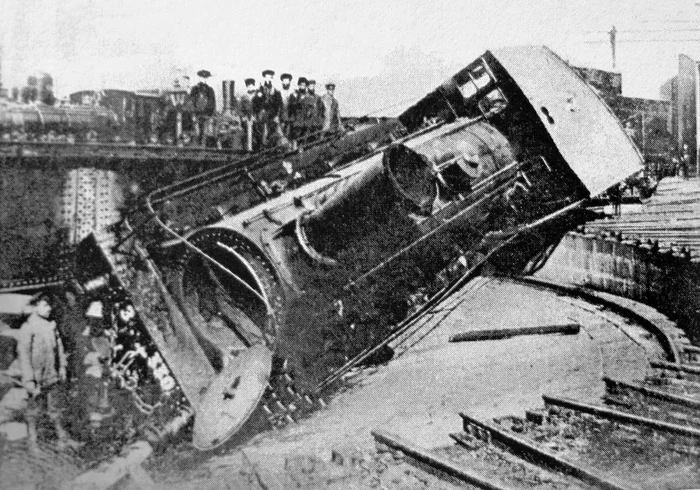
Locomotive overturned by railway workers PHOTO wikipedia
Printers in Moscow went on strike on September 19, and soon other professions joined them. Things became really problematic for the authorities when railway workers in Moscow went on strike in the early days of October. They practically paralyzed the entire empire. They were joined by bakers, printers, clothiers, dock workers, and all the students and intellectuals from across the empire. By mid-October, many cities had come to a complete standstill.
“Neither gas nor electricity is working. Most shops are closed and the entrances and windows are covered with bars and shutters. In different parts of the city, water is only available at certain times”reported a Moscow newspaper.
It didn't take long before riots also broke out in the most bitter and oppressed rural world. Ultimately, the peasants were the most faithful supporters of the tsar. They were religious people and strongly believed that he was God's anointed, ruler by divine right. Even so, their patience had reached its limit. Their riots were extremely violent. Effectively, they took by force the lands they worked, from the domains of the landlords and tenants. “The peasants dispossessed the private owners of their land, animals and tools, often destroying their houses and killing them”specified the sources of the time.
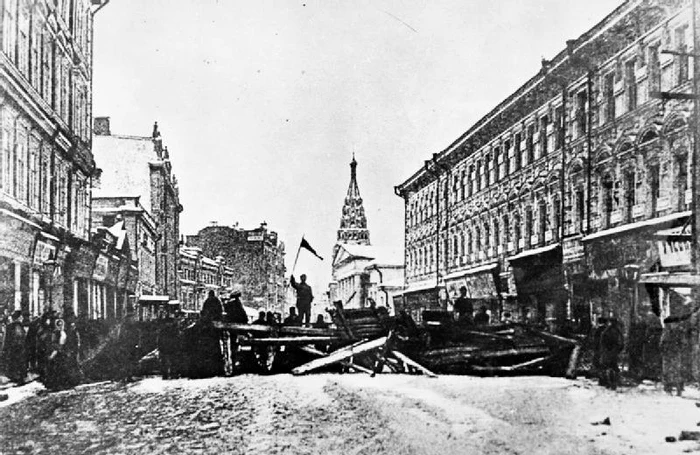
Barricades on the streets of Moscow PHOTO wikipedia
So many farms and mansions were burned that the red glow the flames created in the night sky became known as the “red rooster.” Unarmed and disorganized, however, the peasants were quickly dispersed with the help of the police and army. Instead of trying to rectify the situation, the Tsar ordered the whipping and cruel punishment of the rebels. Things were going from bad to worse.
On May 14, 1905, the terrible news was received that the Imperial Baltic Fleet had been destroyed in the Battle of Tsushima during the Russo-Japanese War. The Russians lost 21 ships, including six battleships, while the Japanese lost only three torpedo boats. Street fighting broke out in Odessa, and sailors on the flagship of the Black Sea Fleet, the cruiser Potemkin, rioted. The Tsar understood nothing of what was happening and wanted to use force.
“I swore on my accession to the throne to keep intact the form of government I received from my father and to pass it on to my successor. Nothing can release me from my oath.(…)I will never agree to a form of representative government, because I consider it harmful to the people whom God has entrusted to me”he stated while the country was blocked by strikes and riots.
An insufficient compromise
Advised by Serhgei Witte, his personal adviser, the Tsar was finally willing to make concessions. First of all, he convinced him not to use brute force in suppressing the riots, in order to avoid a civil war. The Tsar was persuaded to establish a Parliament, called the Duma, by which the people would be represented. In addition, he agreed to a program of reforms and amnesty. All of this was included in a document known as the October Manifesto.
At the same time, the Tsar promised to become a constitutional monarch. In reality, the Duma represented a step forward for liberal intellectuals and the bourgeoisie. For the most affected categories, peasants and workers, nothing changes. The Tsar preferred to double or triple the salaries of the army and police to ensure that he had sufficient repressive forces at hand. At the same time he invested even more in the secret police service.
The damage was already done
What the Tsarist authorities did not realize was that the harm had already been done with the killing of innocents on “Bloody Sunday”.
General strikes and riots created the conditions for the emergence of “soviets”, those nests in which the Bolsheviks would settle. The first was formed in Saint Petersburg and was led by Hurstalev-Nosar and Leon Trotsky, who would become one of the fathers of Bolshevik Russia. The soviets spread quickly and throughout the country, organizing workers into strikes and protests. At that time the Soviets did not have the strength of 1917 being divided between Lenin's Bolsheviks and Martov's Mensheviks. For 12 years, these soviets incubated revolutionary ideas. The failure of the Tsar and those around him to achieve truly effective reforms in Russia, ignoring real problems of the workers and peasants, paved the way for the Bolsheviks to power when, in 1917, the knife came to the Russians again.