LAST TIME Romania entered a technical recession, Statistics confirms. The GDP is still “moving”, but the private sector is increasingly cautious and applying the brakes

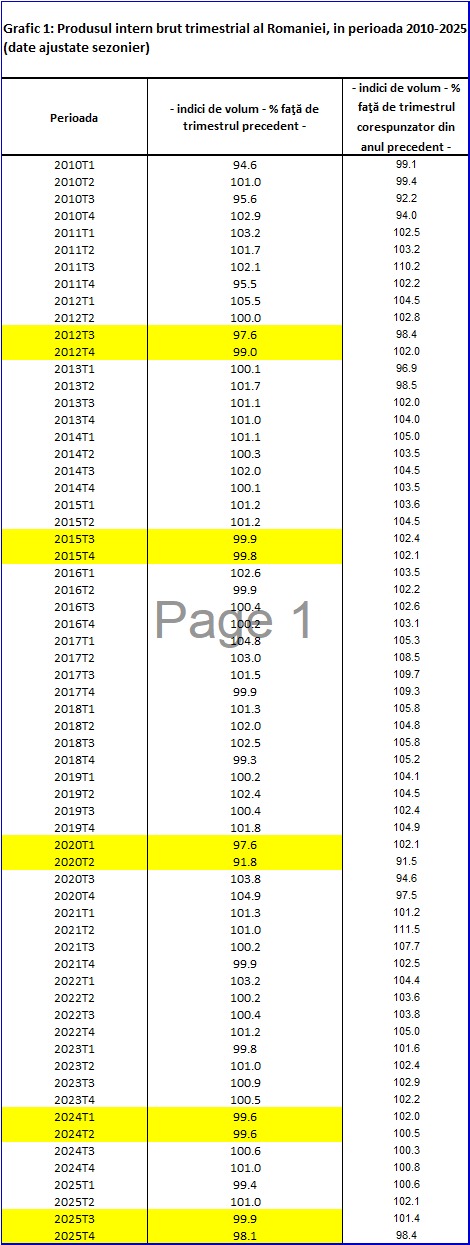
The Romanian economy registered a contraction in the last quarter of 2025 (compared to the previous quarter), after the economy had also decreased in the autumn compared to the summer of last year. Technically, we are in recession, although for the entire year Romania had a 0.6% increase, according to the announcement made by Statistics on Friday.
Also, the INS reviewed the economic growth from the first 3 quarters of last year.
“As a result of the revision of the gross series of the quarterly GDP by including the estimate of the gross domestic product for the fourth quarter of 2025 in the quarterly series, the seasonally adjusted series was recalculated, the volume indices being revised against the second provisional version of the gross domestic product for the third quarter of 2025, published in press release No. 6 of January 9, 2026, as follows:
- the results of the first quarter of 2025, compared to the fourth quarter of 2024, were revised from 100.1% to 99.4%;
- the results of quarter II 2025, compared to quarter I 2025, were revised from 101.1% to 101.0%;
- the results of quarter III 2025 compared to quarter II 2025 were revised from 99.8% to 99.9%”
The Statistics announcement was anticipated by the CONFIDEX index, which fell from 51.3 to 47.2, compared to the previous edition, signaling a decrease in confidence in the national economy at the level of the private business environment.
It is the 5th technical recession in the last 15 years
According to Statistics data, this is the 5th recession since 2010
The decline in confidence in the economy reflects a more cautious perception of entrepreneurs and investors, influenced by political and economic instability at national and international levels.
Jjournalist Dan Popa sends the “EconoMix” newsletter every Thursday morning. If you are interested in personal finances and want to receive economic recommendations, you can subscribe here:
There is greater reluctance to make investment decisions and an increased need for clarity and stability from authorities to foster confidence and long-term development. 78% of managers believe that, in the next six months, the legislative and fiscal context will be less friendly for business.
“You sit and do your calculations exactly like a farmer who knows that out of seven harvests you will have three less good and one bad, because that's the way nature is. You have to prepare yourself, to form an education for resilience, not like those who, if they had a good year, spend everything they spent.” says Ion Lixandru, CEO of Romtrailer
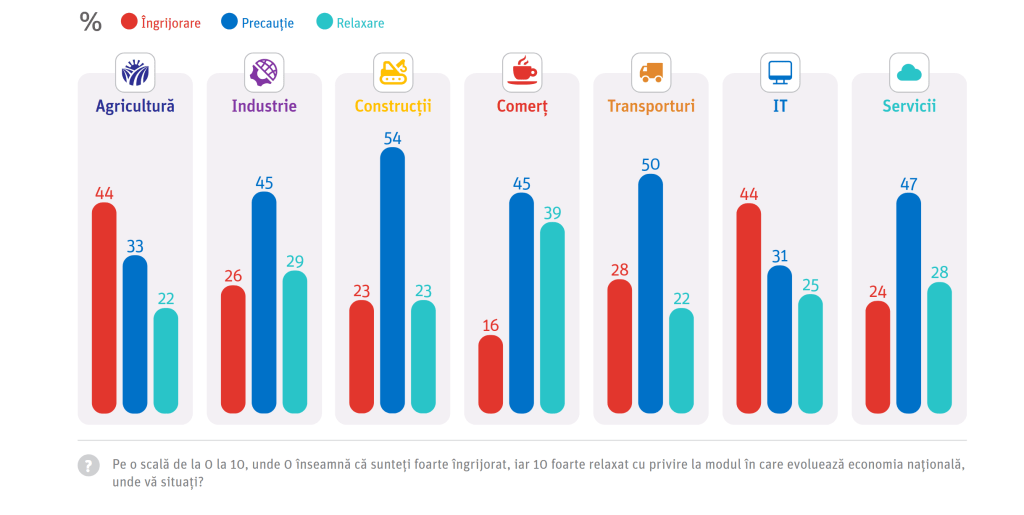
Trade and Industry are the most positive and balanced sectors at the end of 2025. Construction and Transport remain largely cautious, while IT and Agriculture are more pessimistic, especially due to the impact of AI and weather conditions.
Services: Faces the challenge that, in times of uncertainty, companies are less willing to invest, especially in services that, at first glance, may not bring immediate benefits. However, businesses in this field feel that there is still a lot of potential for growth, precisely because it is still an underdeveloped sector in Romania (we don't have much “tradition”), and therefore there is still a lot of room for growth.
Energy: A field with potential for growth, especially in the current geopolitical context. On the other hand, the lack of institutional support may diminish Romania's chances to become an important player in the area or to capitalize on current opportunities
IT: A sector that has been quite affected lately, not only from the perspective of fiscal changes, but also because of the emergence of AI. Moreover, the lower level of investment has affected the area of technology and IT start-ups. There are still open areas of opportunity, especially since Romania is a hub of creative people and there is a diversification of the types of investments in start-ups.
Transports: A field that, in itself, has quite a few offers, given that there is no capacity to develop additional business lines or partnerships. Otherwise, it is quite an exposed field, dependent on international trends and regulations.
In the last 6 months, for 40% of Romanian managers, the situation of their company has worsened.
Optimism about the state of the economy is declining. The majority of managers declare themselves dissatisfied with the evolution of their own companies, either because of their deterioration or stagnation, and show a pessimistic view both on the economy of the sector in which they operate, as well as on a national, European and global level, the general perception being that the economic situation has deteriorated or remained unchanged.
However, the least degree of concern arises when it comes to their own business, which they feel they can control, that it is up to them to make a difference in the market and adopt a winning strategy
Local entrepreneurs and managers maintain, to a large extent, a rather reserved attitude when discussing Romania's economic indicators, especially those that can signal a significant growth of the local economy.
GDP: In general, growth is estimated which can come from various sources (investment, increase in prices or value of services, etc.). However, there is skepticism about how “healthy” or real this growth is. “GDP will go up, somewhat artificially, by increasing the value we ask for things, and, well, we're also increasing some sectors like energy. OK, GDP will go up, but I don't know how profitable it will be, we don't know how we're going to deal with the deficit.” – believes Ciprian Harabagiu, Decalex
Inflation: It is estimated to be relatively constant or even decreasing, on the one hand due to the fact that accelerated growth can no longer be sustained and, on the other hand, in the context of the announcement of a series of investments from European funds and, in the ideal scenario, the resumption of private investments.
Labor market: Even in this case, no significant changes are observed compared to spring 2025. There are still layoffs, especially at the level of white collar employees, which provides greater access to candidates. On the other hand, in the blue collar area, the workforce deficit is maintained, which must be covered by importing personnel, although, ideally, the desire to develop locally trained employees remains, through investments in education and training.
Investments: And in this case a reserved attitude prevails. It is clear that an increase in investments is announced, including by unlocking certain PNRR funds; however, their focus on sectors such as defence/military or energy may mean less impact on a wider part of the population
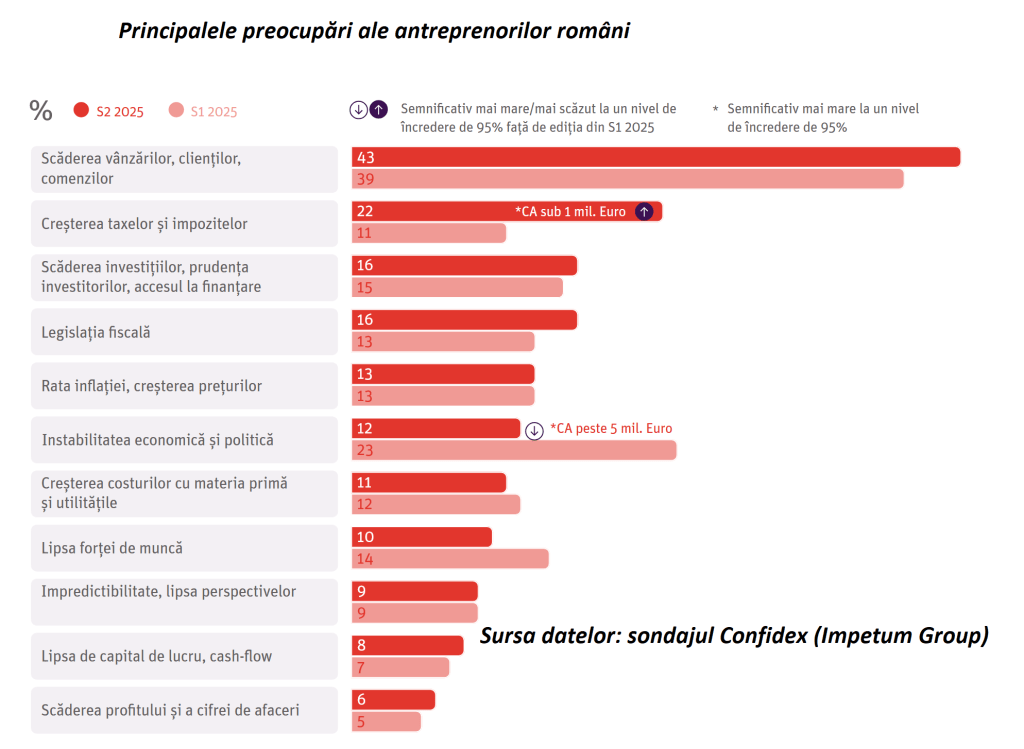
The most common fears remain related to the decline in sales, customers and orders, mentioned by 43% of respondents – a similar percentage to the previous one. In contrast, economic and political instability drops significantly in the ranking, being cited by only 12% of managers and entrepreneurs.
Declining investment, investor caution and access to finance (16%) remain important concerns, with the risk that projects will not be implemented in the current economic and geopolitical context.
At the same time, there is a significant increase in concerns about the increase in fees and taxes (22%).