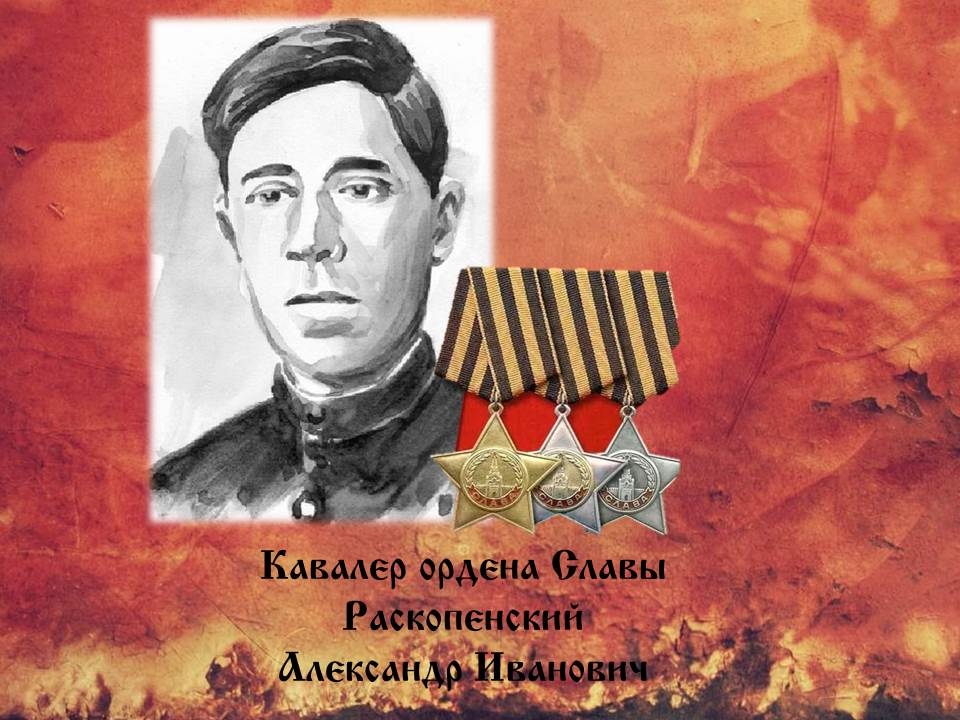
Alexander Raskopensky
Photo: Regional Library
February 10, 1905
Knight of the Order of Glory Alexander Ivanovich Raskopensky was born on February 10, 1905 in the city of Anadyr, Magadan Region.

In the ranks of the Red Army since September 1941. On the fronts of the Great Patriotic War since February 1942. He fought on the Stalingrad, Voronezh, Steppe, and 2nd Ukrainian fronts.
By order of the 110th Guards Rifle Alexandria Twice Red Banner Order of Suvorov 2nd degree division dated January 15, 1944 No. 03/n Guard, Private Alexander Ivanovich Raskopensky was awarded the Order of Glory 3rd degree.
On the night of August 3-4, 1944, Guard Sergeant A. I. Raskopensky overcame wire barriers and was the first to break into an enemy trench, disarm and capture a German soldier, then throw several grenades at the firing point, destroying the German machine-gun crew. The company commander was nominated for the Order of the Red Banner.
By order of the troops of the 53rd Army of September 17, 1944 No. 0235/n of the Guard, Sergeant Raskopensky Alexander Ivanovich was awarded the Order of Glory, 2nd degree.
On the night of January 1, 1945, scouts under the command of Guard Sergeant A.I. Raskopensky, taking advantage of the darkness, crossed the Ipel River using improvised means and held the occupied bridgehead until our main forces arrived. In these battles, Guard Sergeant A. I. Raskopensky personally destroyed 10 and captured one enemy soldier.
By decree of the Presidium of the Supreme Soviet of the USSR of April 28, 1945, for the courage, bravery and heroism shown on the front of the fight against the Nazi invaders, Guard Sergeant Raskopensky Alexander Ivanovich was awarded the Order of Glory, 1st degree.

Full holder of the Order of Glory Alexander Ivanovich Raskopensky with his family. Pos. Kuldur. 1949. Photo: Photo: State Archive of the Jewish Autonomous Region
After demobilization in 1946, he lived in the village of Kuldur, Obluchensky district of the Jewish Autonomous Okrug. He worked as a carpenter in a military sanatorium.
He died on January 19, 1962, and was buried in the cemetery of the village of Kuldur.
February 10, 1938

Thematic photo. Photo: Photo: Regional Library
In the book by Zhuravleva O.P. “History of the book business in the Jewish Autonomous Region (late 1920s – early 1960s)” (0+) there is information that on February 10, 1938, the regional committee bureau adopted a resolution “On the scientific commission for the study of Jewish literature” and instructed the commission “to begin publishing in 1938 a scientific yearbook dedicated to issues of Jewish history, literature, folklore, linguistics and publication of materials on cultural heritage.”
However, despite the expansion of the area of publication of natural science publications, literature on this topic was not predominant during the period under study. The priority direction of book production in the Jewish Autonomous Region, in addition to socio-political, was the publication of agricultural, educational and methodological literature, and especially fiction.
February 10, 1946
The first elections to the Supreme Soviet of the USSR took place after the war. The workers of the Jewish Autonomous Region elected as deputies to the Supreme Soviet of the USSR the first secretary of the regional party committee A. N. Bakhmutsky, the foreman of the vegetable growing brigade of the Waldgeim agricultural cooperative Sh.
February 10, 1968
The XVIII regional party conference took place. The region's industry fulfilled the state plan ahead of schedule for the total volume of production and most of the most important types of products for 1966-1967. The volume of industrial production increased by 18%, and the level of labor productivity increased by 7%. Collective and state farms in the region successfully fulfilled plans and obligations to sell grain, soybeans, potatoes, vegetables, milk, meat, eggs and honey to the state. The resolution defines the main tasks of the regional party organization for the next three years of the Eighth Five-Year Plan.
February 10, 1974

Clippings from the newspaper “Birobidzhan Star”. Photo: Photo: Regional Library
The newspaper “Birobidzhanskaya Zvezda” (12+) in the section “In our region” tells its readers that construction of a factory of artistic products made of colored stone has begun in the village of Budukan, Obluchensky district. The enterprise will produce tens of thousands of Far Eastern souvenirs, ink sets, stands for table lamps and fountain pens, and 500 thousand pieces of marble facing tiles per year for palaces of culture, hotels, and residential buildings.
“Our region has long been famous for its rare natural stones. There is, for example, pink marble with veins, which is mined near the village of Birakan. This stone decorates the Belorusskaya station of the Moscow metro. Pink marble is now used for industrial processing by the Londokovsky lime plant. Several years ago, not far from the famous Far Eastern resort of Kuldur, geologists discovered marble of amazing colors – from light green to red blackness.
The art products factory, which is scheduled to be completed at the end of the five-year period, will use local pink and green marble.”
February 10, 2012

Chapel in the name of the icon of the Mother of God. Photo: Photo: EAOMedia news agency archive
The opening of a chapel in the name of the icon of the Mother of God “Softening Evil Hearts” took place next to the mass grave on Volochaevskaya Hill. The chapel in the name of the icon of the Mother of God was erected on the top of the hill in honor of the 90th anniversary of the Battle of Volochaev. Its construction began in 2011. The dome and cross were installed in January 2012.
A tetrahedral brick chapel with a hipped roof was built next to the mass grave. It has four narrow and long windows covered with wrought-iron white bars. The framing of the openings repeats the shape of the kokoshniks that decorate the transition from the walls to the tent of the building. A large temple icon of the Mother of God “Softening Evil Hearts” was painted for the chapel.