The secret weapon that brought one of history's most feared armies to its knees. The first biological war in history


Ancient chronicles preserve incredible evidence of the use of the first forms of biological weapons in history. A powerful army, one of the best of its time was put to flight only with the help of knowledge of animal biology and behavior.
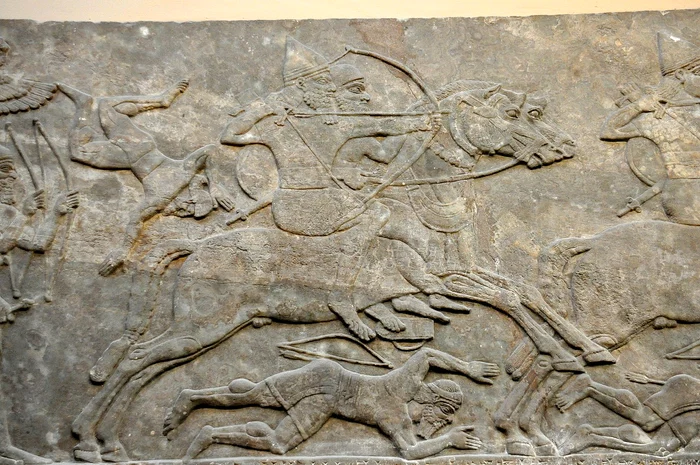
Assyrian warriors were among the most feared PHOTO wikipedia
There is a general public perception that wars in the ancient and medieval world were largely dominated by hand-to-hand combat, violent clashes between armies, lots of blood, and empirical battle tactics far less subtle than those employed in modern warfare.
In reality, warfare in the ancient world had almost the same variety of methods as it does today, only using the means of that time. The ancients were no stranger to psychological or biological warfare. An eloquent example is that of the mysterious end of the military campaign waged by a powerful Assyrian king in Egypt. The huge Assyrian army, the most feared and the best of its time, was scattered in a single night without the Egyptians striking a single blow of a kopesh or firing an arrow. It is one of the most studied and controversial military events in history, considered a clear example of ancient biological warfare.
“Masters of the World” the warriors who turned terror into an art
One of the most important and feared forces of Antiquity was the Assyrians. They were a Semitic people who lived in northern Ancient Mesopotamia, at the foot of the Zagros Mountains, in present-day Iraq. The Assyrians, originally vassals of the First Babylonian Empire, managed to create an extremely powerful state on the banks of the Tigris River. The center of Assyrian power was the city-state of Assur. One by one, the city-states in the area of Assyria were united under the scepter of the sovereigns of Assur.
With the unification and centralization of the Assyrian state, the first large organized army in history was created. A professional army in the true sense of the word. The Assyrian kings developed a special recruitment system and martial culture. The proof is the superb bas-reliefs in the city of Nineveh, in which the ways of spending free time among the Assyrians are depicted. Especially in the aristocracy. And here we are talking about lion hunting, warrior contests and generally stalking enemies.
King Tiglathpalaser introduced a reform by which he created a standing army, integrating other populations. Assyrian warriors were well equipped, including helmets, iron weapons, bows, arrows, spears, swords. At the same time, they used cavalry and especially battle chariots with great success. The Assyrians benefited from protective elements, but also from superior logistics to all other peoples. That is, they developed an army sanitary service, ways of feeding the troops on the march, troops of genius specialized in crossing rivers, building ramps, and everything else that was necessary.
Not to mention siege equipment. With this formidable army, the Assyrians began to conquer the peoples of Mesopotamia one by one and then expanded their borders throughout the Near East. Assyria became an empire. From the 9th century BC The Assyrian Empire reached the height of its power and influence. The great Assyrian kings controlled an empire that stretched from Egypt to Iran, including territories in present-day Syria, Palestine, Israel, and Iraq. And even a part of Anatolia and Egypt. They came to be mentioned in all the texts of the period, including the Old Testament. They were remembered with fear, with horror, as a divine punishment on mankind.
“The Assyrians created the world's first great army and the world's first great empire. This great rule was maintained by two factors: their superior skills in siege warfare and their reliance on pure, unadulterated terror.”specified the historian Simon Anglim.
In addition, as experts have noted, the Assyrians developed psychological warfare, sowing terror through acts of extreme barbarism among the attacked peoples, often guaranteeing them victory without the need for armed confrontation. “The texts also indicated other forms of violence, such as burning adults, regardless of sex, and gouging out the eyes of prisoners. For prisoners, they were skinned, body parts such as hands, fingers, noses, ears were amputated and imprisoned alive in the palace walls of defeated cities. The skin flayed from prisoners was hung on the walls of conquered cities.”stated Weijia Chen in “The Assyrian Empire:Terror Tactics as a Tool of Empire-building”
An army of terror against a secret weapon of the priest-king
In the eighth century BC, the powerful Assyrian Empire, despite the terror, or rather the propaganda of terror, which it had spread for two centuries, was shaken by a series of revolts of the vassal populations. In the kingdom of Judah (not a part of today's Israel), but also in Egypt, the peoples refused to pay tribute to the great Assyrian kings. Such defiance could not go unpunished. Especially since on the throne was Sennacherib, a strong and warrior leader.
He split his army in two, or so it is supposed. One of the columns sent to the Kingdom of Judah and the other to Egypt. He wanted to put down, through a single violent campaign, all these riots. Obviously, the audacity of the rebels would be drowned in blood.
The famous ancient historian Herodotus gave an interesting account of Sennacherib's campaign in Egypt. The powerful Assyrian army—composed of many warriors, including foot fighters and mounted archers—arrived in the Nile Delta with the intention of attacking Egyptian cities, plundering, torturing, and sowing death. At that time, Egypt was ruled by a pharaoh-priest named Sethos. His army would not have stood a chance against the Assyrians. But he trusted in the power of the god Ptah.
Herodotus tells how King Sethos of Egypt panicked when Sennacherib's army entered his country. Sethos, instead of gathering people, went to the temple of the god Ptah to mourn and pray. “As he lamented, he fell asleep and dreamed that he saw the god standing over him, urging him to take courage, for he would suffer no harm from Sennacherib's army. 'I myself,' the god promised King Sethos, 'will send you helpers.'stated Herodotus in his writings.
The next night, while the Assyrians made their camp in preparation for an assault on the Egyptian villages the next day, something strange happened. A host of field mice swarmed over the Assyrian camp and devoured their quivers, bows, and shield handles, so much so that the next day they fled unarmed. Some were chased by the Egyptian army and killed. Herodotus notes that even in his day, more than two centuries after the invasion of Sennacherib in 705 BC, there was a statue of King Sethos in the temple of Ptah in Egypt. The king had a mouse in his hand, and on the statue an inscription read: “Look at me and fear the gods”.
Same campaign, three different versions, one conclusion
To top it off, this campaign of Sennacherib is also described in the Old Testament. More precisely in the second book of Kings. In the Bible, Sennacherib attacks the Kingdom of Judah after Hezekiah's rebellion. The Assyrian captured all the fortified cities of Judah except Jerusalem, then asked Hezekiah to send him a huge sum of money. Intimidated, Hezekiah took all the gold from the temple in Jerusalem and all the riches of the land to escape the wrath of the Assyrians. Displeased, Sennacherib sent his troops to Jerusalem with this taunting message: “On whom do you rely now, that you have rebelled against me? Behold, you now rely on Egypt, on that broken reed (no Sennacherib had also sent an army to Egypt and relied on the fact that it was already victorious)”.
In the temple, Hezekiah prayed: “Lord our God, save us, that all the kingdoms of the earth may know that You are the only God” Isaiah sent a message to Hezekiah with an encouraging vision he had seen.
Specifically, Sennacherib will not enter Jerusalem, shoot no arrows there, and build a siege ramp against it. “For I will defend this city to save it”Jehovah would have said to Isaiah. “That night the angel of Yahweh went up and smote 185,000 men in the camp of the Assyrians. When day came, they were all dead bodies. Then King Sennacherib of Assyria departed and returned home and dwelt in Nineveh. While he was worshiping in the house of his god Nisroc, his sons Adramelech and Sharezer killed him with the sword”is shown in the Old Testament.
There is also a version of Sennacherib. It mentions the revolts in Judah and Egypt. But also the fact that his armies devastated Hezekiah's kingdom.
“As for Hezekiah the Jew, he did not submit to my rule. I besieged forty-six of his strong cities, walled forts, and innumerable small villages in their vicinity, and conquered them by means of well-built ramparts of earth, and rams thus brought close to the walls, combined with the attack of the foot-soldiers, using myself as well as the trenches. I made Hezekiah himself a prisoner in Jerusalem, his residence royal, like a bird in a cage. I surrounded him with ramparts to harass those who came out of the gate of his city. Thus I conquered his country, but increased the tribute due to me as his lord which was to be delivered annually.”Sennacherib specified, as the inscriptions show.
Sennacherib, as can be seen, implies that he did not conquer Jerusalem. Although they seem like different stories, they are connected, experts say. It all started in Egypt. The pharaoh of Egypt, or rather his advisors, found an ingenious method of biological warfare. They somehow managed to cause an invasion of rats (rather than mice) in the Assyrian camp.
It may not all have happened overnight. But rather, within a few weeks, as long as the beginning of the campaign lasted. Rats carrying fleas infested with Yersinia Pestis triggered the plague in the Assyrian camp. Death began to reap quickly, especially in conditions of poor sanitation. The column from Egypt made the junction with that which was besieging Jerusalem or hunting for booty through Judah. The disease spread, wreaked havoc and forced the Assyrians to retreat. The Egyptians made them sick on purpose.