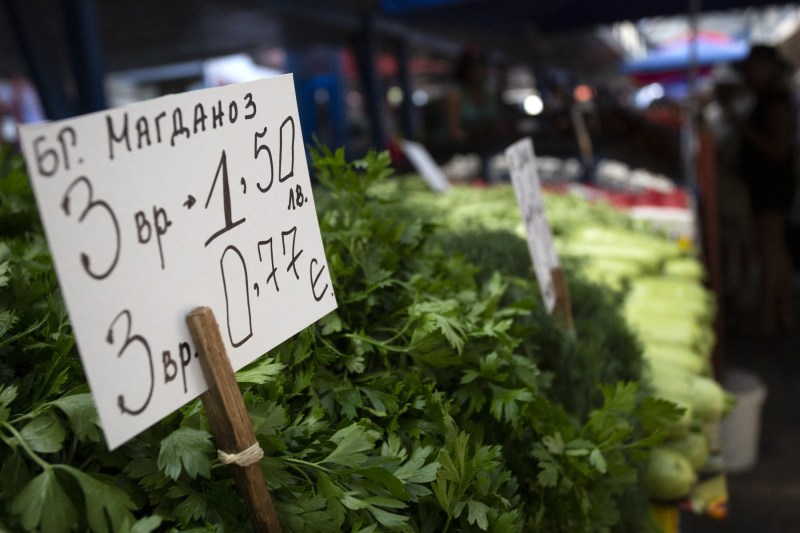
Prices in leva and euro in Bulgaria. Credit line: Hristo Vladev / AFP / Profimedia
The month of the dual circulation of the leva and the euro has come to an end. On January 30, 2026, we know that 75% of the leva in circulation has already been withdrawn, and the economy entered February with over 6.1 billion euros in circulation, the Bulgarian press writes.
The remaining leverage will continue to decrease, but will not reach zero. When we reach about 90% of the cash flow withdrawn into leverage, we will most likely enter a plateau. In other words, we can expect about 2-3 billion leva to remain unchanged (for various reasons) for a longer period, including a huge amount of coins. In Croatia, for example, three years after the introduction of the euro, there were banknotes worth 3 billion kuna and coins worth more than 1 billion kuna, which have not yet been withdrawn from circulation.
The big question is what happened to the prices
The express preliminary assessment of the National Institute of Statistics (INS) according to the national price index reported monthly inflation of 0.7% (1.6% in restaurants) in January 2026. The rate of price increase is lower than in January 2025, when monthly inflation reached 2%, mostly caused by changes in indirect taxes (VAT increase on bread, flour and restaurant services) and of administratively established prices. It is interesting that in all main groups (food, restaurants, utilities, transport) the dynamics of prices was higher than a year ago.
Annual inflation slows significantly – 3.6% in January 2026, compared to over 5% at the end of 2025. This was expected, as the one-off jump in January 2025 is already included in the base and does not affect annual inflation. We observe absolutely the same movements and according to the European methodology, the annual inflation compared to the harmonized index of consumer prices slows down to 2.3%. Eurostat data shows that almost ten eurozone countries have higher annual inflation than Bulgaria in January 2026.
This does not mean that all is well with prices in the economy
First, the little things. Monthly inflation shows some increase in prices, which we can associate with the transition to the euro – in the range of up to 0.5% additional inflation from rounding, which is more visible in the services sector. This was expected and only happened once, no drama. The bigger problem is the pressure on prices coming from the budget expansion, serious wage growth and record lending. These are the processes that we need to monitor with increased attention.
In this context, the discussion of the state of state finances and fiscal policy is particularly important. The implementation of the 2025 budget shows that the state, at least technically and on a cash basis, manages to keep the budget deficit around 3%, but this is without taking into account the hidden payments through the Bulgarian Development Bank and the withholding of certain payments (usually from the investment program, but not only). Despite the very good performance of tax revenues (compared to last year), we cannot fail to consider the 3 billion leva “missing” from VAT revenues (overallocated but impossible to collect).
It was clear to all observers that this VAT revenue forecast would not materialize. The bad part in this case is that the (several) proposed state budget projects for 2026 included the same (and even more generous) forecast for VAT revenues for the current year. Or in other words, if we leave aside the dreams of excessive VAT revenues and the politicians keep their promise (tacit to the people gathered in the markets) not to raise taxes, the 2026 budget must include serious structural measures to control the budget deficit. This cannot happen in the current parliament – this is in response to ideas to now quickly vote on a new budget before the election.
It seems that this parliament will still have work to do on the budget. The reason is that the extended budget, which protects the state treasury and provides some peace of mind, including public sector wage increases, appears to need another extension. The election will not take place until April, and in this form the extended law provides a framework for three months. This is more of a technical and regulatory case, but still, it will most likely have to go through a new vote by the end of March 2026. It is important that this vote is as simple as possible, without allowing extravagant ideas for new spending and making commitments with a long-term burden on taxpayers.(Material produced with the support of Rador Radio Romania)