“We would be alone first.” The Prime Minister of Lithuania on the scenario of the attack on the Suwałki Isthmus. “Everything would be focused on us.”


“Die Welt”: If you look at possible attack scenarios on Lithuania, the Suwałki Isthmus, a short land connection between the Koenigsberg Oblast and Belarus, is considered particularly vulnerable to attack. Is Lithuania afraid of a scenario in which Russia will very quickly create a fait accompli before NATO can react?
Inga Ruginiene: We are aware of these threats. Even if we have a strong alliance and Article 5 applies – we know that for a short time we would be alone at first. In that one moment, everything would be focused on Lithuania.
We are preparing for such a situation. We must maintain security until our partners arrive. For this reason, we highly value the presence of German armed forces in Lithuania and NATO structures in our country.
How exactly do you secure this area?
The most important thing is to provide air defense. There are special plans for this eventuality. I hope we never have to use them. If military units appear in Belarus and the Koenigsberg region, we will respond immediately. We will not wait for foreign military forces to reach our territory.
Last September, when Belarus conducted its annual military exercises, we also conducted maneuvers, together with our regional partners.
In addition, we regularly organize exercises throughout the country, also with the participation of civilians. For example, we practice evacuating people from one part of the country to another. This is everyday life for us. We know that plans on paper are not enough. We need to know what to do in a crisis.
How strong is Russia's influence on Lithuania?
We record various attacks. Currently, these include balloons that intentionally enter our airspace from Belarus. This is a combination of a hybrid attack and smuggling, because they are used to send us, for example, cigarettes.
Can you describe it in more detail?
When the wind blows towards our borders, many balloons appear and disrupt air traffic. They are very difficult to detect because they fly at an altitude of up to 8 km and reach speeds of up to 200 km per hour. At the same time, people live under the trajectory of their flight. We cannot simply shoot down balloons and let 50 kg of cigarettes fall uncontrollably.
However, we have developed technologies to control the balloons and upgraded our detection systems. Our institutions are working day and night to prevent such incidents. There have already been many disturbing events, including damage to infrastructure. Of course, this affects us very much.
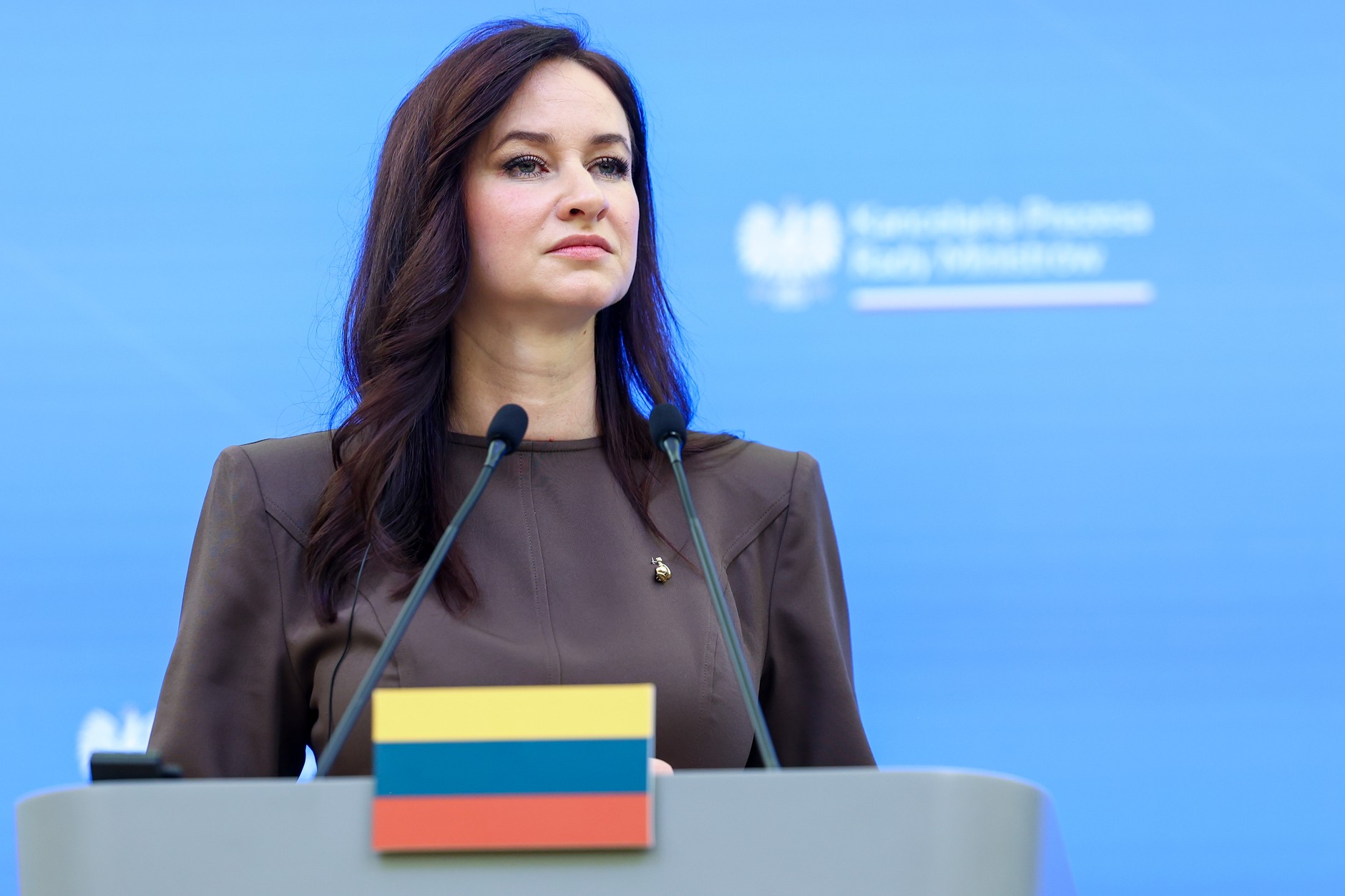
Prime Minister of Lithuania Inga RuginieneFoto Olimpik/NurPhoto via Getty Images / Contributor / Getty Images
“This is a huge step forward for us”
What is the biggest threat?
Hybrid attacks and provocations. Basically, we treat all threats from Belarus or Russia as matters of national defense. That's why we've done a lot about this recently. We are finally energy and gas independent. This is a huge step forward for us. Europe can pass additional sanctions packages and we have nothing against it.
Russia's political and social influence in Lithuania is limited. Many people believe that because Lithuanians speak Russian, we have a large Russian community. That's not true.
We know the language, but the Russian population in Lithuania is a relatively small part of the population, unlike in Latvia and Estonia. There, the risk associated with disinformation campaigns is much greater. There is no party in parliament that represents the Russian point of view. Therefore, it is easier for us to organize preventive actions and strengthen our defense.
Do you also have problems with drones?
The threat from drones is nothing new to us. For this reason, we have allocated an extremely large amount to defense in the 2026 budget, amounting to 5.38%. gross domestic product. This amounts to 25 percent. our revenue budget. We also changed our priorities. One of them is the stationing of a German brigade. Another is for American forces to remain.
Our absolute priority, however, is to strengthen our air defense. That's why we invest in both detection and other systems. We are learning from Ukraine. We draw conclusions and develop strategies that fit today's situation, not the past.
The United States is changing its strategic priorities. The current government wants to focus more on the Western Hemisphere, i.e. on both American continents. What does this mean for the US military presence in Lithuania?
I hope that US military forces will remain in Lithuania. We believe in a strong NATO alliance. When it comes to security, we shouldn't play games. In my opinion, showing strength is in the interests of both Europe and America.
“The Baltic countries understood what was necessary”
Do you think the United States is still a reliable ally?
I think they understand that we need each other – both in security matters and in economic and other relations. Because if we separate from each other, there will be no future. So we have to work very hard to ensure that NATO remains strong. But at the same time, we must work hard to strengthen the EU.
Could European forces in Lithuania be an adequate replacement if Washington decides to withdraw troops from Europe?
We need the armed forces of European countries and American troops. But you never know what might happen. Therefore, the absolute priority should be to strengthen the EU and understand that these are European armed forces. Not Lithuanian, Latvian, Spanish, German. These are the armed forces of European countries. If someone attacks our country, he is not attacking Lithuania, but the EU.
This sounds very similar to NATO Article 5: an attack on one is an attack on all. Should the EU develop its own logic of collective security?
There are discussions in Lithuania that we should prepare for various scenarios.
What scenarios?
The main scenario should be a strong NATO. For this we must do everything in our power. But you never know what will happen. So the question is: how can we ensure the security of our European region? We need to strengthen the EU and we need to talk about how to do it.
So we need a plan B. This is a taboo topic at the moment. We also need to talk about how we can make decisions quickly if someone in the EU has a veto. So we also need to discuss the reform of decision-making processes.
Throughout Europe we are observing an increase in the number of acts of sabotage committed by the so-called disposable agents – that is, not intelligence agents, but private individuals who are often recruited via instant messaging. Can this pattern also be seen in Lithuania?
Yes. This is nothing new either. Russia is very interested in testing us to see how our security system works and how our civilian population responds. Our neighbors – Poland, Estonia and Latvia – have similar experiences. This problem does not concern only Lithuania, but the whole of Europe. Russia is not testing Lithuania. Russia is testing the EU.
The Lithuanian Minister of Defense recently canceled a contract for the purchase of anti-tank mines due to the lack of transparency regarding the order. Where do you see the weak points of the current arms procurement process?
If we spend a lot of money on defense, then that money must be clearly allocated to defense. We also need to spend every euro responsibly. It is unacceptable to me that a company that is not a manufacturer itself, but only an intermediary employing only one employee, wins a public tender. Something is not working properly in our system.
Therefore, we commissioned the Lithuanian Ministry of Defense to further develop the system. We want to shape the procedures to make them much more transparent. Decisions should not be made by one or two people, but by a special group that includes not only the ministry's internal experts, but also external entities – for example, the public procurement office. So independent.
Should more stringent regulations also be introduced at EU level?
At EU level, there is often a lack of quick decisions, simpler procedures and very quick response capacity. We, as countries located in a particularly sensitive region – the Baltic countries and Poland – understood what was necessary. Our solutions can be introduced at the European level.