Moscow is pressing, Europe is paralyzed with fear, the USA is watching from the sidelines. This is how Russia could checkmate NATO. WAR GAME

It is becoming increasingly difficult to predict how the US would react in such a crisis. For years, they have been demanding that Europe take greater responsibility for its own security. Under Donald Trump's rule, the tone of speech is becoming increasingly harsh. The dispute over Greenland undermines the foundations of NATO.
In a war game, the US Secretary of State talks to both sides. He calls the president of Russia, the chancellor of Germany and his foreign minister. The Prime Minister of Poland and the Secretary General of NATO also participate in the confidential conversation.
Washington does not want to engage in a new war in Europe under any circumstances. — People are afraid that the United States will not be drawn into the conflictwhich we thought had already been resolved several months ago, says the US Secretary of State. This refers to the war in Ukraine. Washington is proud of its completion.
The German Foreign Minister protests. — It's obvious we're under attack! – says.
He is supported by the Prime Minister of Poland. “Peace can only be maintained through strength and determination,” he emphasizes.
NATO Secretary General says it straight. — As far as I know, many American troops, at least those in Eastern Europe, may not be available because there is no date yet for when they could be deployed.
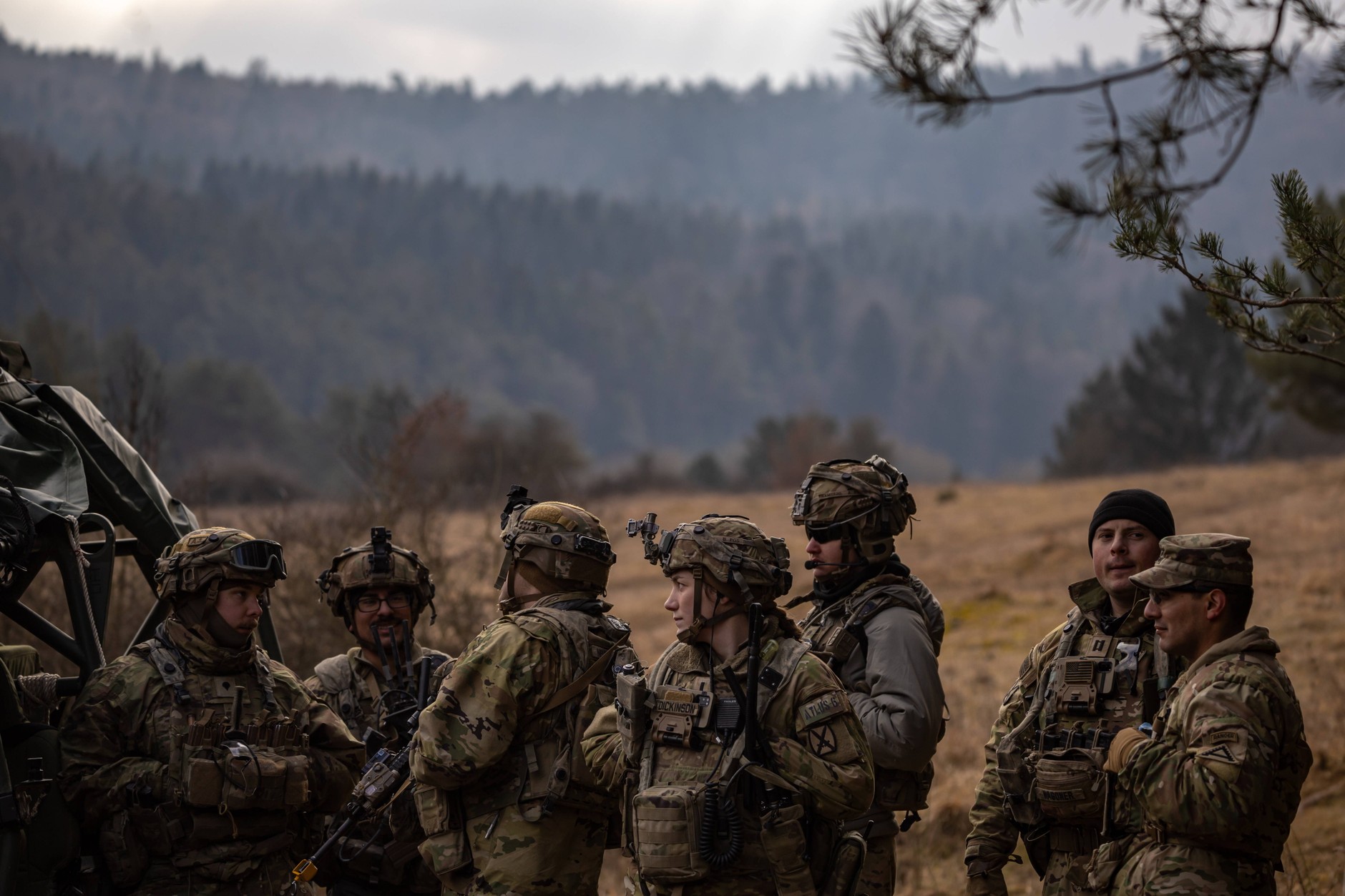
American soldiers during exercises in Hohenfels, Germany, February 3, 2025.EPA/MARTIN DIVISEK / PAP
There are currently approximately 2,000 American soldiers stationed in the Baltic countries, but their presence is not politically guaranteed. Washington has recently been reviewing the deployment of its armed forces around the world, and the new US defense strategy clearly states that Europe must face the threat from Russia alone in the future.
The American position is clear. — We do not want to do anything that could jeopardize current efforts aimed at giving our relations with Russia a broader and more constructive basis, also in the field of economy, says the Secretary of State. Washington rejects sanctions against Russia and refuses to talk to NATO about Art. 5. There is an alliance de facto blocked. The conversation ends.
Moscow
The next step for the Russians is to immobilize Germany. — It is good to stick to the proven carrot and stick strategy, says the Minister of Foreign Affairs.
So the army commander presents a stick: a plan to attack Germany. “I would conduct precision strikes against the railway infrastructure and the port of Bremerhaven, which would be a key entry point for American heavy equipment,” he says.
It also proposes attacks on LNG terminals in Wilhelmshaven and Lubmin, on important railway connections and on wind farms in the North Sea to threaten electricity supplies. In addition, drone attacks on industrial agglomerations. In short: a strategy of massive strikes. Germany would have no military response to this.
— German air and missile defense is very limited, says Russia's military commander. – They don't have enough interceptors. They have almost no means of defending themselves against drones.
These are plans in case a scenario occurs in which NATO jointly defends Lithuania. Then hundreds of thousands of soldiers from allied countries would cross Germany on their way to the front. From Russia's point of view, it would be important to paralyze logistics. For now, however, the stick remains in the drawer. Moscow tempts with carrots: economic cooperation and energy imports.
— There is a strong lobby in the eastern German economy and also in some parts of the federal government, says the foreign minister. “We can sow discord here.
Just a few weeks earlier, Russia was courting Germany, offering them long-term gas supply contracts – with discounts of up to 20 percent. and investment commitments for East German industry. Now the Kremlin is proposing talks on a peaceful solution to the “humanitarian crisis” in Königsberg. At the same time, Moscow exerts deliberate influence on entities in Germany's eastern states — and on elected representatives of the AfD, BSW and SPD parties.
Berlin
No one at the table wants to reach for the Russian carrot. On the contrary: the chancellor and his ministers are tightening economic measures. Russian businessmen no longer receive visas. Berlin breaks off all energy relations with Russia. It is putting pressure on France to do the same and insists on using Russian assets frozen in Europe.
The federal government also decides to take action against the Russian shadow fleet. These are the old tankers that Russia uses to avoid Western energy sanctions – and which are never far away when undersea cables are severed in the Baltic Sea.
Now it has to end. In Germany's exclusive economic zone, Berlin wants to stop, control and divert Russian tankers. If other Baltic countries – Poland, the Baltic countries, Finland – join this initiative, a dense network will be created. In military terms, Russia's scope of action is also expected to decrease. Germany and its partners want to monitor the Baltic Sea area using radars, reconnaissance ships, combat aircraft and air defense.
Suddenly, a decision appears that has never happened before in the history of the Federal Republic of Germany. The Minister of Defense insists on declaring a constitutional state of emergency. He describes the situation as extraordinary. An armed attack on Germany is considered likely.
When a state of emergency occurs, special laws and measures come into force. If NATO declares a state of emergency, hundreds of thousands of troops will have to pass through Germany. In the event of a threat, this country becomes a transit country – NATO's operational center. Allied troops need fuel, accommodation and food. The injured must receive help. – We need extensive support from society – says the commander of the civil protection office – transport, other services, we need help, perhaps we need to prepare hospitals. It takes time.
A state of emergency makes these logistics easier. It allows restrictions to be imposed on the industry. Enterprises must produce primarily for the Bundeswehr. However, the obstacles are great. Two-thirds of the Bundestag must consent.
Taking into account the actual composition of the current Bundestag, the votes of AfD or Die Linke MPs would be necessary. Organizers wargame however, they make the decision themselves: the step was successful, the parliament declares a state of emergency. Nico Lange, political adviser and security expert, observes the simulation in Hamburg from the sidelines. He considers the widespread skepticism that such a decision would not be politically feasible in a crisis situation to be excessive. “If this attack really happens, no one will be able to protect themselves from it,” he says.
In the game, this step has immediate consequences. All adult men are subject to compulsory military service. This is difficult to implement in a short time. There is a lack of recruitment points, instructors and accommodation. However, the state is beginning to prepare personnel for a longer conflict.
The economy also feels this. — Since we do not know how long this situation will last, I reserve the right to impose a budget freeze on all ministries within a year, says the Minister of Finance.
Moscow
German actions do not make much of an impression on the Kremlin. “Surprisingly, it's not here not a single point that would concern the activation of additional NATO forces – notes the chief of the general staff.
— Perhaps their goal is to show that they work and send strong signals, but this does not solve their problem, the president believes.
— Our goal is to push through this corridor. Then we will find ourselves in a different world, says the Minister of Foreign Affairs. — And these actions, in my opinion, somehow ignore that goal.
– Exactly de facto We attacked a NATO country and there was no strong reaction from Germany, says the chief of staff.
Planned actions against shadow fleet However, they irritate Moscow. So the Kremlin is raising the stakes. From now on, tankers will escort warships. Any control carried out by NATO countries could thus lead to a direct military confrontation.
Berlin
The consequences are immediately clear. — Are we ready to stop these ships anyway? – asks the chancellor.
“I think so,” replies the Minister of Defense. “If we withdraw our actions now, it will be a complete concession.
The Chancellor wonders aloud: what to do if a shadow fleet ship refuses inspection? If the Russian Navy moves in? The Minister of Defense replies that it depends on the regional balance of power. But we need to go one step further.
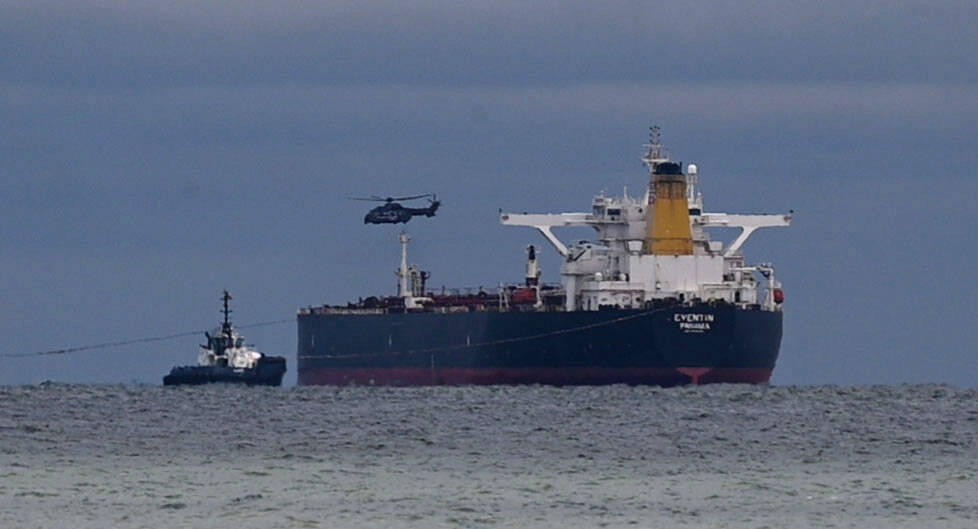
The unsteerable tanker Eventin, classified as one of the so-called shadow fleet, in the Baltic Sea. Illustrative photoSTEFAN SAUER / DPA / PAP
– Then we have to look deeply into each other's eyes – says the head of government. — When in doubt, it means a harsh reaction.
Something fundamental is revealed in this debate: for decades, Germany has relied on the United States to secure the final stage of escalation. Now Berlin must make decisions that, in the worst-case scenario, will lead to a military clash — without U.S. support.
Southern Lithuania
Wars are fought not only on the battlefield, but also in people's heads. That is why Russia is sending, amid much media publicity, a “humanitarian convoy” from Belarus to its supposedly suffering compatriots in Kaliningrad. Trucks, loaded with food and medicines according to the Kremlin, are driving densely one after the other through the occupied corridor in Lithuanian territory. They are accompanied by the Russian Red Cross. This organization is internationally recognized as a tool serving Russia's state and military interests. Russian reporters conduct interviews. Soldiers secure the corridor, but the cameras focus only on civilians, especially women…
We encourage you to read the next parts: