The rental market in Poland has grown by 39% in five years. and today covers over 10 percent. the entire housing stock. This is not only the result of rising housing prices and more difficult access to loans, but also changes in lifestyle. Renting is no longer the domain of twenty-year-olds, but is starting to function as a long-term housing solution for very diverse groups.
Read also: The situation on the housing market is changing. A visible drop in supply
The report “Apartments for young people. Designing for PRS and PBSA tenants”, prepared by ThinkCo, shows that the stereotype of a “young tenant for a while” fits less and less into reality. Instead, what emerges is a market that is maturing – both on the demand and supply sides.
Who are the tenants: the end of the myth that the market is only for young people
The largest group of tenants remain people aged 25-35 (approx. 35%), but the group over 35 is equally important, constituting about half of private tenants.. This means that renting is increasingly becoming a solution for people with a stable professional and family life.
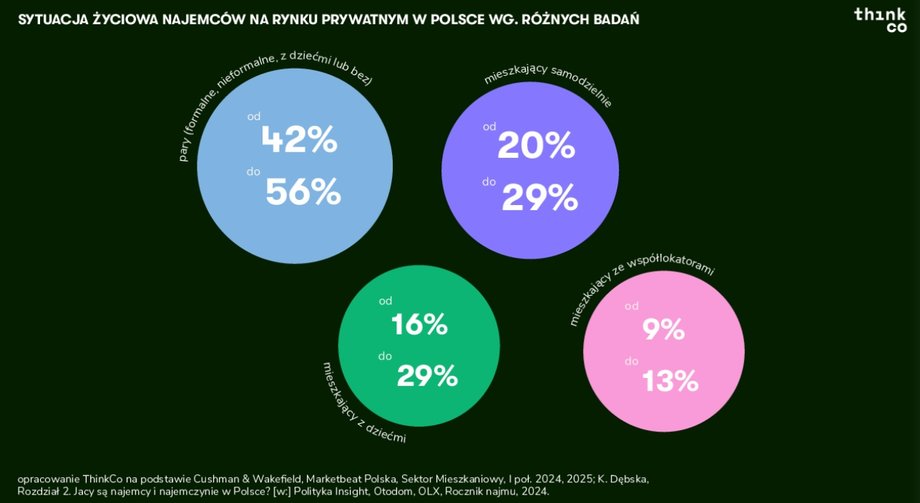
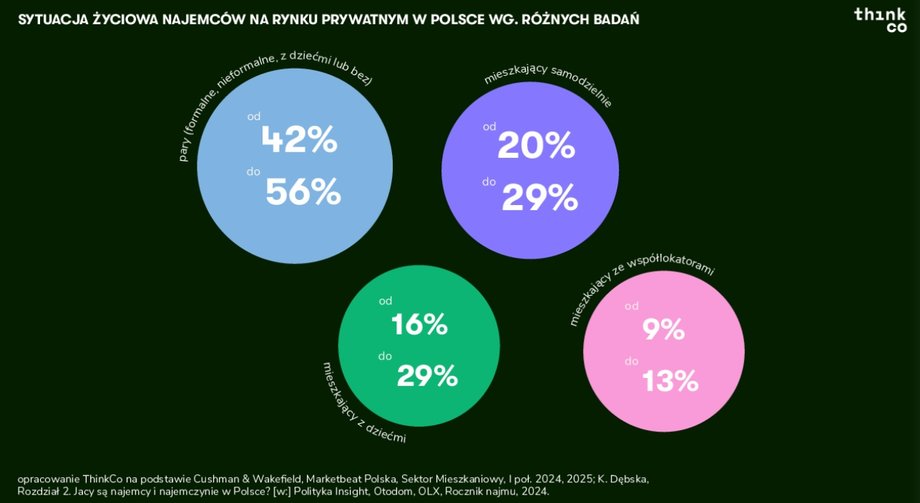
Living situation
|
ThinkCo
See also: Gold or maybe ETFs? What investing should look like for the cautious
The structure of households is very diverse: from singles and couples, through families with children, to roommates without family ties. In practice, this means the need to design various types of premises – from compact studios to multi-room apartments.
— Analyzing data about our residents, it turns out that our average tenant is about 45 years old. (…) Singles, families with children, and seniors live in our buildings – comments Elżbieta Chmiel, member of the management board of PFR Nieruchomości.
Why do we choose renting? Economy, comfort and flexibility
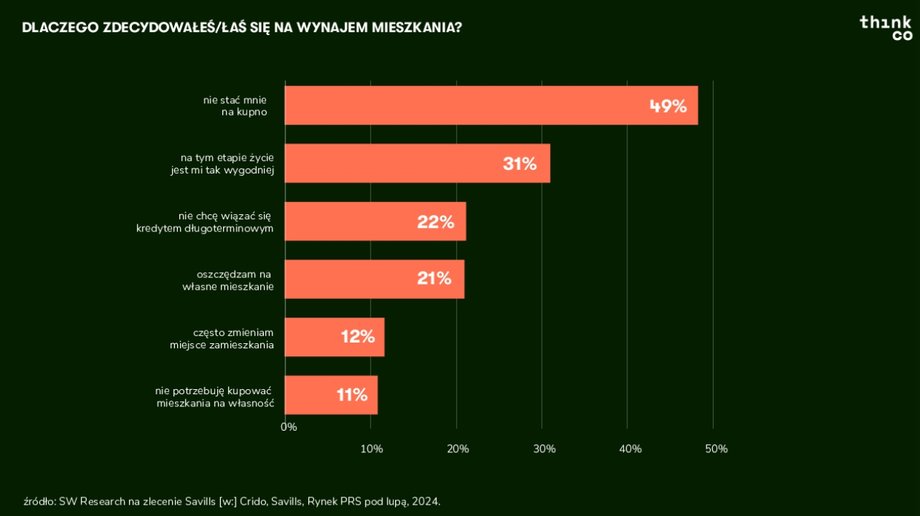
The motivations for choosing a lease are primarily economic. From 49 to 67 percent respondents indicate the inability to buy an apartment as the main reason, but convenience and flexibility (31%), lack of willingness to take out a loan (approx. 20%) and saving money for a future purchase (approx. 20%) also rank high. The aspiration for ownership remains strong — but “for later.”
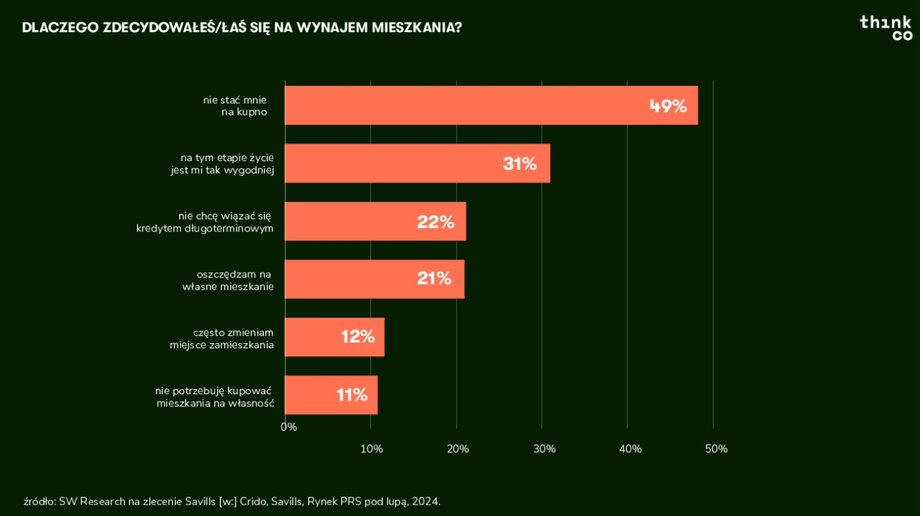
Reasons for renting
|
ThinkCo
Worth reading: Login to KSeF without a trusted profile. Learn about alternative methods
When choosing an apartment the price is unbeatable (94%). Next come the costs of utilities and the method of their settlement (70%), as well as the stability of the contract and the terms of termination (61%). Location is understood broadly: good communication, proximity to work or university, services, green areas – these elements are as important to tenants as the standard of the premises.
— Satisfaction with a place to live results not only from the high standard of apartments or the aesthetics of common areas. It's a series of factors combined – also perfect location, amenities or integration zones – says Joanna Kubiak, leasing operations director, Vantage Rent.
Students and PBSA: quick decisions, shared accommodation, growing demand
The student market is one of the most dynamic rental segments. As much as 40 percent students sign a contract in September, and almost half find an apartment in less than two weeks. Every seventh rents a premises without prior viewing.
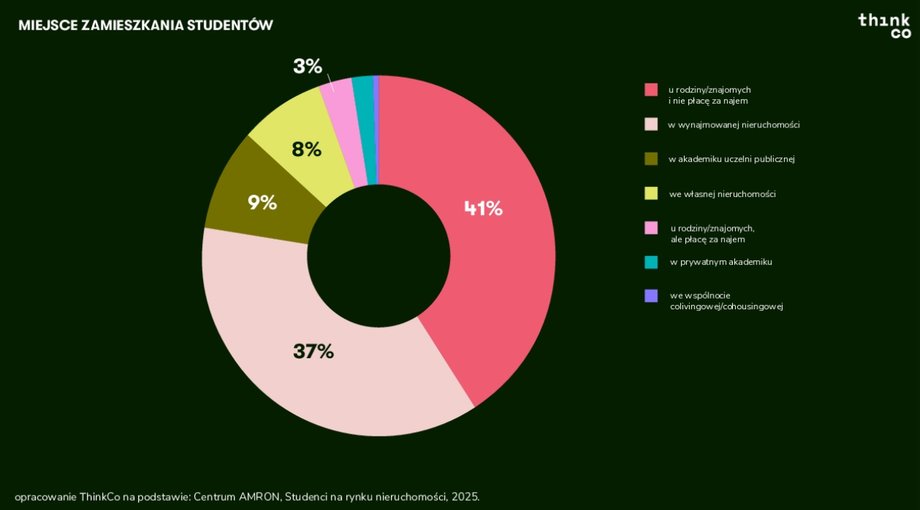
Simultaneously only 11 percent students live in dormitories (9% public, 2% private)while 37 percent uses the rental market – and most of them share an apartment.
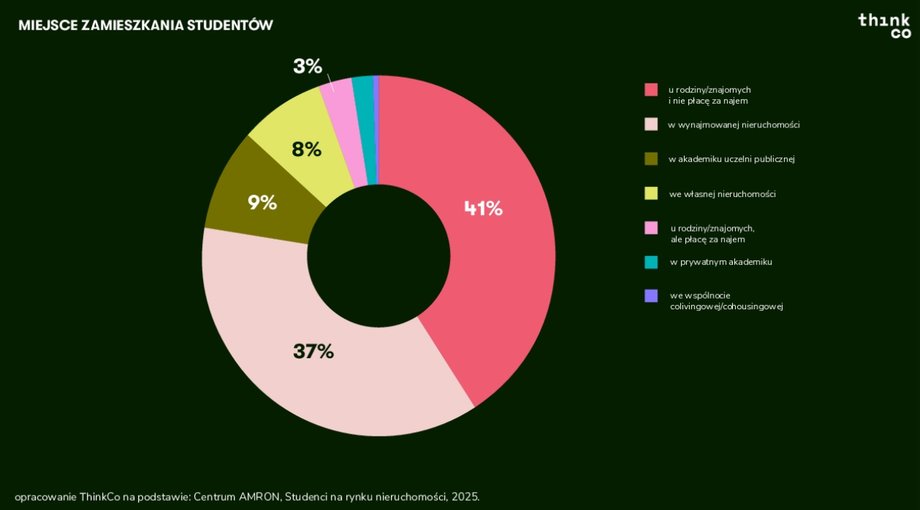
Domicile
|
ThinkCo
Read: Care allowance 2026. How much is it and who is entitled to it?
The most important criterion remains price, but communication and proximity to the university are also highly rated. Social motives are very important – over a third of students change their place of residence to live with other people.
— The demand for high-quality dorms is real, and much of the existing stock is outdated. This is a gap that we want to fill with modern, well-managed residences, says Matas Mockeliūnas, Student Accommodation Fund Partner, 1 Asset Management (SHED Living).
PBSA – or private student dormitories – are gaining in importance. They offer private bathrooms, kitchenettes, study areas, gyms, and events for residents. In practice, they are often a hybrid of dormitory and co-living.
PRS, design and technologies: housing as a service
Institutional leasing (PRS) really changes the way we think about apartments. Unlike the classic private market, PRS offers:
- building in the hands of one owner,
- standardization and full management,
- long-term perspective,
- predictability for the tenant,
- designing “based on user needs”,
- technologies that support comfort and service.
Compact and repeatable layouts, turnkey standard, durable materials and neutral aesthetics dominate. Common spaces are playing an increasingly important role: coworking spaces, gyms, terraces, relaxation zones, bicycle and storage spaces.
Technologies are becoming the norm:
- smart locks,
- smart meters,
- BMS systems,
- platforms for reporting faults and space reservations,
- AI-based monitoring,
- predictive maintenance.
— Young tenants expect solutions that make life easier and fit into the rhythm of modern everyday life. (…) Smart home is no longer a luxury, but a standard – comments Anna Marmur, B2B Center of Excellence expert, Samsung.
The PRS standard also attracts attention stability. The tenant does not have to worry that the owner will sell the apartment or suddenly increase the rent. This is one of the reasons why as many as 28 percent respondents have been living in a tenancy for five years or longer.
— Today they are crucial stability and security. The tenant does not have to wonder whether the owner will decide to sell the apartment in the middle of winter or increase the rent next month – explains Grzegorz Tomaszewski, president of PFR Nieruchomości.
Application? Renting in Poland is no longer an emergency plan
Leasing is maturing – faster than many market participants expected. From a “for a moment” solution, it becomes a full-fledged housing path, chosen by various groups: young adults, families, mobile specialists, students and seniors.
- For investors, this means they need to think about long-term quality and governance.
- For designers – about functionality, durability and the diverse needs of users.
- For cities – about including rental in housing policies and treating it as an important element of the system.
The market is growing not only numerically, but above all qualitatively – and this may be its greatest advantage in the coming years.