When Mark Rutte, Secretary General of NATO, told the European Parliament that Europe could not defend itself without the help of the United States and suggested to those who thought otherwise that they could dream further, he was not only describing Europe's military dependence – turned this dependence into a political doctrine.
He also presented himself not so much as the head of an alliance of potential equal partners, but rather as advocate for European strategic abandon.
Rutte's view of European defense is based on a logic that is well-known but increasingly difficult to defend: nuclear deterrence equals US protection; US protection guarantees Europe's security; consequently European strategic sovereignty is an illusion. However, this line of reasoning is much more fragile than it seems.
First, while Europe's overall strategic stability does depend on nuclear deterrence, most of the real security challenges in the Euro-Atlantic area – from hybrid warfare to limited conventional scenarios – have and will continue to arise. well below the threshold for the use of nuclear weapons.
This is something that the alliance itself takes into account in its deterrence posture. However, overemphasizing the importance of nuclear deterrence is dangerous overlooking the key role of conventional massresilience, logistics, high-quality intelligence, air defense and industrial power – areas in which Europe remains weak as a result of political decisions.
A debate that Rutte avoids
Moreover, the debate on nuclear deterrence in Europe does not come down to a simple choice. The continent is not doomed to choice between total dependence on the American umbrella and complete defenselessness.
A serious discussion about the role of French and British deterrence within the European system – politically complicated but strategically possible – is no longer taboo. Meanwhile, pointing to the prohibitive costs of building European nuclear forces from scratch, Rutte dismisses the possibility of Europe's strategic independence in this areainstead of engaging in this debate.
Europe really has something to be proud of
Moreover, the head of NATO is too hasty to disregard the increasingly widely accepted concept of a “European pillar” within the alliance. The fact is that today the European Union's contribution is best seen in creation a more integrated and dynamic defense marketwhich is actively supported by the European Commission. However, Rutte underestimates existing European military capabilities.
European countries already collectively have modern air forces, world-class submarines, significant naval power, advanced missile and air defense systems, competences in cyberspace, space resources and one of the largest defense industry bases in the world. When it comes to support for Ukraine, European allies — including France — have significantly increased their intelligence involvement.
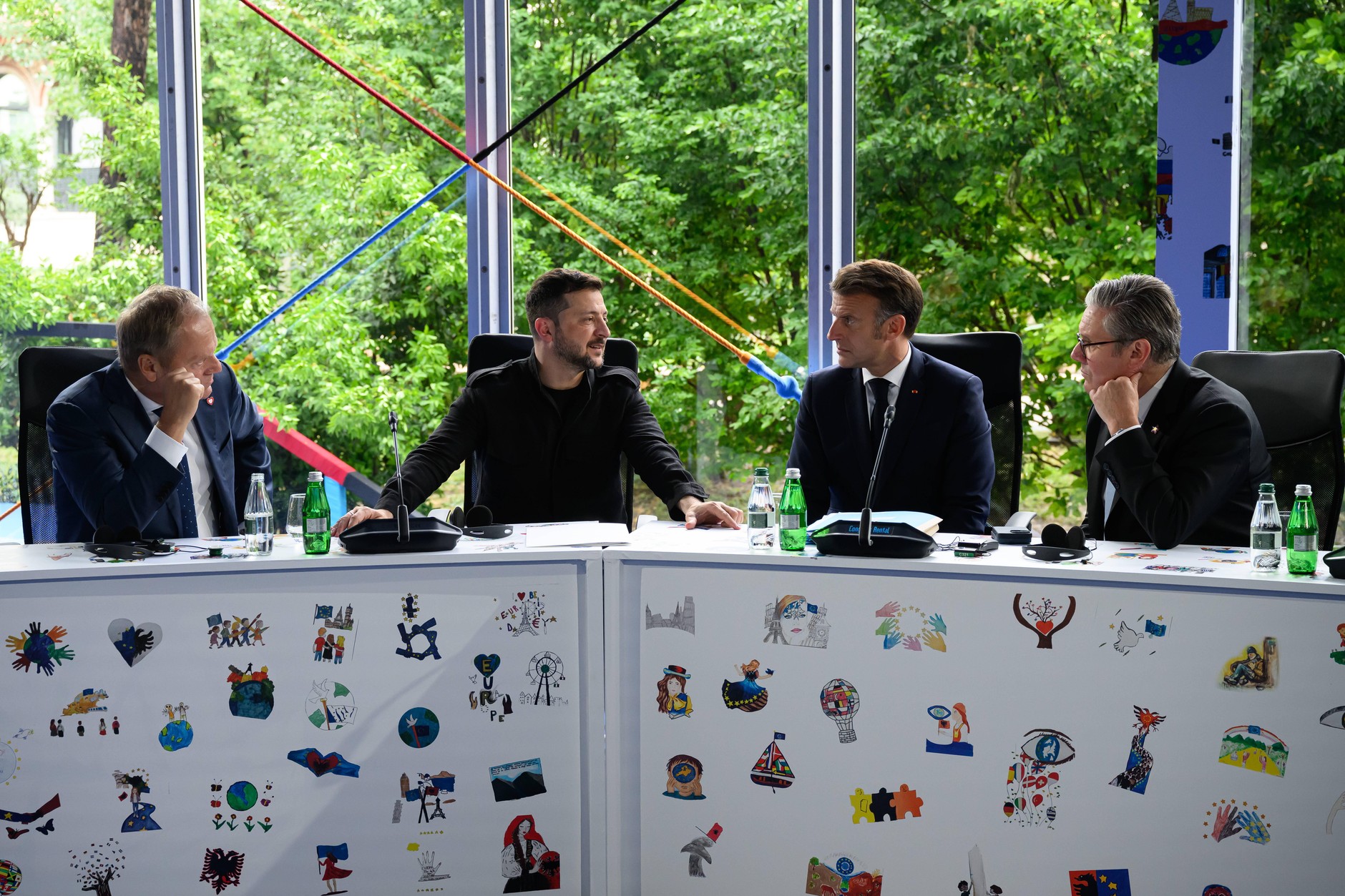
Donald Tusk, Prime Minister of Poland, Volodymyr Zelensky, President of Ukraine, Emmanuel Macron, President of France, and Keir Starmer, British Prime Minister, during a meeting on Ukraine's security at the European Political Community (EPC) summit. Tirana, May 16, 2025Leon Neal / PAP
The problem is therefore not a lack of resources, but national and industrial fragmentation, the risk of technological stagnation and insufficient investment in key areas such as ammunition production, military mobility, reconnaissance, intelligence and surveillance, satellites, air refueling and integrated command structures. As EU satellite projects show, these areas can be improved in months or years, not decades. However, by arguing that sovereignty is a pipe dream, it is easy to kill the political momentum needed for these changes.
Has Rutte really agreed on his message with Washington?
Finally, Rutte's message is also surprisingly divergent from Washington's position. Successive US presidents for a long time they demand that Europe take much greater responsibility for its own defenseand Donald Trump in his second term raised this issue to a new level – from sharing the burdens to shifting them to European allies.
But telling Europe that it must take care of itself as long as it continues to buy American weapons and will never truly succeed, is not a manifestation of strategic clarity, but of cognitive dissonance.
Europe can no longer ignore political reality. Regardless of your assessment of Trump and his policies, the direction of changes in American policy is obvious: Europe is no longer a priority. The center of gravity of American strategy has shifted to the Indo-Pacific, and maintaining dominance in the Western Hemisphere is more important to the United States than defending Europe. In this changed situation, entrusting the entire security of Europe solely to Americans makes no sense.
However, this does not mean giving up NATO or breaking transatlantic ties. On the contrary – it's about recognizing that alliances of equal partners are stronger than those based on dependence. A Europe that can rely on itself militarily, industrially and politically becomes a more reliable and valuable ally. And the 80-year-old transatlantic alliance will only survive if the US and Europe strike a new balance.
Therefore, as transatlantic allies struggle with an increasingly unclear understanding of interests and values, Rutte should promote a more balanced NATO with a strong European pillarinstead of questioning them.