Clippings from the newspaper “Birobidzhan Star”
Photo: Regional Library
February 1, 1880
Merezhin Abram (Avrom) Naumovich (born Avrum Moishe Grubshtein), a political figure and publicist, was born in the town of Dubovo, Uman district, Kyiv region.

His name is almost forgotten in Birobidzhan, but his contribution to the emergence of the Jewish Autonomous Region is invaluable. The arguments he presented in his speeches at OZET meetings, his articles and books became the main justification for the decision of the USSR government to give the territories of the Middle Amur for Jewish settlement.
In 1917, Merezhin published the book “The Bund and Zionism” (12+) in Odessa, in which he detailed his views on the creation of national-cultural autonomy for Eastern European Jewry.
After the end of the Civil War, Abram Naumovich moved to Moscow and there he became one of the leaders of the Central Bureau of Jewish Sections under the Central Committee of the RCP (b). Soon he was appointed secretary of the commission for the land arrangement of working Jews at the All-Russian Central Executive Committee.
Merezhin carefully studies the possibilities of settling Crimea with Jews and makes proposals on this issue. In 1927, his book “Issues of the land structure of working Jews” (0+) was published in Moscow by the KOMZET publishing house. Abram Naumovich focuses on the fact that the existence and development of the Far East is historically and organically connected with resettlement, therefore the resettlement of working Jews here becomes a natural process.
On the territory for which Abram Merezhin fought, the Jewish Autonomous Region was formed in 1934. At the beginning of February 1937, he was arrested on false charges, and on February 27 of the same year he was shot at the Butovo training ground. Rehabilitated.
February 1, 1936

Clippings from the newspaper “Birobidzhan Star”. Photo: Photo: Regional Library
The newspaper “Birobidzhan Star” (12+) wrote on February 1, 1936 that, on the initiative of the director of the Volochaevskaya school, a student club was opened in the village: “EThat club greatly revitalized extracurricular work with students. Evenings for children's amateur performances are often held. The club has clubs: drama, ballet, choir, physical education and military. Training camps and unit training sessions for pioneers are also held here. The result of the club’s work was that the Volochaevsk school took second place at the regional Olympiad of children’s amateur art, held during the winter holidays in Smidovichi“.
February 1, 1938
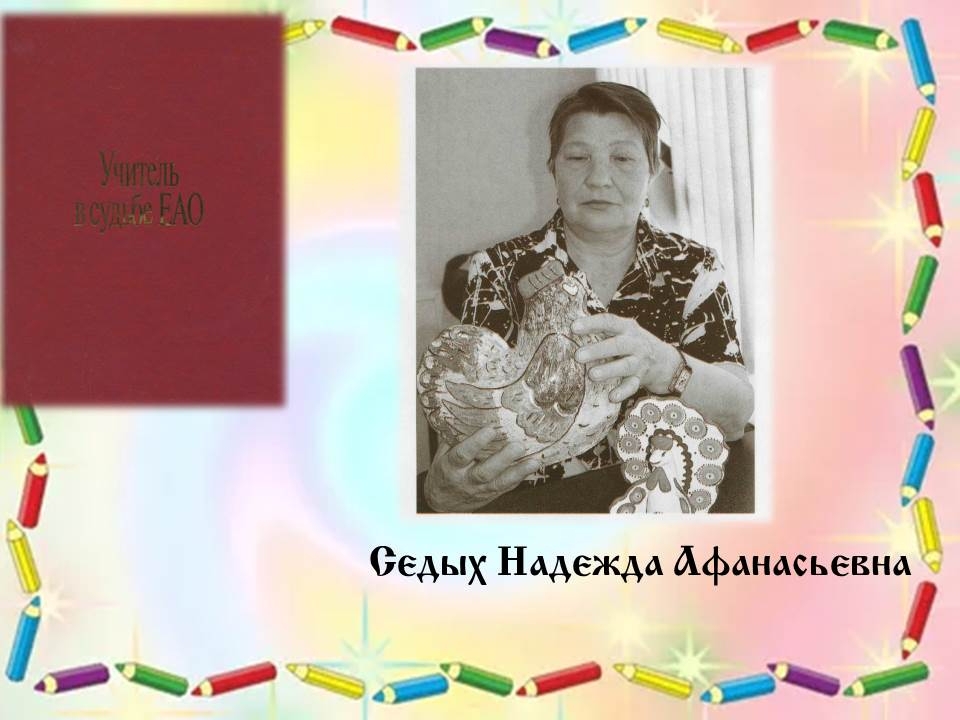
Sedykh Nadezhda Afanasyevna. Photo: Photo: Regional Library
On February 1, 1938, Nadezhda Afanasyevna Sedykh, a primary school teacher, head of a kindergarten, and senior teacher at kindergarten No. 45, was born.
Nadezhda Afanasyevna graduated from the Birobidzhan Pedagogical School with a degree in primary school teacher.
For eight years, Nadezhda Afanasyevna worked as the head of a kindergarten, later she worked as a teacher, and for the last 26 years she has worked as a senior teacher at kindergarten No. 45 in the city of Birobidzhan. Senior teacher Sedykh N.A. studied and promoted the experience of the best teachers and speech therapists, she conducted seminars, consultations, and teacher councils.
Through the efforts of Nadezhda Afanasyevna, a methodological center has been created, where rich material has been collected for each category of teachers. Under her leadership, programs are being developed aimed at improving the professional skills of teachers. One of them, “On the Paths to Life” (0+), won a prize at the regional competition. Sedykh N.A. made a significant contribution to the development of the personality of teachers and pupils of preschool institutions.
February 1, 1942
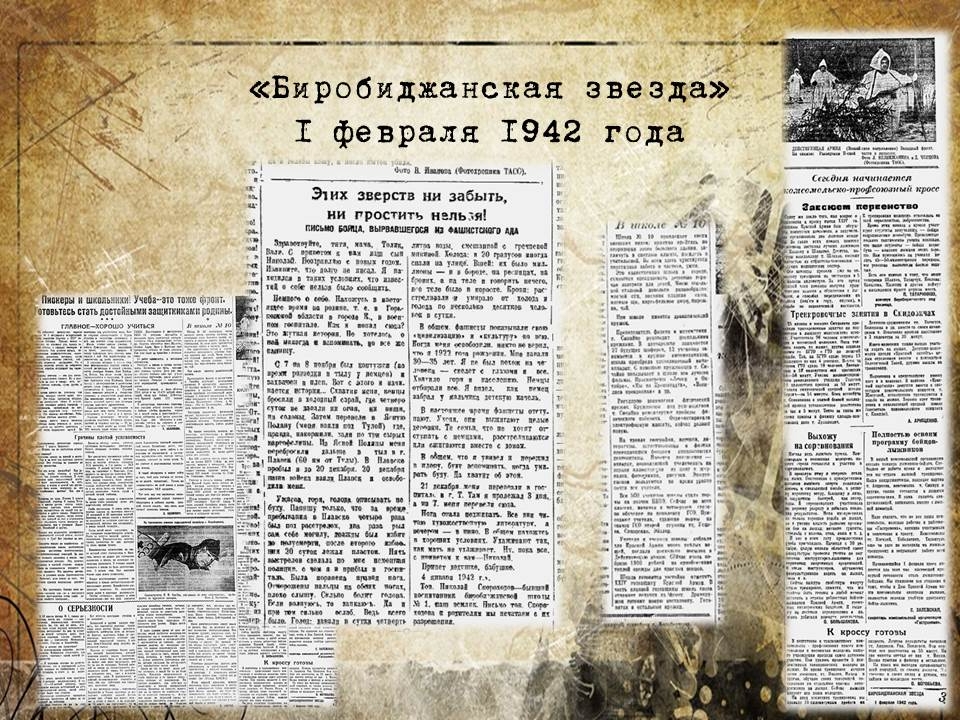
Clippings from the newspaper “Birobidzhan Star”. Photo: Photo: Regional Library
On February 1, 1942, the newspaper “Birobidzhan Star” wrote on its pages reports from the front, letters from soldiers and about peaceful life during the Great Patriotic War in the region and city of Birobidzhan.
This issue of the newspaper published a letter from Nikolai Skorokhodov, a graduate of Birobidzhan school No. 1, who escaped from the fascist hell “…From November 7 to 8 he was shell-shocked (during reconnaissance behind German lines) and captured. This is where the story begins… The Germans grabbed me and threw me into a cold barn, where for four days they did not give me any fire, food, or straw. Then they transferred me to Yasnaya Polyana where, however, they fed me and gave me three raw potatoes. From Yasnaya Polyana I was transferred further to the rear to the city of Plavsk. I stayed in Plavsk until December 20. On December 20, our troops took Plavsk and freed me. I will not describe the horror, grief, hunger. I’ll just write that during my stay in Plavsk I was shot four times, dug my own grave twice, was beaten half to death twice, and after the second beating I lay flat for 20 days. The German police fired five shots at me, with which I arrived at the hospital…“.
On their pages, correspondents inform the population that cheap hot breakfasts for children are organized in the only school No. 10 in the city of Birobidzhan. The school canteen menu is quite varied: “meat soup, sweet rice porridge, meat cabbage soup, mashed potatoes, pies, tea. There is a drama club at the school.” There are many clubs at this school: a car club, a physics club, and a club for repairing various devices.
The same newspaper writes about preparations for the Komsomol-trade-union cross-country race on the estate of the 24th anniversary of the Red Army, “in the village of Smidovich, training sessions were held to prepare for the youth cross-country skiing (6+). 98 Komsomol members and non-union youth took part… Preparations for the upcoming cross-country are also underway on collective farms. Preparations are going well at the Nikolaev secondary school…”.
February 1, 1956
A meeting of party activists in Birobidzhan discussed the draft directives of the 20th Congress of the CPSU on the sixth five-year plan for the development of the national economy of the USSR for 1956-1960. At the meeting of the activists, some successes in the economic and cultural construction of the city were noted.
Industrial output increased in 1955 by 2.4 times compared to 1950. Capital investments in industry over five years amounted to tens of millions of rubles, labor productivity growth – 37%. Over five years, the city's workers received 21,384 square meters of new living space.
In the sixth five-year plan, 40.5 million rubles will be allocated for the development of the city’s industry. The meeting of activists determined the tasks of party organizations for the further development of industry and the introduction of scientific and technological achievements into production.