
The A7 and A8 motorways, integrated into the NATO plans. Details of SAFE-funded dual-role projects and implementation timelines

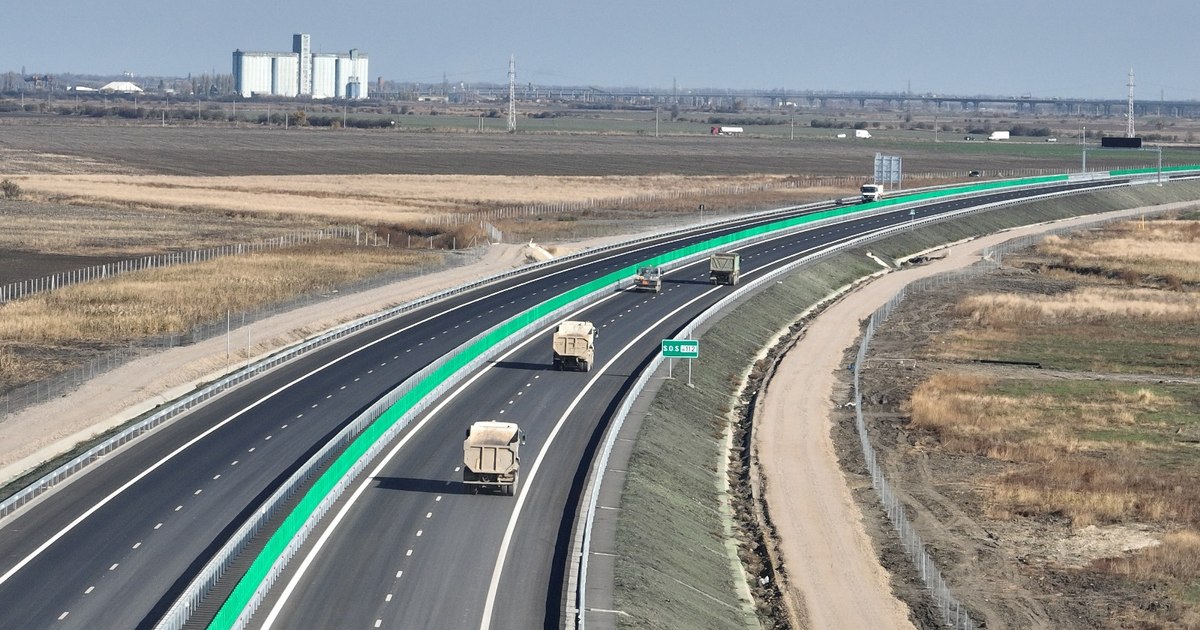
Romania is taking an extremely important step in securing NATO's eastern flank, by integrating major road infrastructure projects into the European funding mechanisms dedicated to military mobility. More precisely, our country will benefit from 4.2 billion euros from the SAFE Program for the construction of the segments of the Moldova Highway A7 Pașcani – Suceava – Siret and the Union Highway A8 Moțca – Iași – Ungheni.
PHOTO Archive
Gabriel Budescu, director of the National Road Investment Company (CNIR), provided details about the status of these strategic projects, about the technical challenges and about the absolute novelty: the expansion of infrastructure works directly in the Republic of Moldova and Ukraine.
Infrastructure ready for tanks and military convoys
Funding through the SAFE Program involves adapting projects to enable the rapid and safe transit of heavy military equipment. Although it sounds complicated, the CNIR director assures that the Romanian rules are already compatible with NATO requirements. Gabriel Budescu explained that, from a technical point of view, the challenges are not major, but the checks will be rigorous.
“In terms of technical particularities, there is not much to notice. There is only one important requirement: the highway must correspond to a European regulation regarding the movement of military convoys, which, from what I understand from my colleagues, would also fall under our regulation. From the point of view of the structure, it would respect what we are currently designing, but we want to, during the design and construction phase, make a clear check to make sure that this requirement is met.” Budescu specified.
Practically, the road structure will support the specific tonnage of military vehicles, an essential condition in the current geopolitical context, which transforms the region of Moldova into a strategic point on the map of Europe.
An absolute first: CNIR will build a highway in the Republic of Moldova
The new element that this project brings is its cross-border character, a condition imposed by the European Commission for granting funding. Thus, the authorities from Bucharest will not stop at the Prut border, but will also manage works on the territory of the neighboring state.
Gabriel Budescu detailed this extension, which initially raised many question marks among consultants regarding the legislation, the reception of works and the assumption of risks. The solution identified was to include the costs in the form of lump sums, to avoid bureaucratic blockages.
“There was the requirement of the European Commission to demonstrate the cross-border character of the project, which is why we should also include works in the Republic of Moldova. This is the new element”, the official explained.
Specifically, the project includes the rehabilitation of approximately 14 kilometers of existing road, but also the construction of a new 4.7 kilometer highway segment, along with a link road and a multimodal hub.
“We also added this segment from the Republic of Moldova. Otherwise, our requirements are similar to the other batches”Budescu added.
Race against the clock: 2027 for contracts, 2030 for completion
Time pressure is significant. In order not to lose the funding, Romania must close the execution contracts in 2027.
The section Pașcani (Moțca) – Iasi – Ungheni is divided into four lots, as follows:
- Lot 1 Târgu Neamț (Motca) – Târgu Frumos, 27 km. In bidding, tender launched in January 2025. Builder appointed in October 2025: the association Danlin XXL – Groma Hold Ltd – Intertranscom Impex – Evropeiski Patishta, cost: 4.76 billion lei, design duration: 10 months, execution duration: 3 years
- Lot 2 Târgu Frumos – Lețcani/DN28, 28.6 km. Up for auction, auction launched in February 2025
- Lot 3 Lețcani/DN28 – Iasi/DN24, 17.70 km. In auction, auction launched in May 2025
- Lot 4 Iași/DN24 – Vămă/Pod Ungheni, 15.47 km. In auction, auction launched in December 2025
The CNIR strategy is based on an intelligent prioritization of vital sections. The director of the company emphasized that the first two lots have maximum priority, especially the link from the A7 section to Moțca and the segment that serves the operational center from Podul Iloaiei. These portions should be ready within a maximum of 12 months from the completion of the design.
Also, special attention is paid to the connection with the Ungheni bridge.
“On section four, we prioritized the connection up to the first node, approximately seven kilometers, which would serve the bridge from Ungheni. The idea is that the bridge is ready and we can open traffic on it”declared Budescu.
The Pașcani – Suceava section, a project carried out by CNAIR, is divided into two lots, as follows:
- Lot 1 Pașcani – Roșcani, 33 km. Tender launched in July 2024. Builder appointed in March 2025: UMB Group, cost: 3.06 billion lei (without VAT), design duration: 6 months, construction duration: 2 years.
- Lot 2 Roșcani – Suceava Airport, 28.97 km. Tender launched in August 2024. Builder appointed in April 2025: UMB Group, cost: 2.86 billion lei (without VAT), design duration: 6 months, construction duration: 2 years.
The last section of the Moldova Motorway, Suceava – Siret, is divided into three sections, all built to express road profile:
- Lot 1 Suceava – Darmanesti, 18.6 km. Tender launched in January 2026, design duration: 9 months, execution duration: 2 years.
- Lot 2 Darmănești – Balcăuți, 24.45 km. Tender launched in January 2026, design duration: 1 year, execution duration: 2 years.
- Lot 3 Balcăuți – Siret, 12.65km. Auction launched in January 2026.
The last of the lots, Balcăuți – Vama Siret, provides, in addition to the construction of the express road, the modernization of 1.45 km of DN2 (up to the border crossing point), but also the modernization of 15 km of the M19 national road, on the territory of Ukraine.
The time horizon for the full completion of the project is 2030.


