Romania chose growth at any cost. The bill is coming now, warns the chief economist of the BNR


In 2015, Romania fulfilled all the Maastricht criteria. In other words, it could take the step towards the euro zone — if it had continued a responsible fiscal policy, writes the chief economist of the National Bank, Valentin Lazea, on the institution's blog. But he didn't. The government of that time, like all the ones that followed, chose a different strategy: economic growth as fast as possible, regardless of the costs, even at the cost of macroeconomic imbalances.
The result was predictable. Romania has achieved, indeed, one of the fastest economic growths in the European Union, but also less desirable “records”: the highest inflation, the largest budget deficit and the largest current account deficit. At the same time, Bulgaria went slower but more balanced — and this prudence earned it entry into the eurozone in 2026.
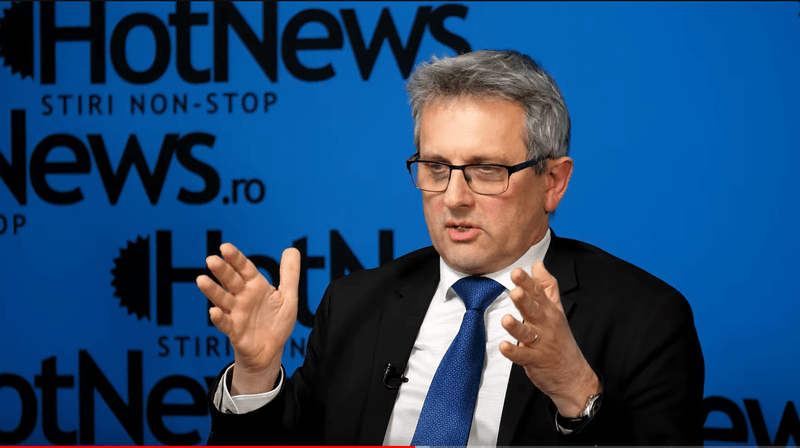
Today, Lazea also says, there is a dishonest temptation: that of placing the degradation of public finances exclusively in the hands of the Ciucă and Ciolacu governments. But the reality is different. The budget deficit, the chief economist of the BNR also says, has grown constantly in the economic boom years (2017–2019), but also in the electoral years (2016, 2024). It is not an exception, but a common feature of governance in the last decade.
The responsibility lies not only with governments, but also with business and the public, who have embraced growth based on fiscal relaxation, consumption and imports
Few wondered what effects this strategy would have on inflation and deficits. And after all, why would they, as long as almost everyone got exactly what they wanted.
The business environment has benefited, in these ten years, from:
- non-payment of payroll tax or social security contributions for entire branches (IT, construction, etc.);
- the very broad definition of micro-enterprises and the preferential tax treatment applied to them;
- extremely low tax rates. Even after the increases of the last year, all tax rates in Romania remain lower than in Poland (income tax, profit tax, dividend tax, CAS, etc.);
- the permissibility of approximately one third of the companies operating in the market without having the minimum capitalization required by law, etc.;
- tolerance of tax evasion, especially (but not only) through non-payment of VAT.
The general public, in turn, benefited massively from:
- free public transport or train;
- meal vouchers, holiday vouchers, gift vouchers;
- subsidized price in some periods for fuels, natural gas, electricity, etc.;
- extremely low levels of property taxes.
All these “gifts” can be afforded by a state with a balanced budget (revenues equal to expenses), by no means a state that goes into massive debt to cover its deficits, says Lazea.
It is dishonest to blame only the state sector for the deterioration of public finances, believes the chief economist of the BNR
It is true that a lot of waste has been done since the municipalities were given the right to increase the salaries of employees without any connection to the receipts from local taxes or when the number of budgetary staff increased without any justification. But, as the figures in the adjacent table show, the state sector is not the only (or even the main) culprit for the deterioration of public finances in the last decade.
Thus, in the period 2015-2024, the effective individual consumption of the population increased in five out of ten years faster than the effective collective consumption of the public administration.
It is true that in the other five years the consumption of the public administration grew faster than the consumption of the population, but it must be taken into account that the relative size of the two indicators is about 1:10 (the consumption of the population exceeds that of the public administration by about ten times, so it is much easier for the latter to grow at relative rates).
Another problem, which has at least been honestly acknowledged in the economic debate of recent years, has been the privileging of consumption-led growth over investment-led growth In five years out of ten, final consumption grows faster than investment. It is true that in the other five years investments grow faster than final consumption, but again it must be taken into account that the size of the two indicators is about 1:3 (final consumption exceeds about three times the volume of investments, therefore it is much easier for the latter to grow at relative rates).
Not to mention the fact that in seven years out of ten final consumption grows faster than GDP, in one year it grows at the same rate and only in two years is it outpaced by GDP growth.
It is dishonest to attribute Bulgaria's recent admission to the Eurozone to luck and chance
In fact this country doggedly pursued this goal, while we ignored it in favor of economic growth at any cost.
The question is: was it worth it? The answer, in Lazea's opinion, depends on the point of view of each observer, but in any case the reduction of the gap in terms of GDP/inhabitant and especially consumption/inhabitant compared to the EU average should be balanced with the following considerations:
- a growth financed by debt but based on consumption will not ensure, over time, the financial resources necessary for the repayment of that debt;
- for nothing it grows a country above potential for several years, if the subsequent fiscal consolidation effort will require several years of below-potential growth, with the gaps from the EU average widening again;
- ironically, the citizens who receive the tax relief are not grateful for it and vote against the parties that gave them those gifts.
Without the measures taken by Bolojan, today we would be talking about an insolvent Romania, relegated to the “junk” category
Lazea gives one last example of dishonesty at the end: the vehement criticism brought in the last six months to the Bolojan government, for the fact that, through fiscal consolidation measures, it would have affected consumption and economic growth.
The truth is that, without those fiscal consolidation measures, today we would be talking about an insolvent Romania, relegated to the “junk” category by the rating agencies, unable to pay pensions and salaries other than by printing money (inflationary). But, thanks to the fiscal consolidation measures, Romania avoided recession (economic growth was close to 1 percent in 2025), and external and internal loans became cheaper (this being one of the main causes of the overperformance of reducing the budget deficit from 8.7% to 7.7% of GDP on national accounting and from 9.3% to about 8% of GDP on ESA accounting).
More importantly, in these six months, decisive steps have been taken to replace the consumption-based growth model with investment-based growth, and there is hope that this trend will continue in the coming years.
It may be that in the difficult times we live in, at the national and planetary level, many may find honesty in debate an unnecessary luxury. On the contrary, says Lazea, we believe that honesty is a fundamental precondition for strengthening the resilience of a society. And this resilience will be fully tested in the years to come.