Until recently, the “I'll wait until it's cheaper” strategy prevailed. Today it is increasingly clear that this narrative is losing importance. Customers active on the housing market in Poland have stopped counting on broad price corrections, which directly translates into an increase in the number of transactions and a change in the demand structure. The recovery that occurred at the end of 2025 and the first months of this year is the result of both interest rate cuts and improved availability of the offer – especially on the primary market.
The way of thinking about housing is also changing. More and more often, it is perceived not only as a place to live, but also as element of financial strategy and capital protection tool.
Price expectations
|
Otodom
Read also: Apartments with potential for rent. This is how investors win today
No more belief in falling housing prices
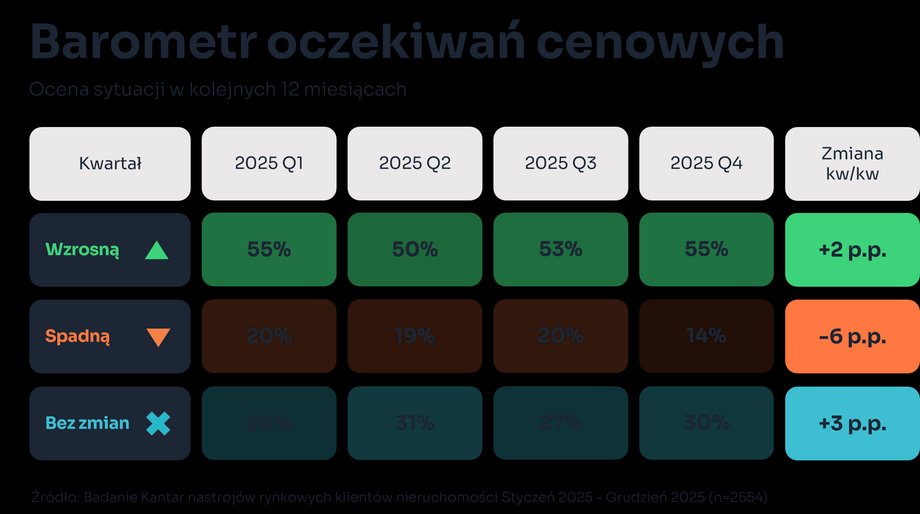
Otodom's latest “Real Estate Customer Sentiment Monitor” shows that in the fourth quarter of 2025, the percentage of people expecting housing prices to decline decreased by 6 pp q/q and amounted to only 14%. Simultaneously over half of respondents (55%) expect rates to increase over the next 12 months, and another 30%. assumes their stabilization.
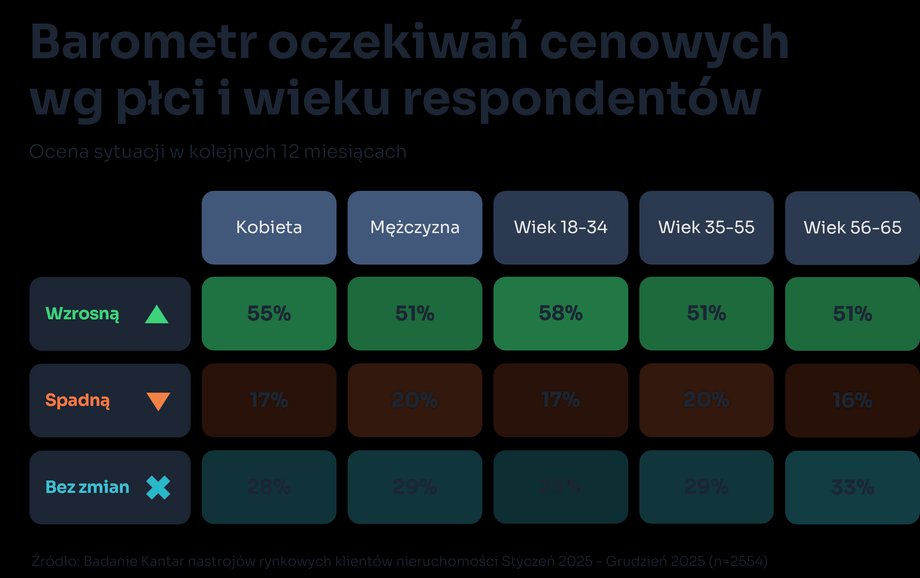
This means that as much as 85 percent people active on the market see no room for reductions. Young adults aged 18-34 are the most confident in future increases – 58%. of them believe that prices will increase.
— Paradoxically, the belief in further increases in real estate prices acted as a catalyst in the current market conditions. With the high availability of offers and a relatively stable credit situation, it encouraged consumers to finalize previously postponed purchase decisionswhich is also confirmed by the high sales results on the development market in the last months of 2025. This tendency is also visible in the group of the youngest respondents who, instead of waiting for price corrections, are trying to get ahead of subsequent increases and secure their capital in real estate – emphasizes Katarzyna Kuniewicz, director of market research at Otodom.
Price expectations by gender and age
|
Otodom
See also: This is the income ladder of Poles. Find yourself there [KWOTY]
Changing moods has a practical dimension. Buyers are more likely to accept current price levels, focusing on finding a home that fits their needs rather than bargain hunting.
Buying an apartment: investment or your own needs
Real estate in Poland still has the status of a “safe haven”. As much as 62 percent respondents consider purchasing a flat or house to be a good investment. The strongest belief can be seen among people aged 35-55 (65%) and among women (64%).
At the same time, half of the inhabitants of Poland declare that plans to purchase it primarily for its own housing needs. The remaining motivations are increasingly diverse:
- every sixth person buys with a view to securing the future of their loved ones,
- 10 percent planning a long-term lease.
— The study results show that the purpose of the purchase significantly determines the choice of a specific market segment. While the secondary market is the domain of people looking for a place for themselves, the primary market has become a magnet for investors. New investments are most often chosen by people who plan to rent or want to benefit from the increase in the value of the property over time – notes Paweł Jarząbek, an Otodom real estate market expert.
The profile of the youngest market participants is particularly interesting. In the 18-34 age group, as many as 58 percent buys an apartment for their own needs, but at the same time, young adults treat real estate as a tool for capital diversification more often than the general population.
Price expectations
|
Otodom
Read also: How to make money on real estate? The 32-year-old with 30 apartments gives eight tips
9 percent of them plan to purchase to diversify their investment portfolio (compared to 4% of the total), and 7% looking for premises for short-term rental.
— The desire to diversify capital through real estate, visible among the youngest respondents, is a signal that an apartment is no longer perceived only as a roof over one's head, but has become a key element of building a financial strategy. – adds Paweł Jarząbek.
Primary and secondary markets: the boundaries are blurring
The image of development companies remains weak — at the end of 2025, only 16% rated them positively. respondents. This is the lowest result in the history of the study. At the same time, the group of people with a neutral attitude is growing: already 50 percent. respondents describe their opinion as “neither positive nor negative”.
Importantly, cooler emotions towards the industry do not mean an outflow of customers from the primary market. For 33 percent inhabitants of Poland, the type of market is not of key importance today. With similar offer prices, the choice is primarily determined by: square footage, apartment layout, building standard and access to social infrastructure.
However, differences are still visible depending on the purpose of purchase:
- the secondary market dominates where lower prices are important (37% vs. 26%) and own needs (55% vs. 38%),
- the primary market attracts people expecting a higher standard (15% vs. 8%) and investors.
As much as 24 percent buyers of an apartment from a developer plan to rent it, and 21 percent counts on profit from future resale. On the secondary market, these percentages are significantly lower.
— For developers, the growth of the group of people without specific preferences means that their offer must win not only in terms of architecture, but above all in terms of standard and process security.. We see that while price is the main magnet on the secondary market, on the primary market customers are looking for a higher standard of finishing and transparency. The key to success is also the skillful integration of the investment into the urban fabric and social infrastructure, especially important for young buyers buying an apartment for their needs – sums up Katarzyna Kuniewicz.
Everything seems to indicate that The Polish housing market is entering a stage of greater maturity. Buyers are less often guided by emotions and expectations of a miracle in the form of price drops. Instead, they increasingly make decisions based on real needs and long-term financial calculations.